


Denmark. Part 12
Description
This section is from the book "Denmark - John L. Stoddard's Lectures", by John L. Stoddard. Also available from Amazon: John L. Stoddard's Lectures 13 Volume Set.
Denmark. Part 12

Winter In Northern Europe.

A Pure White Winding Sheet.
A trip in one of the little boats that several times a day glide up and down the Sound is thoroughly delightful. It is like sailing on Lake Maggiore, save that the vegetation and architecture are northern rather than Italian, while the cool, saline breeze assures us that we are slipping through a channel of the sea. The Danish shore consists of gentle slopes, covered with woods, in whose continuous frame of lustrous green are set, like pictures, scores of villas, home-like rather than palatial, embowered in shade, approached by lawns, and often bright with flowers. A summer night upon the Sound can hardlv be surpassed for beauty. It is not really night, but only curtained day. In June one reads here without artificial light at ten o'clock at night and at two o'clock in the morning. In the brief interval the heaven is not dark, but merely a deeper blue. At the first hint of coming twilight the scene is often glorious. Watch, then, the surface of the Sound, and you will see a wonderful expanse of varied colors, - sapphire, amethyst, beryl and topaz; now mingled, now in alternation, but always followed by the violet that comes with shadows. Over this rainbow-tinted area sea gulls are w h e e l i n g high in air, or swooping down so low that their white breasts are stained by the brilliant hues beneath them, into which at times they sink, to float upon the iridescent plain, too wearied with their flight to keep on wing. Later, the water is like a mirror, holding at once the last faint blush of sunset and the silver of the dawn. When the first light steals over Sweden's hills, the Sound seems never to have slept. Life is already active on its surface. The fishing boats are in their places; steamers are passing northward or southward, trailing sable plumes; ships come forth tremulously from the silvery haze, white-winged and noiseless as a troop of swans, we know not whence or whither, while, here and there, some tiny sails, floating upon the rim of the horizon, and tinted by the deepening color of the sky, look like the scattered petals of a pink rose wafted on the morning breeze. At the upper entrance to the Sound, just at the point where Sweden and Denmark approach each other most closely, and only about three miles of water intervenes between them, stands the imposing castle of Kronborg, renowned alike in peace and war. A kinglier site could not be found; yet this has ceased to be a royal residence, and is to-day used chiefly as a barrack and a lighthouse, although a few historic rooms are still preserved and shown to visitors. As a fortress, it would now be powerless against modern ordnance; but formerly this grand old stronghold was a watchful and aggressive foe, guarding the northern gateway of the kingdom as its most important sentinel. In 1574, when its fine towers and massive walls were reared, and rendered doubly safe by deep, encircling moats, Denmark was mistress of both shores, and every ship that passed between them had to pay tribute to the Danes. The latter were by no means satisfied with the formality of lowering a flag or firing a salute. Hard cash was demanded and obtained, the vessels of all nations being obliged to halt before the adjoining town of Elsinore, until their captains had, in person, come ashore and paid their tolls. Now that this "Golden Vein of Denmark" has become an artery of international commerce, it seems incredible that all the world should have consented to this tax, from which the Danes derived their principal revenue. But it was not abandoned until 1857, then only in return for a payment, by the countries interested, of over seventeen million dollars to the Danish government.
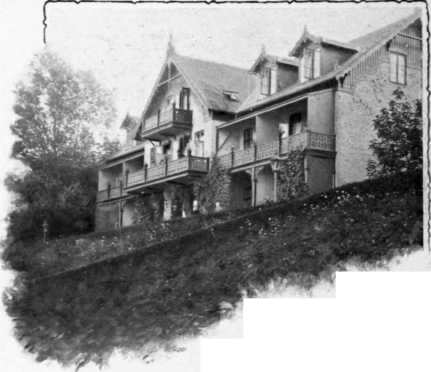
A Villa On The Sound.

Simmer Twilight Ox The Oeresund.

Kronborg Castle.

The Outer Moat At Kronborg.
It is a delightful experience to stand upon the ramparts of this ancient fortress and watch the ships and steamers gliding by with unchecked speed. No less than forty thousand vessels, on an average, pass the castle annually; but now the record made of them is merely a matter of statistics, not of revenue. Beside me, as I lingered on the parapet nearest to the sea, stood a Danish officer whose duty it was to mark upon a blackboard the nationality of each passing ship and steamer, and the direction in which it was moving. Among those registered that day in half an hour were five from England, two from Russia, and one from Turkey. None thinks of halting now. To their commanders Kronborg has become as harmless as a captive lion, crouched behind his bars.
Continue to:


My Books

