


Denmark. Part 11
Description
This section is from the book "Denmark - John L. Stoddard's Lectures", by John L. Stoddard. Also available from Amazon: John L. Stoddard's Lectures 13 Volume Set.
Denmark. Part 11

Alexandra.

On The Oeresund.
"Saxon and Norman and Dane are we, But all of us Danes in our welcome of thee," she has so endeared herself to the British people, that the title which they have loved to give her is " Her Royal Sweetness." Soon, in the natural order of events, the King of Denmark must pass away, and the principal reason for these annual visits will, with him, cease to exist. One feels, however, that the trees, those leaf-crowned monarchs whose dynasties so long outlast the short-lived reigns of human potentates, will not forget them. Amid the snows of Russia, the frosts of Sweden, the smoke of London, and the classic ruins of Athens, these children of King Christian will work out their several destinies; but when they are all sleeping in their royal tombs, the trees of Fredensborg will still be standing here solemn and silent, casting their shadows upon other actors in the world's great drama, whose denouement is for us a mystery.
Between the eastern coast of Denmark and the southwest shore of Sweden extends for thirty miles - from Copenhagen to Helsingors (the Elsinore of Hamlet) - the Oeresund, or Sound, the silvery link which joins the Baltic and the Cattegat. This is the Scandinavian Bosphorus, brilliant, blue and beautiful. All Danish poets have extolled its charms. In sight of it the subjects of King Christian love to dwell, and at its name the eyes of every exiled Dane grow soft and luminous. To familiarize myself with its attractions, I spent two weeks beside it, at a pleasure-resort called Scodsborg. This lovely spot, a few miles out of Copenhagen, appeared to me ideal in its peace and beauty. Its admirably kept and scrupulously clean hotel stands on a terrace fifty feet above the sea. From its front balconies a pebble can be tossed into the waves, yet its rear rooms are shaded by a noble forest. This was a combination that I had never elsewhere met in such perfection and proximity. Thus from my windows, reaching almost to the floor, I could look straight across the violet-blue water to the cliffs of Sweden, yet by a little bridge, leading directly from my corridor, I could in a moment enter an arboreal temple, whose stately columns, long-drawn aisles, and delicately groined roof made all the cathedrals of the world seem insignificant. If I grew weary, therefore, of the Sound, with its continually changing hues and ever varying panorama of yachts, ships and steamers, I could retire to this leafy labyrinth, which skirts for miles the terraced shore. Here I could walk for hours in the shadowy silence of grand beech-trees, often six feet in girth and eighty feet in height, through whose soft, fern-like tops the sunlight filters in big drops of gold, flecking their clean round trunks of dappled gray, and forming brilliant arabesques upon the emerald turf or last year's leaves of russet brown.

Scodsborg Hotel.
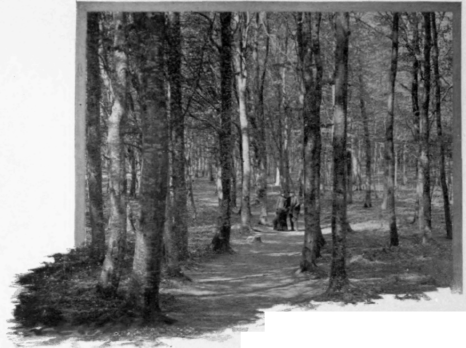
Forest At Scodsborg.
Denmark is at its best in early summer. Winter in northern Europe has few outdoor charms to those who love the sun. The limited amount of daylight then enjoyed, the great preponderance of cloudy over sunny days, the chilling fogs and long-continued storms of rain and snow make those who can escape such feebly lighted lands flee to the South, as worshipers of Phoebus. But spring and summer in these higher latitudes present some features which in part atone for the prolonged seclusion of the solar god. To watch a northern spring unfolding, one by one, the beauties treasured for so many months in expectation of this period, - each tree a herald, and every shrub a pretty, winsome page, announcing by their waving banners the coming of the king of life; to see the evergreens, those faithful guards that never lay aside their armor, growing more glossy and resplendent in the warmer air; to note the pulse of Nature once more stir where all has been so cold, apparently so dead; and to behold its heart-throbs break the ice which has so long concealed the face of inland waters, - all this is to enjoy something denied to those who dwell among the olives and the palms, and flowers that bloom the whole year round. The trees of Denmark awakened not alone my admiration, but my enthusiasm. I love a noble tree, and nothing in the way of natural scenery gives me greater pleasure than a well-kept forest. To watch the reawakening of a tree, to see the quickened vital current clothe its bare limbs with an exquisite green veil; then to discern the first few daring birch buds throw aside their silken wraps; and finally to see the unfolding of the leafy canopy, and the pinks and whites of fruit-trees gleaming in the sun, this is to witness in a fortnight's time a miracle such as Aladdin's lamp never achieved. Nor is the ground beneath forgotten. A wave of color ripples over the breast of Mother Earth, and speedily the wild rose, sweet brier and azalia mantle it with beauty, while buttercups and daisies light the grass with glints of gold and silver. Such is the spring in northern woodlands. In autumn, too, how glorious are the trees, when some invisible power sets their foliage aflame! A prophecy of it has already gleamed in the clusters of grapes, turning to amethyst or amber on the hillsides. A little leaf glows brightly a few hours, then floats down through the eddies of the air, its life forever separated from the parent tree, and doomed to quick extinction. Then, one after another, its comrades also blaze with color, fall and die, until a morning comes with crisp and frosty air, and lo! the scarlet maples, purple beeches and brown oaks all stand denuded of their glory, above a pure white winding-sheet, beneath which the arboreal forces are to hibernate.
Continue to:


My Books

