


Denmark. Part 10
Description
This section is from the book "Denmark - John L. Stoddard's Lectures", by John L. Stoddard. Also available from Amazon: John L. Stoddard's Lectures 13 Volume Set.
Denmark. Part 10
The Museum, as was natural on such an occasion, was visited all day long by crowds of patriotic Danes; and, after having once more made the round of its apartments, I spent the summer afternoon ensconced with book and pencil among the shadows of the neighboring forest, watching the people come and go, like pilgrims to a hallowed shrine. Yielding completely to the fascination of the place and time, I lingered in the peaceful solitude and silence of the waning day, until there stole across the sunset-tinted lake the deep, sonorous tones of the new castle bells, successors of those melted by the flames. Foreigner though I was, I shall not soon forget the impression made upon me by both scene and sound; and, had I been a Dane, my heart would have been thrilled, as those rich waves of harmony intensified the majesty and beauty of the noble structure, - a nation's gift, a nation's treasure-house, a shrine of art, a school of patriotism !
A pleasant drive of five miles from Frederiksborg to Fre-densborg conveys the tourist from the princely to the pastoral, from the past to the present, and from pageantry to peace. Fredensborg is the modest summer home of Danish royalty at ease. It is the little Trianon of Copenhagen. Its name, signifying the Palace of Peace, was given to it in commemoration of the peace-bringing treaty of 1720, and its walls and towers are appropriately white as the wings of a dove. A tiny lake, but a few paces from the door, reflects the smile of heaven; while from its threshold stretches silently away a lovely park of oaks and beeches, beneath whose sheltering arms one walks enchanted with the softened light, the pure, sweet air, and that mysterious charm which such old trees possess for those who love and reverence them. It would be an ideal place for painter or poet, even if no human foot save theirs had ever pressed its shadowed turf. But Fredensborg is not devoid of history. Within this Castle of Repose there has been enacted, summer after summer for many years, a domestic scene, not less important than impressive. For here the chil-dren and grand-children of the king and queen have l o v e d to assemble to render homage to that model couple, Christian IX. and wife, as well as to fraternize with one another in the delight of unconstrained and cordial intercourse. Beneath these mighty trees, or on the gently sloping lawns, have frequently been seen at one time, not only the aged sovereigns of Denmark, but their daughter Dagmar, the Tsarina, and by her side the heroic figure of her husband, Alexander III.; the Prince and Princess of Wales, the King and Queen of Greece; the Duke and Duchess of Cumberland; and the Crown Prince of Denmark with his Swedish bride; and while this first generation of descendants and their consorts have talked and jested here as brothers and sisters, their children have strolled through the park, or played upon the lawns, unmindful of the grave responsibilities which in their different realms awaited them. At such a time, one may see, lying at a little distance from the shore on the blue waters of the Sound, several royal and imperial yachts; such as the "Osborne," in which the Princess of Wales was wont to come when visiting her parents; or the "Standard," that superb vessel built in Denmark, at a cost of one and a half million dollars, for the late Alexander III. The Russian Emperor for whom it was designed did not, however, live to enjoy it; but it was delivered in 1896 to his son, the present Tsar, and that same summer Nicholas II. sailed in it on its first voyage from Copenhagen to England.

Among The Danish Beeches.
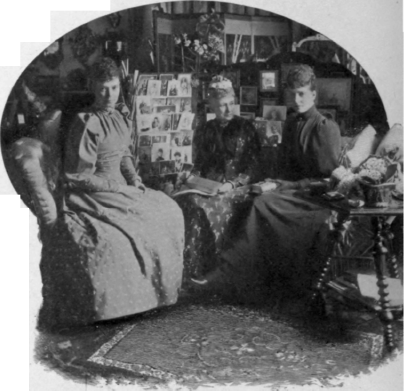
Queen Of Denmark, EX-Empress Of Russia, And Princess Of Wales.

A Family Reunion At Fredensborci.
In these family gatherings only the trees hear the conversation of the various crowned heads; but one would like to know what confidences they exchange about the cares and dangers which infest their lives in their respective kingdoms. It is as true to-day as in the past that "Uneasy lies the head that wears a crown."
There is hardly one of the princes who assemble here, whose life has not been threatened, and who has not escaped one or more attempts at assassination. It is not strange, therefore, that sheltered Fredensborg was the place to which, above all others, the late Tsar preferred to come-perhaps the only spot in the whole world where, with his wife and children, he felt free to walk out unattended. Something of sadness, too subtle to be defined, floats on the breeze that stirs the foliage of these whispering trees. One thinks instinctively of the future. Already one of the royal group is missing, and Dagmar, once the Empress of the Russias, is a widow. What a contrast is presented in the lives of the three Danish sisters! Behind the domestic happiness of the Tsarina lurked always the shadow of a violent death, and her exalted station has made her live in regal isolation, almost removed from human sympathy. On the other hand, the youngest daughter of Christian IX. wedded unostentatiously the son of the ex-King of Hanover, and, as the Duchess of Cumberland, has lived a happy, quiet life, free from distressing fears and the trammels of royalty. Alexandra, as Queen of England, is now the most prominent member of the family, and probably no woman in the world is more beloved. From the day on which she first set foot on English soil, greeted by the words of Tennyson:
Continue to:


My Books

