


Denmark. Part 9
Description
This section is from the book "Denmark - John L. Stoddard's Lectures", by John L. Stoddard. Also available from Amazon: John L. Stoddard's Lectures 13 Volume Set.
Denmark. Part 9

A Corner In The Old Glyptothek.
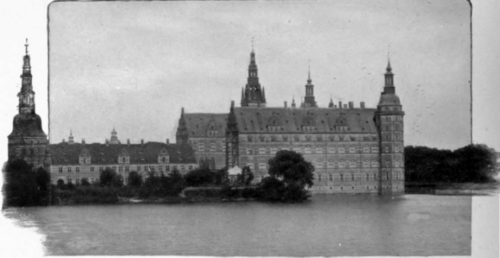
Frederiksborg Castle.
In a lovely section of country, only a few miles distant from the Danish capital, stand two castles, whose names, Frederiksborg and Fredensborg, are so similar that by a stranger one is frequently mistaken for the other. A greater contrast, however, than that existing between these buildings it would be difficult to find. It is the difference between Rosenborg and Amalienborg intensified. Frederiksborg is a stately edifice, rising from a pretty lake of the same name, and covering no less than three islands, one of which is occupied by the stables and the servants' quarters, another by the official apartments, and the third by the residence itself. Its walls of old red sandstone are diversified by frequent layers and window-frames of gray. Quaint pinnacles and gables greet the eye at every turn; statues surprise us on the corners of the roofs like elevated sentinels; and numerous towers, half enclosed in the thick walls, give strength and grandeur to the massive pile, above which rise three spires crowned with ornaments of gold. Founded by the most renowned of Denmark's warrior-monarchs, Christian IV., three hundred years ago, this was for generations a royal residence, and is to-day a national landmark of which the Danes are justly proud. In 1859, however, a catastrophe occurred here that shocked the entire country. In the winter of that year, while Frederick VII. was living in the palace, a fire broke out which in a few hours reduced the splendid structure and its contents to a mass of ruins.
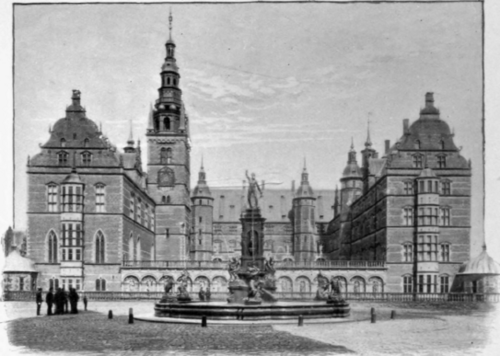
Frederiksborg Courtyard.
This was a blow at Denmark's heart. At once the nation manifested its desire to rebuild the castle in its original form; and, costly as the undertaking was, it was speedily accomplished. Subscriptions for the enterprise poured in alike from rich and poor. Mr. J. C. Jacobsen, the father of the patriotic citizen already mentioned, alone contributed for the furnishing and interior decoration of the castle one hundred and fifty thousand dollars, on condition that it should thenceforth be used as a National Museum. Such, then, it is to-day, bearing to Denmark about the same relation that the palace of Versailles maintains to France. Upon its walls hang admirable portraits of Denmark's famous heroes, musicians, poets, painters and sculptors; as well as paintings portraying many of the prominent events in Danish history; while tapestries and furniture of former periods reveal the taste and luxury of Scandinavian kings, and the fine work of Scandinavian artisans.

The Knight's Hall, Frederiksborg.
A visit to Frederiksborg is a positive revelation to most travelers, even to those who think they have seen all that is worth inspecting in royal abodes. I know of few rooms so richly ornamented as the Knights' Hall in this Danish palace; and the Chapel, a restoration of the one where many sovereigns were crowned, is one of the most magnificently decorated apartments I have ever entered. One could spend hours here in studying and admiring the pulpit of ebony and silver, the exquisite mosaic woodwork of the stalls, and the superbly embellished ceiling, walls and arches; while that portion of it known as the King's Oratory has a marvelous display of carving in wood and ivory, and more than a score of pictures on sacred themes by the celebrated artist, Carl Bloch. Its beautiful organ, too, is said to rank among the finest in Europe.
One needs to bear in mind that almost all this splendor is but a reproduction of the castle's ancient elegance before its ruin in 1859. It is indeed this fact that justifies its existence; for it has thus become a National Museum, not merely in its con-tents, but also in the framework which e n-closes them.

The Chapel, Freder1ksborg.

Fredensborg.
It was on a famous national holiday, the 5th of June, that I last visited Frederiks-borg; and on its lofty towers, as well as on innumerable private houses, I saw, conspicuous in the brilliant sunshine, the hand-some Danish flag. Apparently no palace was too proud, no home too humble, to display the national emblem which, with its clear-cut, beautiful design of a white cross on a red field, is certainly one of the most attractive standards in the world.
Continue to:


My Books

