


Denmark. Part 4
Description
This section is from the book "Denmark - John L. Stoddard's Lectures", by John L. Stoddard. Also available from Amazon: John L. Stoddard's Lectures 13 Volume Set.
Denmark. Part 4
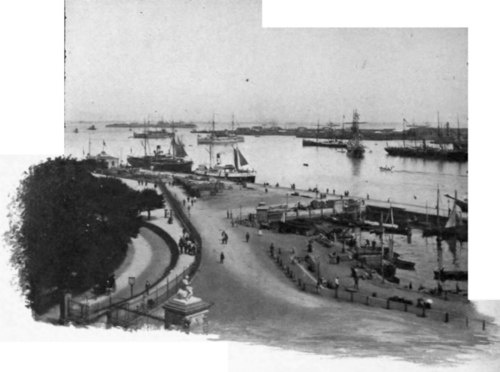
The Harbor Of Copenhagen.

Commercial Activity.
Thorwaldsen is the glory of Copenhagen, and toward the two buildings of that city made famous by his genius the traveler soon wends his way. One of these is the Church of Our Lady, a modest edifice, the portal of which is a portico of Doric columns, surmounted by a pediment containing a group of sixteen marble statues, representing the preaching of John the Baptist. The works of Thorwaldsen may be sharply divided into two classes, - secular and sacred. In the early part of his life the sculptor devoted himself principally to heroic and mythological subjects; but after his first return to Copenhagen, from which he had been absent nineteen years, he directed his energies largely to religious themes and enriched this church in particular with some of his greatest master-pieces. The Church of Our Lady may, in fact, be called the Sacred Museum of Thorwaldsen's works, since all its sculptural ornamentation, even to the mural decorations of the chapels and the collection-boxes for the poor, is due to him. No one whose privilege it has been to enter this northern sanctuary can ever forget the solemn impression produced by his famous Christ-figure - that matchless representation of divine compassion which stands above the altar in a black marble shrine. This is approached between two lines of life-sized statues of the twelve apostles, identified by their traditional emblems or tokens of martyrdom. Saint Paul replaces Judas in the series, and these imposing, dignified figures, together with the noble form of the Master, constitute a group that has no rival in the realm of sacred sculpture. Of the Christ but little can be said, so profoundly does it move the reverent beholder. The ineffable pity, love and tenderness expressed in face and gesture, as with extended arms he stands ready to enfold all sorrowing humanity, while uttering the words, "Come unto Me," cannot be adequately portrayed by pen or picture. In harmony with the spirit of this figure there runs above the chancel a high relief, depicting the procession of the Man of Sorrows on its way to Calvary.

The Church Of Our Lady.

Thorwaldsen.
In the front of the chancel stands another exquisite work by Thorwald-sen, a baptismal font, the bowl of which is a beautiful fluted shell presented by an angel upon bended knee. The face is serene, the form stately, and the attitude dignified even in its posture of humility, while the wings, with their strong, feathered quills, are cut with consummate delicacy and fidelity to nature, and seem capable of untiring flight.

Thorwaldsen's Christ.

The Angel. Font.
However plain, there-fore, the church itself may be in its severe simplicity of architecture, it certainly contains a wealth of art in statues and reliefs unequaled in the world, as the productions of one master. It is interesting to remember that the statue of Christ was evolved slowly in the mind of Thorwaldsen through several stages of conception. Preliminary sketches and models show that his first idea was to have the face uplifted, the right arm raised, and the left extended. The Danish professor, who was present in his studio at Rome when the sculptor finally decided on the attitude which he would give to this masterpiece, states that Thorwaldsen was on the point of going out with him, when, in the very act of crossing the threshold, he turned back and stood for a few minutes before the model of his Christ, contemplating it in silence. Suddenly he stepped forward, made several rapid changes, which gave to the gracious figure the appearance it now presents, and exclaimed: "That is my Christ, and thus it shall remain."
The building known as the Thorwaldsen Museum contains a complete collection of the sculptor's works, either in originals, replicas, or models. What first impresses the visitor there is the wonderful productiveness of the Danish master. Two stories of a large edifice are filled with creations of his genius, which overflow from the rooms into the corridors and stairways. In all, no less than eighty statues, one hundred and thirty busts, two hundred and forty reliefs, and three large friezes here claim admiration, besides a multitude of Thorwald-sen's models, sketches and personal relics. Among the latter are his modeling-stand and tools, and the unfinished bust of Luther on which the aged sculptor worked, only a few hours before his death. Although it is the contents of this treasure-house that principally interest us, it is impossible not to regret that its exterior should appear neglected. It is a matter of surprise that the government does not restore at least the weather-beaten frescoes on its outer walls, which represent the enthusiastic reception given the illustrious artist in 1838, on his return from Rome, where he had resided, in all, more than forty years. While the first part of that period had been marked by poverty and almost hopeless struggle, the later years had been replete with marvelous success and world-wide fame. Who can read, unmoved, of the turning-point in his career, when the first clay model of his "Jason" had crumbled into fragments because he could not afford to have it cast in plaster, and when the second model stood neglected and unknown? Just as Thorwaldsen, baffled and discouraged, was on the point of returning to Copenhagen, and when his trunks were actually packed for the journey, an English banker, who bore the appropriate name of Hope, gave him an order for the " Jason " in marble. From that moment Fortune smiled upon the youthful Dane, and his genius, recognized and encouraged, speedily proceeded to enrich the world.
Continue to:


My Books

