


Denmark. Part 5
Description
This section is from the book "Denmark - John L. Stoddard's Lectures", by John L. Stoddard. Also available from Amazon: John L. Stoddard's Lectures 13 Volume Set.
Denmark. Part 5

The Thorwaldsen Museum.

Summer.
Winter.
The interior of the Museum is admirable in that it carries out, as far as possible, the master's wish that each room should contain only one statue, with the addition of two busts and a few reliefs, so that the attention of the visitor might be concentrated for the time on these alone. It can be safely said that Thorwaldsen (with the possible exception of Michael-angelo) is more widely known, and certainly more beloved, than any other sculptor in the world. There is scarcely a city or town, possessing the slightest claim to artistic culture, that cannot show in terra-cotta, bisque, or photograph some reproductions of his figure of the Christ and his reliefs of Day and Night. That the latter have a remarkable intrinsic beauty is proved by their universal popularity. The contrast between them repays careful study. It is the difference between joyous movement and an almost solemn repose. Day is portrayed as springing upward, and scattering flowers in her rapturous flight, as the beautiful winged boy, resting lightly on her shoulder, holds aloft a lighted torch. Night, on the other hand, crowned with poppies, floats gently downward. Even her wings show the descending movement, and in her arms she holds two infants, one representing Sleep, the other his twin brother, Death. The feet of Day are separated in activity; those of Night are folded and turned back, while over them appears the emblematic owl. The drapery of both figures is beautifully modeled, and in each case is as expressive of radiant motion or peaceful immobility, as are the forms themselves.
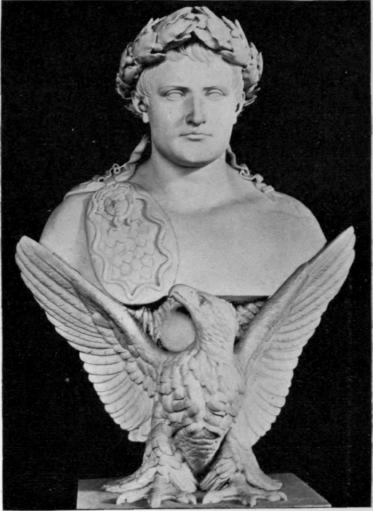
Thorwaldsen' S Napoleon.
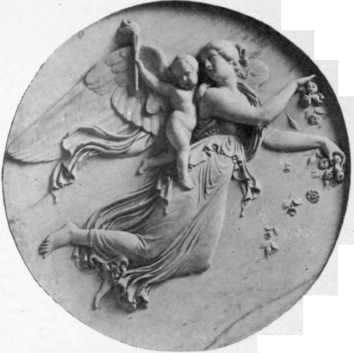
Day.
It is manifestly impossible to describe, or even to enumerate here, all the creations of this prolific genius; but many of them, such as the Jason, Venus, Ganymede and the Eagle, Hope, Hebe and the bust of Napoleon, will occur at once to every reader. It may seem unfair to praise particularly any special department of his work, yet in my opinion it is the reliefs of Thor-waldsen that best show his strength and originalit) This class of sculpture, which from the time of the first masters had fallen into neglect, he resurrected and perfected. His magnificent work, the Triumph of Alexander, considered by man1 to be his masterpiece in relief, is a remarkable illustration of his fertility of imagination, combined with scrupulous adherence to nature and historic detail. His four medallions of the Seasons, also, are as eloquent and idyllic as pastoral poems, Summer and Winter being especially strong and refined. Serious and full of fine sentiment as Thorwaldsen was, his delicate humor shows itself frequently in his delineations of the infant Cupid. Of these perhaps the most interesting is that which represents a shepherdess holding upon her knees a nest of little Loves. Two of them innocently kiss in pretty, baby fashion; three sleep with unaroused emotions in their cozy home, while a solitary, faithful Cupid plays with the impersonation of fidelity in the lower animal kingdom, a dog. To all of these the shepherdess pays no heed; but she extends her hand in vain to recover fickle Love, which flies away without regard to her entreaties. The dainty grace of the modeling, the simple charm of the design, and the careful fidelity to detail mark this as one of the cleverest of the artist's works, as well as one of the gentlest satires ever expressed in marble. It was in his reliefs, also, that Thorwaldsen found himself most at ease, and he improvised them with an almost incredible facility. It is said, for example, that even his famous "Day" and "Night" were modeled in a single day.

Night..
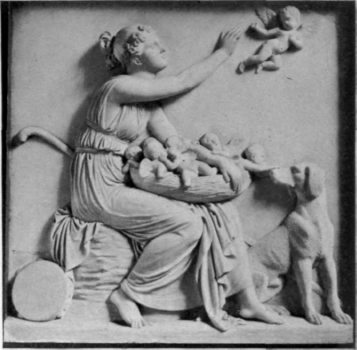
A Nest Of CU'Pids.
In Copenhagen, the city of his birth, rests all that is mortal of Thorwaldsen - the clay which the Divine Sculptor left when He removed His finished statue to the Halls of Immortality. But hundreds of Thorwaldsen's noble thoughts, embodied in marble pure and white as his ideals, live to give delight and inspiration to generations yet unborn. It was his unexampled fortune to see completed, shortly before his death, an edifice exclusively devoted to the reception of his works; and, as he superintended their arrangement, he expressed the wish that he might ultimately rest among them. His desire was fulfilled. No other man possesses such a burial place; glorious in artistic treasures of his own creation, yet simple as the humblest grave beneath the grass and flowers. In the Museum courtyard, whose only canopy is the blue dome of heaven, the sculptor lies at peace, beneath a coverlet of ivy, surrounded by a sleepless guard of gods and heroes, saints and angels. When the adjoining doors are open, on a summer day, the master seems to be reposing in a sunny garden, holding communion with his children. His is indeed an enviable immortality, enshrined not only in a multitude of noble forms, but in innumerable souls made happier by his life and labors. Hence, as I turned for a last look at his low, ivied couch, it seemed appropriate to behold, through the great portal of the courtyard, his stately figure of the Prince of Peace, with gaze bent lovingly upon the sculptor's resting-place, and hands outstretched in everlasting benediction.
Continue to:


My Books

