


Denmark. Part 6
Description
This section is from the book "Denmark - John L. Stoddard's Lectures", by John L. Stoddard. Also available from Amazon: John L. Stoddard's Lectures 13 Volume Set.
Denmark. Part 6
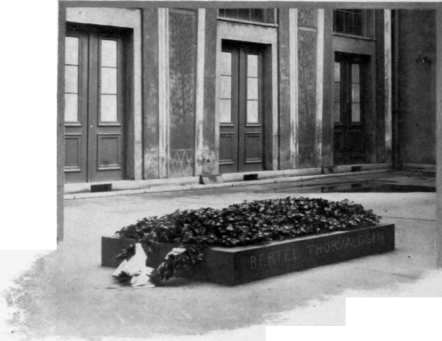
Thorwaldsen's grave.

Thorwaldsen's Ganymede And The Eagle.
An interesting excursion from Copenhagen brought me one day in half an hour to Roskilde, the former capital of Denmark, and the residence of Danish sovereigns as late as 1416 a.d., when the seat of government was removed to its present site. Beneath the roof of Roskilde's cathedral rest all the kings and queens of Denmark, from the tenth down to the present century. I wondered, as I looked upon their tombs, where the fierce Vikings who preceded them are buried. They figure as the demi-gods of Denmark. Wild, reckless sea-rovers and conquerors, their forms appear colossal on the horizon of the Danish past. They are, however, by no means mythical. No lands aroused in them no fears. For centuries they ravaged Britain, Ireland, and the north of France; and for a time the Danish sovereign, Canute, was also king of England. Though this great conquest was in a few years lost to Denmark, the Scandinavian kingdom added to its territory on the east, and at the beginning of the thirteenth century was the most powerful realm of northern Europe, possessing the entire Baltic coast from the river Trave to the Gulf of Finland; while, in the following century, Queen Margaret, daughter of the heroic Valde-mar mar, reigned as sole sovereign of Denmark, Sweden and Norway. Remembering this, as I walked through Roskilde's royal burial place, I could but think how all the smaller European countries, which were once so powerful, have sunk into a subordinate position, dependent for their national existence on the rivalry of the greater Powers. Greece, Italy, Holland and Denmark, in numerical and martial strength, live only in the past. Yet it is well to remember, in these days of imperialism, that a nation's quality is fully as important as her quantity. In the opinion of scholarly critics the little kingdom of Denmark, with her two millions of inhabitants, has, during the nineteenth century, kept abreast of any country in Europe in intellectual activity, and in one department of art she has surpassed the world. Moreover, Denmark's present ruler, Christian IX., has done more to preserve the independence of his realm than the most warlike monarch could have possibly achieved. For from this quiet northern home his children have gone forth to govern literally more than half the world; and, while they live, the Danish throne will stand secure from outward molestation.

Roskilde Cathedral.

The Burial Place Of Danish Sovereigns.

Amal1enborg, The Royal Residence, Copenhagen.
Thus, one of his daughters, Dagmar, as the consort of the late Alexander III., was Empress of the vast dominions of the Tsar; another, Alexandra, formerly Princess of Wales, is Queen of the great British Empire, on which the sun never sets; the eldest son, the heir apparent to the Danish throne, has married a daughter of the King of Sweden; while his brother George is King of Greece, and has for his heir to the Greek kingdom a son who is wedded to the sister of Kaiser William II. But though these powerful alliances have now removed all danger of such loss of life and territory as little Denmark suffered in 1864, in her unequal, hopeless struggle with the combined forces of Austria and Prussia, the reign of the present king has not been free from much internal discord. After her crushing defeat and dismemberment by the two great Powers of central Europe, a part of the nation wished to expend large sums of money for the defense of the country. In particular, a line of fortifications around Copenhagen was insisted on as absolutely necessary. The rest of the people, however, argued that the real defense of such a tiny land as theirs (which is only one-thirteenth the size of France, and has a population of only a trifle more than two millions) lay in moral safeguards, rather than in heavy armaments. They claimed, moreover, that the nation was impoverished, that its coast line was enormous, and that if the capital alone were scientifically de- fended, the other ports of Denmark would be all the more exposed to the attacks of an enemy. This difference of opinion led to a bitter conflict on financial matters, which has been in many ways a serious injury to the country. Year after year the official budget has been rejected, and only a provisional one has been obtained as a temporary measure. Hence it has been extremely difficult to make improvements and reforms which an unfettered government, with a free, full purse, could easily have accomplished.
Continue to:


My Books

