


Denmark. Part 7
Description
This section is from the book "Denmark - John L. Stoddard's Lectures", by John L. Stoddard. Also available from Amazon: John L. Stoddard's Lectures 13 Volume Set.
Denmark. Part 7

A Reception Room In The Royal Palace.

The Palace Square, Copenhagen.

A Danish Country Seat.
A Danish Village.
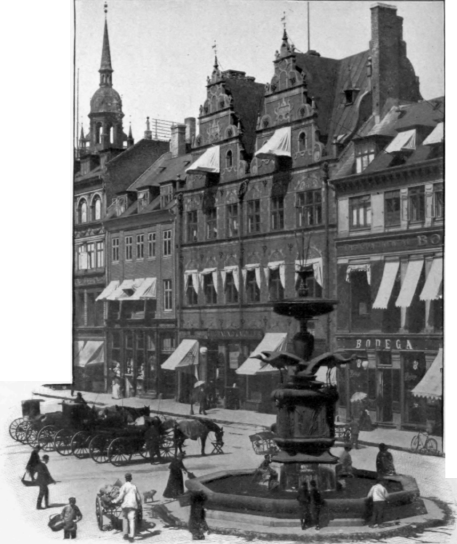
The Stork Fountain.
In 1886 a royal order was necessary to empower the ministry to pay the current ex-penses; and from that time till 1894 there was no regular budget, and many expenditures deemed necessary by the government were made under continual protest from the Folkething, or House of Commons. Since then there has been a compromise between the two branches of the legislature, and regular budgets have been issued; but it is probable that another controversy will soon arise over the old question of fortifying the capital, since the military party, supported by the government and the Lands-thing, maintains that the city is not sufficiently defended.
In one of the busiest and brightest thoroughfares of Copenhagen stands a fine bronze fountain, representing a vase surmounted by three storks with outspread wings. It is a favorite resort for children, and perhaps this circumstance first led me to associate it with the stories of Hans Christian Andersen, that tender-hearted, lonely man, who, although childless himself, has nevertheless become the personal friend of the innumerable children who have read his fairy-tales. These (like the very different, but admirable, Franconia Stories by Jacob Abbot) have been largely superseded of late years by a more sensational literature; but childhood is the poorer by their loss. Unfortunate is the adult whose prosaic maturity has been reached from a fairyless childhood. Wherever Hans Andersen's tales form part of the reading of the young, not only does the world itself become to them more beautiful, ideal and significant; but even the helpless birds and beasts are made happier, because such children will respect their rights, and shrink from any suggestion of their persecution. So deftly does he invest dumb beasts with human sentiments and affections, and so closely does he link their lives with ours, that children who become imbued with his spirit regard all animal life as sacred. Much of the love and sympathy that I have always felt for the furred and feathered members of life's lower kingdom, I owe to a familiarity in my early years with those charming tales, so eagerly devoured and implicitly believed. Life is with most of us a gradual disenchantment. As we advance, illusion after illusion is dispelled, and one by one the threads of faith break under the strain of rude experience; but of the losses of my childhood the most irreparable was that of my belief in the fairies with which Hans Andersen had peopled my little world. In the park of Rosenborg Palace at Copenhagen stands a simple, yet dignified, monument erected by the grateful people to this gentle Dane who, touched by the hardness of their lives, devoted his own to making theirs more beautiful. A grove of noble trees stretches away from the spot where the old man sits in serene repose. A tender smile rests on his aged face, softening and beautifying its rugged, homely features. In one hand he holds a book, and with the other he seems to be blessing the children who romp in happy abandon through the adjoining avenues of spreading beeches; for this garden is the favorite playground of the little ones of Copenhagen. On one side of the pedestal is portrayed a stork carrying an infant, and on the other are three swans, commemorating two of his dearly loved stories. Around its base are beds of pansies and forget-me-nots; but this mute, delicate appeal, made in the language of flowers, is not needed. Hans Andersen will not be forgotten. One may forget the volumes of philosophers, historians and scientists; but those delightful fairy-tales can never die in the mind of one who has read and loved them in his youth. They are as fresh in the memory of threescore years as any incidents or influences of life's first decade; and men and animals owe more than ever will be rendered to this dear old son of Copenhagen, beloved by the children of every land.

Continue to:


My Books

