


Egypt. Part 12
Description
This section is from the book "Egypt - John L. Stoddard's Lectures", by John L. Stoddard. Also available from Amazon: John L. Stoddard's Lectures 13 Volume Set.
Egypt. Part 12

The Overthrown Statue.

The Vocal Memnon.

The Colossi Of Thebes.

A Dervish Drum.
For many years the usual explanation of this phenomenon was that of fraud. It was supposed that a priest concealed himself in the statue, and at sunrise, by striking the stone with a metallic hammer, produced the sound which awed into amazement the worshipers of old. But, on the other hand it seems incredible that for two hundred years priests could climb into this statue every night and climb down again every day, and never be discovered. Obviously, this colossus could not, like a chess automaton, be rolled away occasionally from the stage, for it stood out boldly on the plain, and could be watched continually by thousands. Nor was its voice immemorial. The statue had stood here for fifteen hundred years before it be-vocal. It was only after its injury by the earthquake that its voice began to be heard. It then continued musical for two hundred and twenty years; but as soon as it was repaired by the Roman emperor, - that is, as soon as its crevices were filled with stone and plaster, - it became dumb again, and has remained so ever since. It would seem conclusive, therefore, that the mysterious sound which puzzled all antiquity, was due to the warmth of the rising sun acting on the mass of cracked and sundered stone, which had been thoroughly chilled and moistened with dew during the night, - a fact not without a parallel in some peculiar rock formations of the world. On the opposite bank of the Nile to that on which the Vocal Memnon and his comrade sit alone, stands the most wonderful of all the edifices of old Thebes, the temple of Kar-nak. It forms, in fact (with the exception of the Pyramids), the largest and most imposing ruin, not only in Egypt, but in the world. The approach to this was formerly by an avenue nearly two miles long, lined with at least two thousand colossal sphinxes, crouching side by side, fragments of which are still discernible. Between them, so long ago as the time of Joseph, passed with reverent tread unnumbered worshipers, who must have been overwhelmed with awe by the grandeur of this unrivaled vestibule. To-day Arab beggars sun themselves here in the sand. Some one has said that it is fortunate for these sphinxes that they are beheaded, since they are spared the sight of the temple's degradation. Beyond them one perceives, from a great distance, a solitary portal. Beneath it giants might have passed, for it is seventy "Wild confusion." feet in height. Compared to it, a man appears to be a pygmy. Time seems to have favored certain portions of this ruined shrine, and this is one of them; for, preserved in the wonderfully clear atmosphere of Egypt and the unvarying sunshine of the Nile, it stands at present in its stately beauty almost as perfect as when its lofty arch resounded to the murmur of adoring thousands.

An Egyptian Head-Dress.

Approach To Karnak.
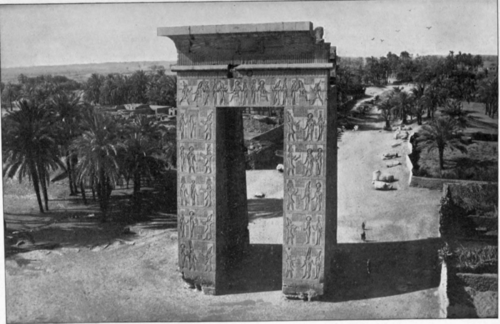
Gateway Of Karnak.


In Karnak.
Passing through this gigantic outer gate, we paused with bated breath before a glimpse of Kar-nak itself. Who can ever forget his first view of this temple, whose walls are eighty feet in height, some of whose towers reach an altitude of one hundred and forty feet, and whose vast area is a mile and a half in circumference? Before us was a wild confusion of mammoth columns, Cyclopean walls, and towering obelisks. It seemed to be a ruined city, rather than a temple, reduced to chaos by an earthquake. One feels that he is standing here upon a battlefield, where Time has struggled with the products of human genius. With whom the victory has rested, the mutilated remains upon the plain significantly prove.
Continue to:


My Books

