


Egypt. Part 13
Description
This section is from the book "Egypt - John L. Stoddard's Lectures", by John L. Stoddard. Also available from Amazon: John L. Stoddard's Lectures 13 Volume Set.
Egypt. Part 13
Making our way through this bewildering labyrinth, we approached one of the smaller avenues of Kar-nak. How well preserved the columns are! And yet in point of age they are as far removed in one direction from the birth of Christ, as we are in the other. Despite their history of four thousand years, these columns wear no ivied wreaths of age, and had not the ruthless hands of iconoclasts been raised against them, they would doubtless have remained intact to the present day. One realizes here that the Egyptians built their temples, not for centuries, but for ages. In fact, one of the inscriptions on these walls states that the king Rameses confidently counts upon the gods for help, because he has reared to them "eternal mountains."

An Aisle In Karnak.
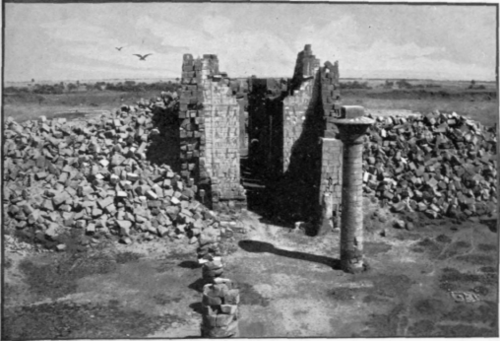
A Bit Of Karnak.
The columns, first met with as one approaches Karnak, enormous though they are, sink to comparative insignificance, when we enter the main avenue of the temple. No illustrations or statistics can give an adequate idea of the majesty of such architecture as this. Yet in one hall alone are no less than a hundred and thirty-four columns, some of which are thirty-six feet in circumference and sixty-six feet high, while many of the solid blocks which they support are forty feet in length. The lotus flowers which crown them are so vast that twelve men can, with outstretched arms, and hands pressed finger-tip to finger-tip, barely enclose one of their curving lips. What wonder that the Arabs declared that the ancient Egyptians were giants, who had the power of moving at will cyclopean masses of stone, as by the mere stroke of the enchanter's wand? On entering another shadowy aisle of Kar-nak, we found that conquerors had sought to overthrow some of these mighty pillars. In several instances the miscreant vandals were successful; but one huge shaft refused to fall, and, although started from its foundation, it leans against its neighbor (one fancies wearily and painfully), as though it were a giant's dislocated limb. However, we can safely walk beneath this leaning column, for it has been thus deflected since before the time of Christ. Soulless indeed must be the traveler who can walk among the ruins of Karnak without emotions too profound for words.
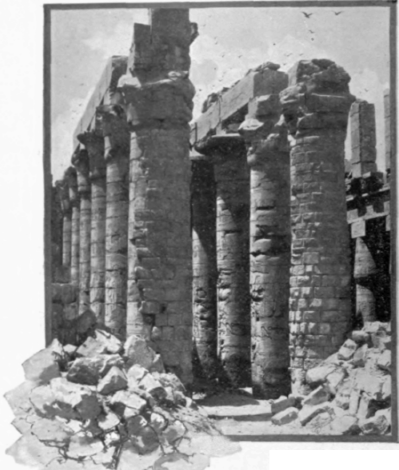
Eternal Mountains.
In the whole world there is no temple that can be even remotely compared to it. It must have been even more impressive, when its vast aisles were covered with a roof, which, if we may judge from other Egyptian ceilings that remain, was probably painted a deep blue, to represent the cloudless sky of Egypt, and glittered with a thousand golden stars. Even now the daylight, streaming down through this forest of columns, reveals to us pictorial carvings twenty feet in height, with a multitude of sacred characters, cut several inches deep into the solid stone, each letter polished to its entire depth and colored like mosaic. These are not fanciful and meaningless decorations, but hymns of praise to kings and gods, as perfectly comprehended in those times as Latin sentences are to-day.
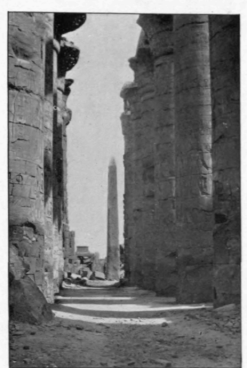
A Corridor.

The Leaning Column.
Until 1799, Egyptian hieroglyphics were a mystery, but at the close of the eighteenth century these sacred writings of past ages were made plain by the discovery of a tablet of black basalt (called the "Rosetta Stone" after the town near which it was found), which was dug out of the soil of the Delta. Upon this stone, which is about four feet in height, was inscribed in three languages a decree issued by the Egyptian priesthood at Memphis, about two hundred years before Christ. One of these languages was Greek, the other two were, respectively, the priestly and the popular writing of the Egyptians. By a comparison of the known Greek with the unknown Egyptian characters, a key was found by which to decipher the priestly symbols of the Pharaohs. To Champollion, the distinguished French linguist, is due unstinted praise for this great work, without which the reading of the monuments of ancient Egypt and even the comprehension of Egyptian history would have been impossible. As is well known, the Rosetta Stone now forms one of the most valued treasures of the British Museum.
Continue to:


My Books

