


Egypt. Part 14
Description
This section is from the book "Egypt - John L. Stoddard's Lectures", by John L. Stoddard. Also available from Amazon: John L. Stoddard's Lectures 13 Volume Set.
Egypt. Part 14
Time, the destroyer, can apparently lay no hand on sculptures such as these. They still remain, and will no doubt remain for centuries to come, illumined tablets of history, as perfect as when they were beheld through clouds of incense by the assembled worshipers of old.

The Rosetta Stone.
In strolling through the immense area of Karnak's ruins, we frequently discovered stately obelisks which were hewn from the primitive volcanic granite nearly forty centuries ago. One of these, which, as the inscription tells us, was once surmounted by a little pyramid of gold, is ninety-two feet high and eight feet square. Some of these monoliths are prostrate, while others are erect; but whether prone or perpendicular, amid these wonderful surroundings, and with the secrets of past ages graven on their sides, they are unusually impressive memorials of the heroes of the past, and " Like a right-arm lifted towards the sky, Each obelisk makes oath their memory shall not die."
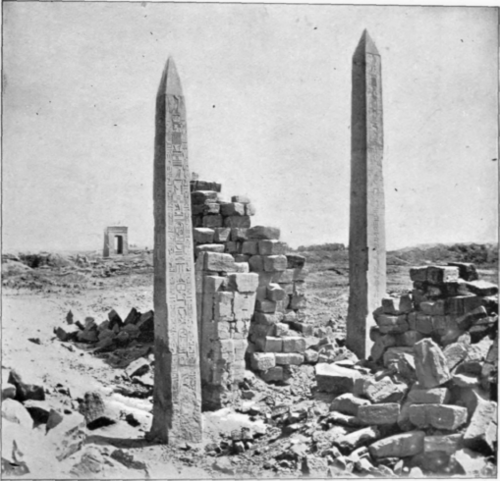
Obelisks At Karnak.
" Like a right-arm lifted towards the sky, Each obelisk makes oath their memory shall not die."
Though Karnak is the most stupendous ruin of Upper Egypt, by far the loveliest is the island of Philae, encircled by the glittering Nile. It is an uninhabited island now, only twelve hundred feet in length and five hundred in breadth, but the memories it awakens are like precious jewels in a tiny casket, - "infinite riches in a little room." This "Pearl of the Nile," as it is called, now fringed with palms and crowned with ruined temples, was formerly sacred to the goddess Isis, the mightiest of the Egyptian Trinity; and here her worship was continued secretly, long after the decrees of Christian emperors had elsewhere abolished the old faith of Egypt.

Phil*.
For centuries before that time, however, the templed isle of Isis was the resort of countless travelers and pilgrims, by whom it was as much revered as is the Holy Sepulchre at Jerusalem by the majority of Christians to-day; for this was supposed to be the burial-place of Osiris, the husband of Isis; and the most sacred oath of the Egyptians was the phrase, "By him who sleeps in Philae."
At one extremity of this island is an exquisite little structure known as "Pharaoh's Bed." It is difficult to imagine anything architecturally more beautiful than this graceful pavilion, outlined against the glorious blue sky of Upper Egypt. It is not, however, very ancient, as things go in Egypt, having been built by the Roman emperor Tiberius, about the time of Christ. How Egypt dwarfs all lands and ruins which we have previously called ancient! In Britain we survey with wonder its old cathedrals, built six centuries ago; in Italy we are thrilled by scenes reminding us of Roman life and customs eighteen hundred years since; in Athens we go back still farther. But here upon the changeless Nile, when once accustomed to its antiquity, we find ourselves exclaiming lightly: "Oh, this is merely Greek," or "That is as modern as the Caesars.

Pharaoh's bed.
If the island of Philae is beautiful by day, by night it has a fascination almost beyond the power of language to describe. For when the moon threads these deserted avenues with silver sandals; holding her pale light, here and there, for us to note these sculptured chronicles of kings, beautiful Philae rises once more in its splendor, its sculptures speaking to us of the vanished Isis and Osiris, in that mysterious language of dead ages whose books were the temples of the gods, the leaves of which were blocks of stone.
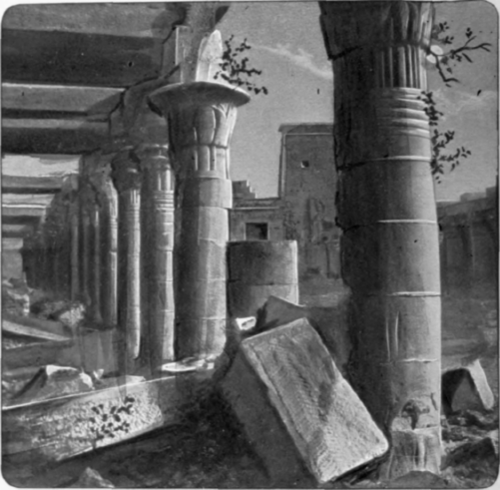
Philae By Moonlight.
Most tourists on the Nile are content to go no farther than the first cataract and Philae; but those who journey still farther southward into Nubia are abundantly repaid by one of the most awe-inspiring of Egyptian ruins, - the temple of Abou-Simbel. This edifice, which is cut for a distance of three hundred feet into the rocky hillside by the river, is now half-buried in drifts of shining sand. Beside it are four statues of Rameses II, of such prodigious size, that the huge door, although enormous in itself, seems small beside them. This portal conducts the traveler into a subterranean hall, where are still other monster statues, waiting with folded arms through the slow-moving centuries, like captive giants whom only a terrific earthquake shock can liberate. Torchlight reveals an altar where sacrifices were offered to the gods more than three thousand years ago.
Continue to:


My Books

