


Gibraltar. Part 2
Description
This section is from the book "Gibraltar - John L. Stoddard's Lectures", by John L. Stoddard. Also available from Amazon: John L. Stoddard's Lectures 13 Volume Set.
Gibraltar. Part 2
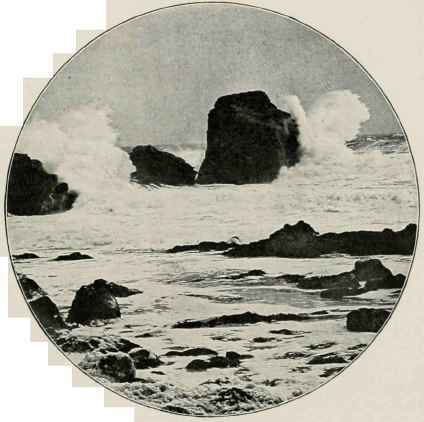
A Cruel Coast.

The Northern Pillar Of Hercules.

Mount Calpe, Now Gibraltar.

A Follower Of Mohammed.
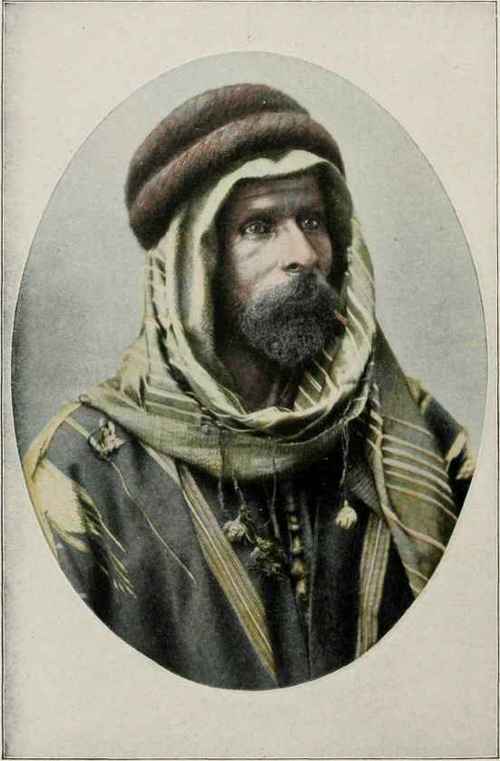
A Descendant Of The Conquerors.
This was no short-lived conquest. The grand old vantage-point remained in Moslem hands for more than seven centuries, and (hard as it may be for us to realize it) it was not until 1462 that it became a permanent part of Christendom. By that time the long struggle between Moors and Christians in the south of Spain was gradually nearing its conclusion, and the Spanish territory of the Saracens grew steadily more restricted, as the advancing Cross forced back the waning Crescent toward the sea. Gibraltar held out nearly to the end, and its surrender to the Christians preceded by only thirty years the capture of Granada and the departure of the Moorish King Boabdil into Africa. Then for two centuries the government of Spain was its possessor, and on the shore which it so grandly dominated was focused for a time the attention of the civilized world. For then it was that the old promontory saw the little fleet of Columbus sail away on its immortal voyage, and first descried its happy home-coming with the astounding tidings of the discovery of a new continent. Thereafter, too, for many years it watched the ships of other heroes and adventurers, as they started forth upon the path of conquest, and grimly looked upon them as they came again, laden with that ill-gotten gold, whose weight was finally to paralyze the nation's energies and drag it downward to a gilded tomb. Yet Spain in her decadence did not place a proper estimate on this outer key of the Mediterranean, but left it to rust icily in the lock, guarded at last by only eighty men. The world being what it is, what followed was inevitable. In 1704, a sudden, unexpected attack on the part of England changed again the fortunes of Gibraltar; and with a trifling loss of life, and almost with the swiftness of a prestidigitator's legerdemain, it passed into Great Britain's unrelaxing grip. There it remains to-day, perhaps the strangest geographical anomaly in the world, - the natural terminus and bulwark of the great Iberian peninsula held by a foreign nation, - a fact as irritating doubtless to the Spaniards as the possession of the Isle of Wight by France would be to England, or the occupation of Long Island by the British would be to the United States.

The Old Moorish Castle.
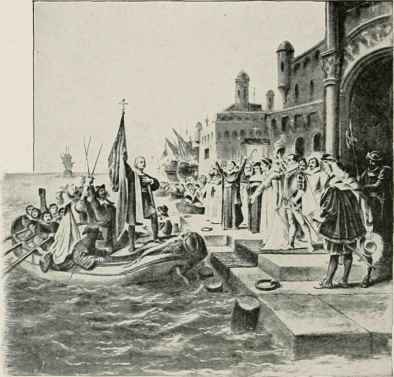
The Departure Of Columbus From Spain.
It was about five o'clock in the morning, at the end of a transatlantic voyage, that I first saw Gibraltar. Called by the steward half an hour before, I hastened to the steamer's deck, to find the ocean covered with a tantalizing fog, beneath which only the edge of the Spanish coast was visible. But soon, as if by a magician's spell, the soft gray curtain which surrounded us rose gradually from the rim of the horizon, and a bright spot of gold upon the Mediterranean's eastern verge foretold the coming of the god of day. The effect that followed will never be forgotten by those who witnessed it; for, as if that first sign of the approaching luminary were a preconcerted signal, the sombre drapery of clouds, which had till then enveloped the stupendous rock, was slowly rolled up like a scroll, revealing first the feet and left flank, then the side and shoulder, and finally the majestic head of a couchant monster, three miles long and fourteen hundred feet in height, turned by a fiat of the gods to stone. Whether its form resembles most a lion or a sphinx, it is, at all events, sublime. I had supposed that it lay headed toward the sea; but its stern, awful face is turned toward Europe, as though at one time it had been the guardian of a narrow isthmus connecting the two continents, and had been stationed here to keep inviolate the northern limit of the causeway and check all European inroads into Africa. Meantime, our steamer had dropped anchor in Gibraltar's pretty harbor, sheltered by its western side. Across this stretch of animated water, sparkling with the dawn, I could discern a group of stuccoed buildings, most of which were painted yellow. These proved the existence of a town; but, when compared with the great cliff to which they clung, they seemed as insignificant as barnacles upon a vessel's keel. In fact, we do not think of this huge promontory as a residence, but as a fortress. True, it supports, besides the garrison of five thousand soldiers, a population of some twenty thousand souls; but these appear like supernumeraries on a stage, useful no doubt, but not essential to the performance of the play. Nor is there any special evidence that civilians are desired here. No foreigner may reside at Gibraltar unless his consul or a householder becomes security for him, and even then permits for such a privilege are rarely granted for more than twenty days. Moreover, the rock is ruled by martial law. At sunset all the entrances are closed inexorably for the night, and even transient visitors from steamers halting a few hours in the harbor are not allowed to pass within the settlement until they have obtained at the Marine Gate tickets of admission, whose value ceases when the stern voice of the evening gun proclaims the passing of another day.
Continue to:


My Books

