


Gibraltar
Description
This section is from the book "Gibraltar - John L. Stoddard's Lectures", by John L. Stoddard. Also available from Amazon: John L. Stoddard's Lectures 13 Volume Set.
Gibraltar

Isolated points of the earth's surface, whether they project as promontories into the ocean, or pierce as mountains the incomparably vaster sea of space, possess an element of mystery that fascinates the human mind. The North Cape, standing in majestic solitude, and as the farthest sentinel of northern Europe beating back the billows of the Polar Sea; Cape Horn, the tempest-riven terminus of South America, dividing the Atlantic and Pacific, and like its Arctic rival pointing ever toward the unattained; and those sublimest pioneers of our planet, which cleave the empyrean in the inaccessible crests of the Himalayas - who can behold any or all of these without emotions widely different from those awakened by an ordinary coast line or a range of foothills? Nor was there ever probably a time when such localities did not produce a powerful im pression on the race. Remote, conspicuous, comparatively few, and, from their very situations, swept by violent storms, the capes and mountains of the globe must always have been grand or gruesome to mankind, according to the sunshine or the shadows which enveloped them. So far as we can judge, the ancients felt in presence of such objects far more fear than pleasure, because what lay beyond those prominent terrestrial limits was usually unexplored and filled with nameless terrors.
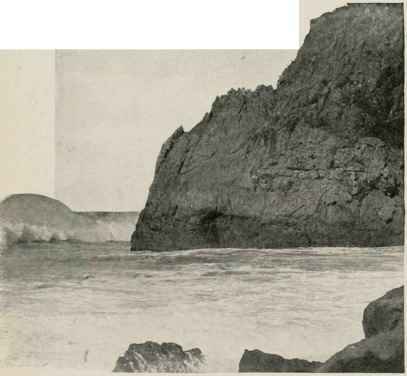
Cafe Spartel, On The African Shore.
In our case science has enabled us to look upon all natural phenomena, and even on the outermost boundaries of our whirling orb, not only without fear, but with the keenest interest. Yet, although dread has been dispelled, a sentiment of awe and reverence abides with us, such as the ancients never felt, because we know, as they did not, the countless eons necessary to evolve our world and the immeasurable' firmament in which it floats. Nevertheless, so much of the great realm of the Unknown still lies about us that under its mysterious influence we do poetically what the Greeks and Romans did religiously; and in our simple moments, when we no longer study Nature but enjoy her, we drift instinctively again toward paganism. In such moods, moved by impulses perhaps inherited from our remotest ancestors, we half unconsciously invest material things with human attributes. An isolated promontory buffeting the winds and waves, a solitary island on a trackless sea, or a forbidding mountain peak as yet untrodden by the foot of man, then seem to us like sentient beings. We think of them as lonely, because we know that in their places we should feel companionless; as cruel, because they strew the coast with wrecks and lure men to a fearful death upon their jagged cliffs; or as immaculate in character, because their shoulders bear a chasuble of virgin snow. Such fancies are not blameworthy, if not allowed to influence our rec-o g ni t i o n of established facts. Frankly indulged in as pure sentiment, they are like the atmosphere which makes the distant mountain soft and beautiful. Indeed, from pantheism and mythology has sprung the poetry of the world.
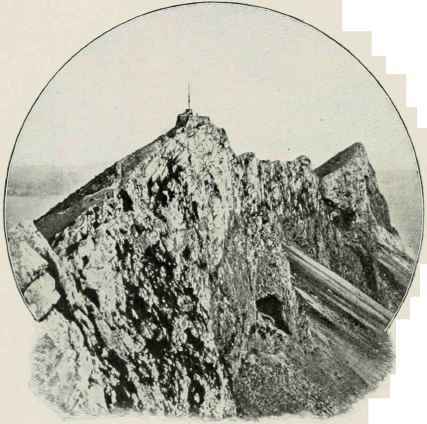
The Signal Station.
Few natural objects appealed so powerfully to the imagination of the ancients as the western boundary of the Mediterranean. To them that inland sea appeared the centre of the universe, its terminus the limit of the world. How solemn and suggestive, therefore, must have seemed its solitary outlet! How awe-inspiring the space beyond! Although impressive in itself, Nature had made this portal of two seas and meeting place of two great continents still more imposing by two giant promontories, - Mount Calpe (now known as Gibraltar) on the European shore, Mount Abyla (the Mount of God) in Africa. These were believed to be the Pillars of Hercules, left by that god of strength as proofs of his prodigious prowess when he rent the continents asunder. Hence, since the fabled Hercules was but the Greek and Roman incarnation of the Sun God of the old Phenicians, his mythical adventures with the golden apples in the Garden of the Hesperides may well have had their origin in the saffron-colored sunsets of this ocean gateway. Beyond these cliffs the most adventurous navigators for many centuries dared not go, regarding them as the divinely stationed termini of travel. Westward of Abyla and Calpe stretched away to the horizon the mysterious expanse into whose depths men saw with mingled curiosity and fear the glittering car of Phaethon every night descend, to be submerged apparently in a waste of waters vast enough to quench its fires. What this might mean, whither it went, whether it would remain forever in the nether world, and by what miracle of resurrection it appeared again with undiminished fervor every morning over the Mediterranean's Syrian shore - all this was to their minds inexplicable. How many fleets came bravely to the threshold of this narrow vestibule, but at the sight of the appalling area beyond turned timorously back! Even as late as the Augustan Age how few the ships that dared to leave the shadow of the northern rock, and creep along the sunset side of Spain ! As for sailing out of sight of land upon the terrible Atlantic, that was not thought of; or, if occasionally attempted by some bolder spirits, the result was ominous, since the bewildered navigators either nevermore returned or else came back with such a horror of the trackless main that no one cared to follow their example. Owing perhaps to its inhospitable aspect, as well as to the awe inspired by its situation and reputed origin, Gibraltar never was inhabited in classic times. Its massive form looms lifeless through the whole millennium of Rome's rise and fall, belonging less to man than to the gods. At last, however, in the dawn of the eighth century of the Christian era, it suddenly emerges clearly into view, to hold thenceforth a prominent place in the affairs of men. Its advent is associated with that wonderful phenomenon of history - the rapid spread of Islam, when, having conquered Asia Minor, Persia, Palestine, and Egypt, the followers of Mohammed had swept resistlessly along the northern coast of Africa and reached the shore of the Atlantic. There, pausing by the southern Pillar of Hercules, they looked across the Straits at its companion, Calpe. Beyond that frowning headland Europe lay before them ripe for conquest. Hence, flushed with victory and burning with religious zeal, they crossed the narrow channel on the 30th of April, 711, and landed in that lovely portion of our earth whose natural charms they were so wonderfully to increase by irrigation, art, and agriculture, and in which the fine flower of Arabic civilization was to flourish seven hundred years. Gibraltar, therefore, which then passed from the realm of myths to that of Moorish history, commemorates at once their landing and their leader, for its modern name is but a modification of "Gebcl-al-Tarik," or the "Mountain of Tarik" - its Mohammedan conqueror.
Continue to:


My Books

