


Holland. Part 2
Description
This section is from the book "Holland - John L. Stoddard's Lectures", by John L. Stoddard. Also available from Amazon: John L. Stoddard's Lectures 13 Volume Set.
Holland. Part 2
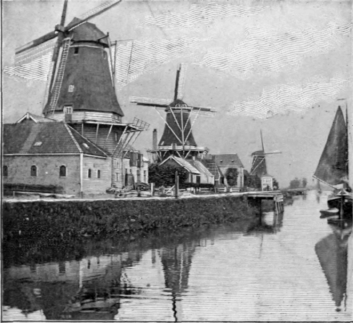
A Dutch Waterway.

Holland Women.
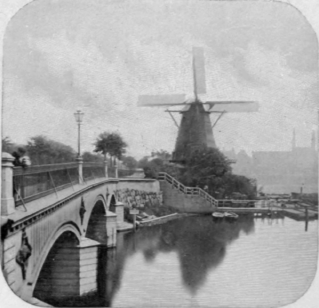
A Bit Of Holland.
The climax of Dutch ingenuity has been reached, however, in compelling the ocean - their natural enemy, which threatens constantly to overwhelm them - to actually aid them in repelling human foes; for, by an intricate system of locks and sluices, they can inundate certain sections of the country, and either drown or drive away invaders. Small, therefore, though their army be, the Hollanders have a natural ally that even the best-trained European soldiers cannot conquer; and the brave Dutch may well exclaim to any mightier nation which shall try to rob them of their independence, "One, with God, is a majority."
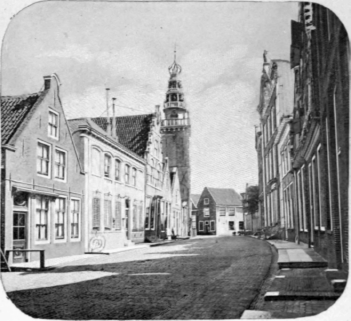
A Quaint Street.
So profoundly uneventful seems Dutch existence, that I should think physicians would prescribe a residence in sleepy Holland as a cure for nervous prostration. In winter, however, life here must have some excitement. Without much snow, yet with a temperature often below the freezing-point, Holland is the paradise of skaters; and on the crystal paths which then bind all departments of the realm together as with silver cords, men, women, and children spend delightful hours, having practically no limit to their wanderings; since they are able, if they choose, to glide for miles along these frozen highways, and visit in a short time, and with no cost of transportation, numerous towns and villages. Thus people often skate from Rotterdam to the Hague, and return the same day; in all, a distance of thirty miles. It is a common thing for boys and girls to skate to school, and even for Dutch ladies to make use of skates to do their marketing. Cities, too, institute ice carnivals, and invite their neighbors to join them in skating festivals. The lower classes in Holland have an advantage in dress over their superiors, when skating; for their baggy trousers serve as sails, and when a plethoric Dutchman puts his hands in his pockets and expands his nether garments, so as to catch the breeze, he rapidly leaves behind him those who are clad in the conventional style. It should, however, be remembered that these canals, when frozen, are not merely avenues of pleasure, but are also used as thoroughfares of transportation. Hence skaters on them frequently encounter sledges, containing articles which would in summer be conveyed by boats.
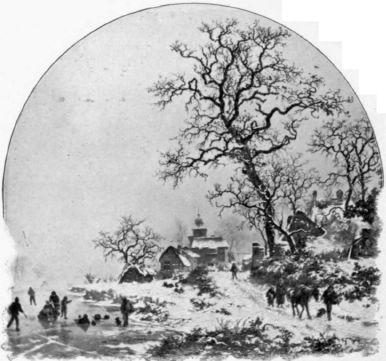
Holland In Winter.
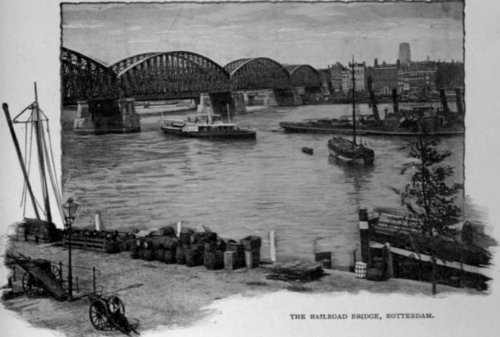
Delighted with the oddity and beauty of Holland scenery, we saw at last from our car window the city of Rotterdam. This famous centre of Dutch commerce, fourteen miles from the North Sea, lies at the union of two rivers, one of which is called Rotter, and with the great dike, erected on its banks, gives to the town the name of Rotter-dam. This is a clew by which to comprehend all similar titles. Thus, Amster-dam signifies the dam upon the Amstel; and the names Schiedam, Zaandam, Edam, Durgedam, Volendam, and all the other "dams" refer to dikes in their vicinity.
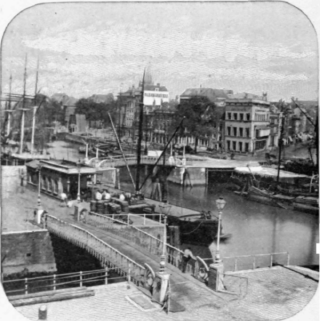
Drawbridges, Rotterdam.
On my first walk in Rotterdam, I was bewildered by its mul-titude of bridges. From almost any halting-place I could count eight or ten; and, as most of them were drawbridges, they rose and fell like parts of an immense machine. Another feature of the town that seemed to me remarkable was the sign which I observed quite frequently above the doors of shops, "Fire and Water to sell." If it had read simply "Firewater," I might have concluded that Holland gin could there be bought; but "Fire and Water" puzzled me, until I learned that a regular trade is carried on here of selling to the poor hot peat and boiling water, with which to cook their frugal meals. Many boats are employed in bringing water to the city for sale.
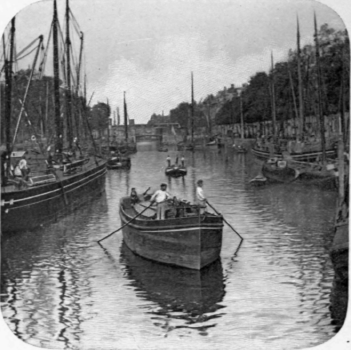
A Canal In Rotterdam.
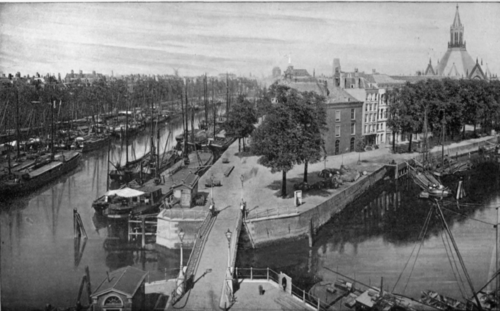
Rotterdam.
Continue to:


My Books

