


Holland. Part 4
Description
This section is from the book "Holland - John L. Stoddard's Lectures", by John L. Stoddard. Also available from Amazon: John L. Stoddard's Lectures 13 Volume Set.
Holland. Part 4
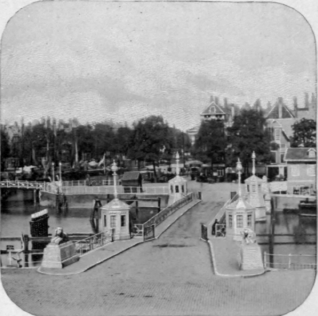
A Characteristic Scene, Rotterdam.
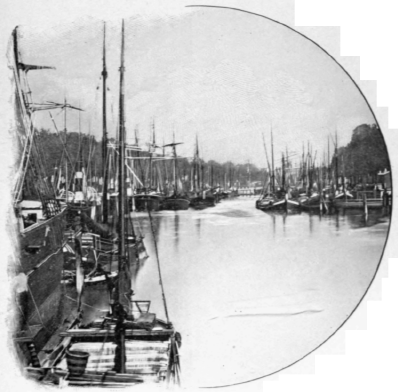
A Commercial Centre.
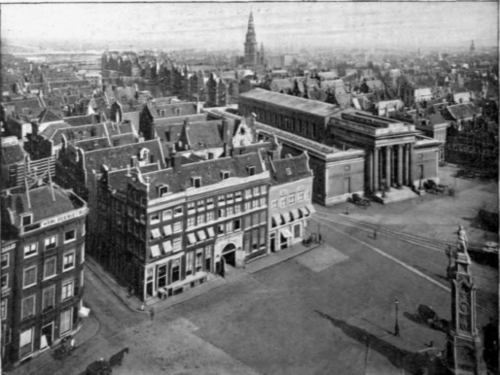
Panorama Of Amsterdam.
The contrast between the cities is, perhaps, best shown by the conveyances peculiar to each place. In Venice they are those dusky spirits of the canals, - the slender, graceful gondolas. In Amsterdam they are the heavy boats of traffic.
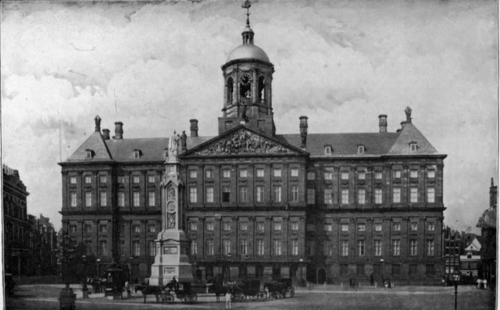
The Royal Palace, Amsterdam.
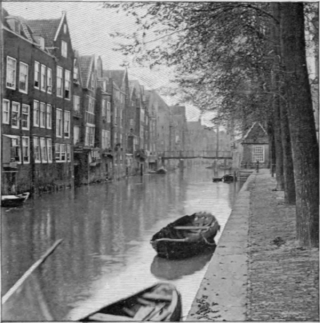
A Side Street In Amsterdam.
The future of the cities, also, will be entirely different.
Venice is dying like a gorgeous sunset; but Amsterdam, the rugged offspring of the northern sea, is, for its size, one of the wealthiest cities in the world; its bankers hold the securities of every nation, and on its broad canals float vessels from all quarters of the globe.
Many of the barges in Amsterdam form the abodes of people who have no other homes. Among a certain class of Hollanders, when a young man has saved or borrowed money enough he buys a huge, broad-shouldered boat; and, like the Patriarch Noah, leads into it not only his family, but also all the animals of which he is possessed, including poultry, hogs, and even cows. Thenceforth he is independent; and, as the master of a floating house, stable, farmyard, and express cart all in one, and never absent from his family, he transports loads of merchandise from town to town, and even sells a few superfluous eggs, or a little milk. What is most amusing is the way in which such an amphibious farmer, having moored his boat, takes his wares from house to house; for he may be frequently observed standing without a blush of shame beside the only vehicle I ever saw, that could be properly called a dogcart! How often on my walks in Holland I have met peasants tramping along in whitewashed wooden shoes, beside a muzzled dog which sometimes staggered, and frequently lay down from sheer exhaustion! It makes no difference what their size or breed may be, all dogs are forced to labor here unmercifully. My pity for them may be owing to the fact that in America dogs are regarded merely as pets; but I confess that I always felt, on observing Holland dogs compelled to draw heavy loads, much as I do at seeing children kept from play and made to labor in factories. Moreover, the work of Dutch dogs does not end, when the merchandise is sold; for, when the chance is offered him, the driver seats himself in the cart, which frequently is heavy enough for a small pony, and makes his wretched steeds draw him home. It really exasperated me to see this treatment of the canine race in Holland. But the dogs are cheap, and the men are either lazy or hard-hearted; hence, so long as no society exists there to prevent it, man's most devoted friend and trusty comrade will probably be compelled to lead a worse existence than is indicated by our expression, "A dog's life!"
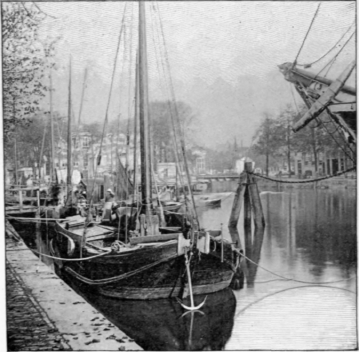
The Shipping, Amsterdam.
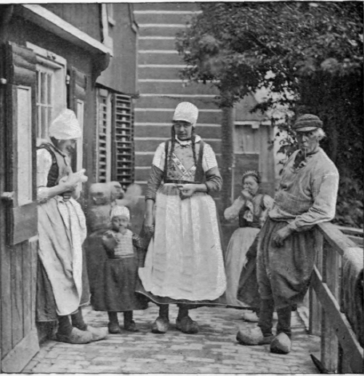
A Dutch Family.
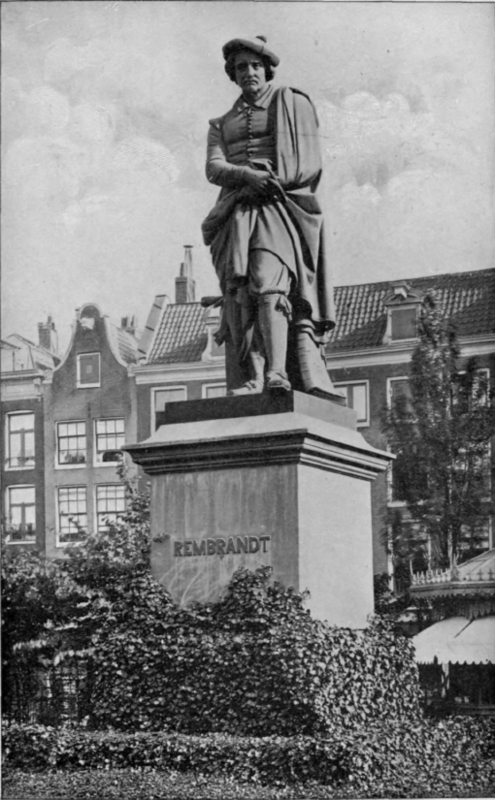
Statue Of Rembrandt, Amsterdam.

Canine Usefulness.
Sometimes, however, Hans does not own a dog. What then? Does he assume the load himself? O, no! He puts it on his wife. "Gretchen," he says, "bring me my pipe, like a good hausfrau, and [ will help you get the yoke upon your shoulders." Then, while he calmly sits upon the deck, a halo of tobacco smoke about his head, his patient spouse goes on her way, like the mere beast of burden that she is. I wonder if she ever asks the question, "Is marriage a failure? "Poor creature! We may laugh at her odd dress, her hat which looks like a wash basin inverted, and the huge bows of stiff, black cloth which stand out from her head like a bat's wings; but, after all, hers is a sad fate, and will continue to be till the Holland peasant rises to some sense of chivalry. It must be confessed, also, that Dutch husbands, in even the middle and upper classes of society, do not show excessive gallantry to their wives. I shall not soon forget a conversation I once had with my landlady in Amsterdam. Amazed, apparently, at my expressions of sympathy for Holland dogs and peasant women, she said to me: "I am going to tell you something which I know will please you, and which is really true. Some years ago, an American gentleman and his wife were boarding with me. The lady was recovering from an illness, and one day her husband wished her to take a drive. Now, what "do you think he did? Why, when the horses were at the door, he took his wife up in his arms, carried her downstairs, and put her into the carriage. Nor was that all. When they returned, he took her in his arms again and carried her upstairs. There! Did you ever hear of such a thing as that? Was not the man a saint?"
Continue to:


My Books

