


Ireland. Part 13
Description
This section is from the book "Ireland - John L. Stoddard's Lectures", by John L. Stoddard. Also available from Amazon: John L. Stoddard's Lectures 13 Volume Set.
Ireland. Part 13
Macaulay, an historian not particularly favorable to the Irish, nevertheless pronounced Burke " in aptitude of comprehension and richness of imagination, superior to every orator, ancient or modern": and the English statesman, Fox, declared, " If I were to put all the political information that I have ever gained from books, and all that I have learned from science, or that the knowledge of the world and its affairs have taught me, into one scale, and the improvement I have derived from the conversation and teachings of Edmund Burke into the other, the latter would preponderate."
What wonderful men poor Ireland has brought forth in her wretchedness and given to the world, as models of oratory, poetry, statesmanship, and valor! The different stars composing this superb galaxy naturally shine with various degrees of lustre; but all of them are suns, not satellites, and they together form a Celtic constellation, whose brilliancy will never be extinguished until the stellar hosts themselves shall be dissolved, and " the heavens shall be rolled together as a scroll."
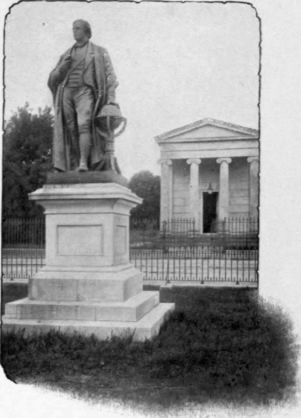
Statue Of The Earl Of Rosse, Dublin.
Passing within the enclosure of the University, I paused in admiration before its Campanile, a beautiful combination of triumphal arch and belfry, the latter containing a melodious bell which calls the students to their various duties. This structure, the cost of which is estimated at sixty thousand dollars, was the gift of Lord George Beresford, whose exalted station as Archbishop of Dublin and Primate of Ireland did not prevent him from regarding his Alma Mater with the love and gratitude of a loyal son. It is evident from the stories still related of him by the collegians that he was no exception to the rule, that Irishmen are generally endowed with irrepressible wit and humor. Thus, even when Archbishop, during the meetings of the National Board of Education, over which he pre-sided, he would often gravely announce some scientific discovery for the amusement of his co1-leagues. On one occasion, referring to the particu- larly flat-topped head of a neighbor, he propounded what he called a "new phrenological test." "Take," he said, "a handful of peas and drop them on the head of the patient. The amount of the man's dishonesty will depend on the number that remain there. If a large number fail to fall off, tell the butler to lock up the spoons."
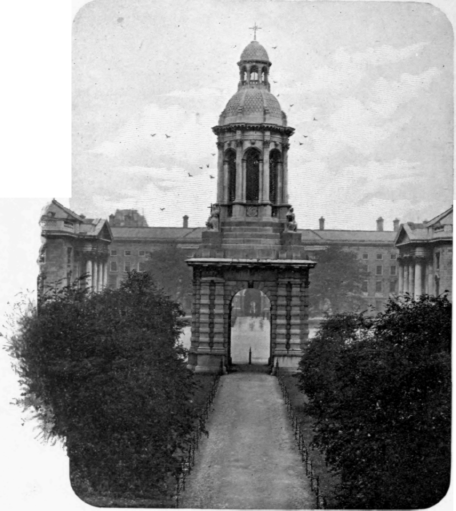
The College Campanile.
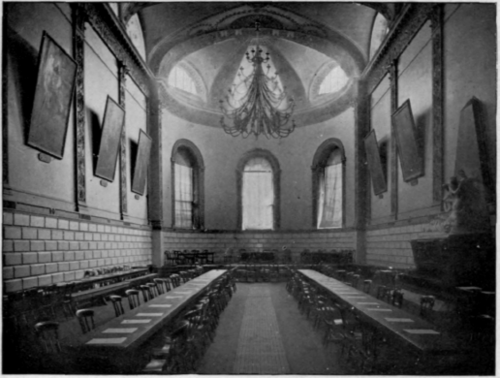
The Examination Hall, Trinity College.
In the Examination Hall of this institution hang several interesting portraits, including those of Dean Swift, Bishop Berkeley, and Edmund Burke; and, just as in the Dining Hall the likenesses of Grattan, Flood, and Beresford look down upon the students, when for a time the knife and fork are more important than the pen, so here the faces of these eminent graduates seem to survey with sympathy the youthful aspirants for fame, as they attempt to answer on the sheets of paper placed before them questions, which to the average collegian, breathlessly awaiting promotion, graduation, prize, or fellowship, inspire almost as much dread as the ingenious tests of mediaeval torture-chambers.
But the special glory of Dublin's University is its famous Library, which contains nearly a quarter of a million of volumes, and has, like the British Museum in London, the right to a presentation copy of every book published in the United Kingdom. The exterior of this Library is severely plain, though not without a certain dignity and rugged grandeur; but the interior is really noble in the majestic height of its great central hall, with wainscoting and ceiling of old Irish oak. Along the sides are marble busts of many of the world's most eminent contributors to knowledge, from Homer, Socrates, and Plato, to Shakespeare, Bacon, and Dean Swift. Here also is a beautiful bust of Wellington by Chantrey; and since these portraits are not strictly limited to literary benefactors of the race, I should have liked to see enshrined within these walls the face of Mr. Fawcett, who finally, in 1873, caused all religious tests of the University to be abolished, and all its scholarships and fellowships to be thereafter free for competition to Catholics as well as Protestants. For, although Trinity College was founded in 1591, it was not until 1792, or more than two hundred years later, that Roman Catholics were allowed to take degrees here, and even then for nearly one hundred years more they were excluded from a full share in the University's privileges and endowments. In the centre of this long hall are cases which contain the precious manuscripts, rare books, and other interesting relics, of which the Irish are so justly proud. How literally splendid and beyond all price are some of those old manuscripts! I was astonished at their wonderful beauty, and was greatly impressed by the proof they give of the artistic skill and intellectual activity that once prevailed upon the island. Many of these parchments are decorated with intricate patterns that should be studied under a magnifying glass, and are illuminated in five or six different colors. It is plain, therefore, that the most loving labor was bestowed on their embellishment. The most remarkable of these works is a seventh-century copy of the four Gospels in Latin, known as the "Book of 'Kells," because it was written in the monastery and village of that name. This is undoubtedly the most beautiful book in the world. Nowhere have I seen in manuscript form anything equal to the splendor of its coloring, the delicacy of its tracery, and the exquisite designs of its ornamentation. By the aid of a microscope there can be counted in the space of one inch no less than one hundred and fifty-eight interlacements of tiny bands, each of which is composed of a strip of white, bordered on each side with a black line. Some of its leaves are entirely filled with ornament, and every sentence begins with an ingeniously decorated letter, each different from the rest. Many of its superb pages look like gold plates, jeweled and enameled. This wonderful volume rests during the daytime on a metal stand beneath a glass case, over which a curtain is drawn, when no one is inspecting it, to prevent its colors from fading. At night it is removed into a fireproof safe, borne on the metal rack that supports it, so that the book itself may not be handled. In fact, only once in twenty-four hours does a hand touch the precious volume, and then merely to turn a page, exposing a new leaf daily to the light and to the examination of visitors. Another manuscript treasured here, containing an entire copy of the New Testament, together with a "Life of St. Patrick," is almost as perfect a specimen of scriptic art as the "Book of Kells."
Continue to:


My Books

