


Ireland. Part 14
Description
This section is from the book "Ireland - John L. Stoddard's Lectures", by John L. Stoddard. Also available from Amazon: John L. Stoddard's Lectures 13 Volume Set.
Ireland. Part 14

The Library, Trinity College.

The Home Of The Manuscripts, Trinity College.

An Initial Letter In The " Book Of Kells.".
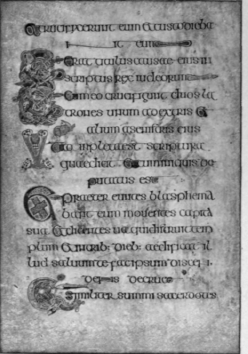
Ordinary Text In The " Book Of Kells.".
It is not difficult to account for the vast amount of labor expended on these works of art. In the first place, writings of any kind were in those days rare. Printing was not to revolutionize the world for centuries. The copyists also had abundant time at their disposal, and could spend days, if need be, on the illumination of a single letter. Then, too, they loved and reverenced their work. It was for them a pious duty to transcribe the sacred text, and they took genuine delight in rendering it as beautiful as possible. We cannot, therefore, be surprised at the value placed upon such treasures in the early centuries; for, even if one lacked the learning to decipher them, he saw at least their beauty, and looked upon them also with a superstitious reverence, as the words of God. Accordingly, they were often carried into battle by old Irish warriors, as aids to victory, and a single manuscript was sometimes offered and accepted as ransom for a captive king.
As we should naturally expect in a land, the piety of which was so renowned, and in an age, most of whose literature and learning centred in the monasteries, a large proportion of these writings have a religious character, and several are copies of the Scriptures. The longest of them, however, the "Book of Leinster," produced about the year 1160, contains in its four hundred and ten pages nearly one thousand Irish literary compositions, treating in prose and poetry of great historical events and popular romantic tales. Some of these parchments also are devoted to the study of medicine; for it appears to have been an ancient custom in Irish families to keep for consultation one or more manuscripts, in which the doctors of the time were wont to write, year after year, and generation after generation, the results of their experience. There is something pathetic in looking on these carefully traced words, and thinking of the painfully slow progress that they mark toward a correct interpretation of the laws of health. It is all the more pathetic because even now, so many centuries later and in the full blaze of scientific research and discovery, we see "How little we have gained. How vast the unattained ! " in finding suitable defensive weapons for the ill-matched struggle, forever going on between mankind and death, in which each victory gained by man is but a respite from his ultimate defeat.

A Bit Of Interlaced Ornament In The "Book Of Durrow.".

Where Copyists Used To Work, Castle-Dermott Abbey, Kildare.
Another thought suggested to me by these Irish writings was that the language of their script is practically moribund. Some things of value must exist in the old literature of a land whose institutions once drew to their halls students from Rome itself; and yet, so obsolete has that ancient tongue become, that much of the contents of those parchments is practically unknown. Only a few scholars now remain who can translate them, and even their number is steadily diminishing. As winter's glacial hand arrests the river's flow, and holds it locked in icy immobility, so has the chill of age crept over Erin's early language. Its flow of eloquence is checked. Its gems of literature lie concealed beneath the freezing mantle of neglect. Some Irish men and women, it is true, loyal to Ireland's past and to the Celtic tongue in which her poets wrote, are trying to revive its use, and even to make it obligatory in the public schools; but the great trend of modern life, like a huge, irresistible glacier, will doubtless crush out of existence these few tardy flowers of hope. The warmth of the young year will annually melt the fetters of a frozen stream, and send it singing on its way; but it is hardly probable that any vernal breath will ever wake to music the old speech of Ireland, or call to life again the spirit lying in its vellum shroud.
Continue to:


My Books

