


Ireland. Part 15
Description
This section is from the book "Ireland - John L. Stoddard's Lectures", by John L. Stoddard. Also available from Amazon: John L. Stoddard's Lectures 13 Volume Set.
Ireland. Part 15

The Museum, Trinity College.

An Unfettered Stream, Love Waterfall, Killarney.
But calligraphy was not the only fine art that prevailed in Ireland in those early days. Not far from Trinity College stands a handsome edifice known as the New Museum of Dublin. Within its walls are many objects of transcendent value, not only to the student of ethnology and archaeology, but to all visitors who take the slightest interest in specimens of gold and silver handicraft, which would in any age win admiration, but which are truly wonderful, when one considers the time and place of their production. The most remarkable of these is a sacred reliquary, called the Cross of Cong, designed, as its inscription states, to contain a portion of the true Cross. Fully to appreciate this masterpiece of early Irish art, one should examine this also with a magnifying glass. It consists primarily of a cross of oak, two and a half feet high, with arms that measure from one extremity to the other about eighteen inches. This oaken frame, however, is sheathed in copper, which is, in its turn, covered with a beautifully designed and exquisitely finished filigree of gold. Originally eighteen gems were set along the arms and shaft, thirteen of which remain in place, while in the centre is a large quartz crystal, covering a cruciform piece of wood, apparently much older than the rest. This, it is believed, is the relic of Christ's Passion for which the shrine was made. The archaeological interest of this reliquary rivals even its artistic value, for it is possible from its lettering to learn not only the approximate date of its production, but also the names of the patron who commanded it and the artisan who made it. Along the edges of the cross have been engraved five sentences, the first of which states in Latin:

The National Museum, Dublin.
"In this cross is preserved the Cross upon which suffered the Founder of the world."
The other inscriptions are in the Irish language, and request prayers for Turlough O'Conor, "the King of Erin for whom this shrine was made "; for the Archbishop and Bishop of Con-naught, under whose supervision it was constructed; and finally for Maelisu O'Echan, its artificer. The mention of these personages fixes the date of the work as being early in the twelfth century, probably in 1123 a. d.; for the ecclesiastics referred to are well known to students of Church history, and were connected with the beautiful Augustinian Abbey of Cong, where the cross which bears its name was reverently kept until the ruin and abandonment of the noble edifice. The last mitred Abbot of Cong subsequently found it in a chest of oak in a little cottage in the village of Abbotstown, where it had probably been placed by pious hands at the period of the Reformation, and where it had for more than two centuries lain concealed. Turlough O'Conor, by whose order the work was undertaken, was even better known than these Church Fathers, since he was one of the best and most renowned of Irish kings, his reign having lasted more than fifty years.

The Cross Of Cong.
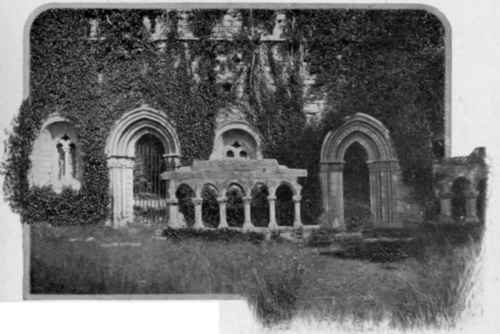
The Abbey Of Cong.
Difficult as it may seem, for those who have not investigated the subject, to associate such men and deeds with the early history of Ireland, it is nevertheless a fact that this illustrious monarch was called the Augustus of western Europe, and that he was distinguished for his culture and munificence, and for his patronage of art, especially where it illustrated and enriched religion. Of the artist himself, however, nothing but his name is known; and this has been preserved to us only because he inscribed it on his masterpiece, the last of all, humbly entreating those who looked upon his work to pray for him, as well as for the king and prelates. After all, it is of him that we think longest here. His birth, condition, history, the school where he acquired his skill, his death, his burial-place, - of all these we know nothing; but we are touched to find at the foot of this memorial of Calvary his name, as if his soul still lingered there in prayer. Nearly eight hundred years have passed since his deft fingers pressed the last gold spiral into place. The brain that planned, the hands that fashioned it, the eyes that probably grew dim at parting from the precious object of his toil, have long since mingled with the elements; but the fair reliquary, which no doubt sums up the work and aspiration of his life, has happily survived the storms of centuries almost intact; and in the centuries to come, when it will probably be treasured still more tenderly than in the past, each lover of the beautiful, as he thinks of Maelisu O'Echan, will answer his petition with the heartfelt utterance: May he rest in peace!
Continue to:


My Books

