


Ireland. Part 21
Description
This section is from the book "Ireland - John L. Stoddard's Lectures", by John L. Stoddard. Also available from Amazon: John L. Stoddard's Lectures 13 Volume Set.
Ireland. Part 21
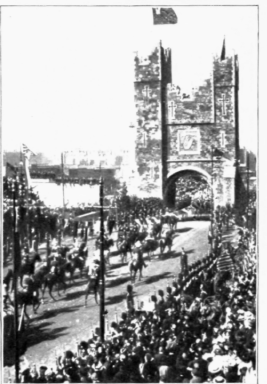
Iass1ng Beneath The Arch.

Where The Queen Lodged, Vice-Regal Lodge, Phoenix Park.
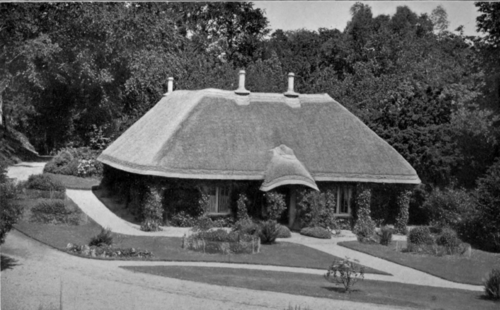
On Ross Island, Killarney.
The tour of the average traveler in Ireland comprises Killarney, Blarney Castle, Dublin, and the Giant's Causeway, with scarcely more than a day allowed for each. Even of these Dublin is apt to receive the least attention, and its vicinity none at all. Yet, in reality, the country lying within a radius of fifty miles from the Irish capital is thickly strewn with objects, which cannot be surpassed or equaled in any part of the world outside of Ireland. Among these are the cromlechs, - those ancient relics of the Celtic race, which add an interest to almost every portion of the island. These primitive structures, three hundred and fifty of which may still be seen, consist, in each case (where they have not been overthrown), of two or more upright stones, supporting an immense rock sometimes twenty feet in length and six in thickness. How these colossal blocks were brought to their positions and then elevated, is a question that presents itself to any one who looks at them and thinks how few were the appliances for such tremendous labor in those early days. As a rule, they stand on hilltops and suggest huge altars reared to pagan gods. They were, indeed, at first supposed to have been used, if not for human sacrifices, at least for solemn Druid ceremonials. Some of the rocks composing them are boulders, brought hither in that distant age when Ireland was covered with a sheet of ice which in its southward march ground down the mountains, grooved out valleys, and launched its hosts of icebergs on the deep, as Greenland's glaciers do to-day. Some bear strange marks upon their surfaces, as if they would reveal to us the secrets of the past, if we would only learn their language. Year after year, and century after century, they make the same appeal; but no one enters into converse with them. Men come and go; governments change; new faiths replace the old; but their mysterious coils and spirals still lie undeciphered, and children play among their moss-grown shapes where Druid priests performed the sacred rites connected with the burial of Celtic kings. For there is now no doubt that all these cromlechs were the tombs of royal or distinguished personages. Beneath their ponderous roofs have been discovered, in some cases, skeletons, in others urns of clay containing calcined human bones. From this it seems that both interment and cremation were practiced by the early Celts.
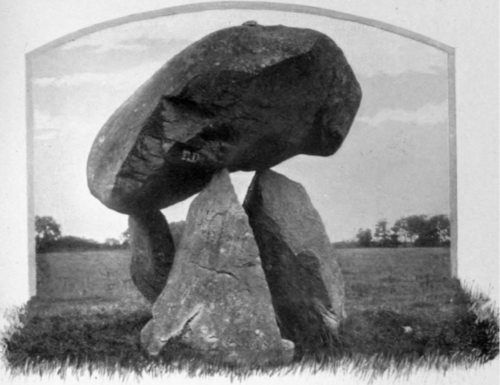
A Cromlech.
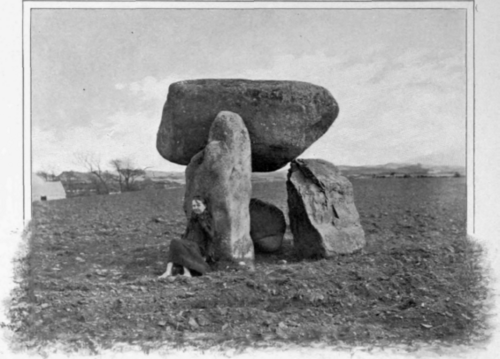
A Celtic Tomb, Newcastle.

Undeciphered Characters, Tyrone.
Far more elaborate, however, than the cromlechs, are the sepulchral mounds of Ireland. One of these at New Grange, easily reached from Dublin in a day, proved a most weird and interesting place. Leaving the jaunting-car which had brought me from the railway station a few miles away, I found myself confronted by what seemed to be merely an ordinary hill about seventy feet in height, covered with bushes, grass and trees. In reality, however, like the Pyramid of Cholula in Mexico, it is almost entirely artificial, and its green mantle covers an enormous cairn of stones, occupying nearly two acres, and estimated as weighing one hundred and eighty thousand tons.

The Great Stone Circle, New Grange.
Formerly a circle of thirty monster stones surrounded it, but all save twelve have disappeared. On reaching the entrance of this tumulus, I noticed that the huge stone threshold was carved with spirals, coils, and diamond-shaped figures in regular designs, which seemed like reproductions, on a gigantic scale, of the ornamentation wrought in gold filigree on some of the specimens of Celtic art preserved in the Dublin National Museum. A narrow passage, sixty feet in length and lined with enormous blocks of stone, enabled me to go, without much difficulty, to what I found by lamplight to be a rotunda, whose dome-shaped roof, about twenty feet in height, was built by means of slabs which overlap one another toward the centre, like a flight of steps. What most surprised me here were the mysterious carvings which the lamplight showed on every portion of the walls from floor to ceiling. Why were they wrought here with such care, when it was known they would remain in total darkness, without an eye to note their beauty or significance? The hieroglyphics in the secret halls and apartments of Egyptian temples, such as Denderah and Edfou, though never greeted by the light of day, were seen at least by priests as they passed through those corridors with lamps; but this old Celtic tomb was closed designedly forever; and, like the Pyramids, would probably never have been disturbed but for the sacrilegious greed of man. Did the devoted labor of those mound-builders spring from affection for the king who was to be buried here? Or did they hope that he would recompense them from the spirit world? The royal tombs of Egypt are immeasurably grander, and display decorations worthy of the art and civilization of the Pharaohs; but they resemble Celtic burial-mounds in this, that the motive for their construction was the same, - the old, old longing to rest undisturbed. Among the mighty ones of earth, in view of death, the dread of desecration has at times proved greater than the fear of being forgotten, and has caused their graves to be made both as secret and as strong as possible. It is, however, pathetic to recall how seldom this desire has been realized. "The Scipios' tombs contain no ashes now." Where is the body, where even the superb sarcophagus, of Alexander the Great? Whither did Father Tiber bear the ashes of the Roman emperors, flung by the Goths from the imposing Mausoleum of Hadrian? Even the Pyramids, the oldest, mightiest and most-enduring structures ever reared by man, could not retain within their chambers, hidden with such skill, the bodies of their royal builders. So, in this Celtic cairn, plundered by Danes eleven hundred years ago, no trace remains of him who was in all probability buried here with pomp and pageantry, characteristic of the Irish kings. Whether, indeed, it was the tomb of one king, or of many, who can tell? From its shrouded solitude there comes to us no whisper, even of a name.
Continue to:


My Books

