


Ireland. Part 20
Description
This section is from the book "Ireland - John L. Stoddard's Lectures", by John L. Stoddard. Also available from Amazon: John L. Stoddard's Lectures 13 Volume Set.
Ireland. Part 20
Happily, too, they now receive abundant recognition and appreciation. The recent visit of the Queen to Ireland was virtually an aged sovereign's personal tribute of thankfulness for Irish heroism in the African War. As such, it gratified her Celtic subjects immeasurably more than any gifts or formal thanks from a distance could have done. One of the many evidences of tact which she displayed on that occasion was her granting permission to all Irishmen to enjoy the "wearing of the green"; thus wiping out the memory of an era when, as an indication of hostility to England, it had been prohibited. Whether or not Saint Patrick made use of the three-leaf shamrock to explain to the pagan Celts the doctrine of the Trinity, that little trefoil is to Ireland what the thistle is to Scotland, and the rose to England. Accordingly, it was with the utmost satisfaction that Ireland learned of the Queen's recent order that the shamrock should be formally worn by her Irish soldiers on Saint Patrick's Day as an emblem of nationality. Apparent trifles often have great weight with ardent temperaments, and the fate of individuals and nations has sometimes been decided by a word of sympathy, or a fancied slight. Certainly the people of Dublin were immensely pleased that the first purchase made by the Queen, after landing on Irish soil, was a bunch of shamrock, which she carried conspicuously during her drive of six miles from Kingstown harbor to Dublin. I shall not soon forget the impression made upon me by her triumphal entry into the Irish capital. In the bright sunshine of that April morning the lovely Bay of Dublin presented an enchanting picture. The royal yacht, in which her Majesty had crossed from Wales, lay on the crisp, green water, like a gull at rest. The Wicklow Mountains cut their deep blue profiles sharply on a cloudless sky. The air was scented with the breath of blossoms, mingled occasionally with a briny fragrance, as the light breeze puffed inward from the sea. Thousands of people of all classes and conditions, who had been pouring into Dublin from various portions of the island, filled Kingstown's streets, and lined the entire route between the seaport and the capital. As I stood waiting in the throng, I felt no longer any apprehension as to the warmth of the Queen's reception. I must confess that, before leaving England, I had been fearful lest some insult might be offered her by bitter partisans. But from the moment of my landing I had seen how groundless were my doubts of Ireland's hospitality. The Irish seemed to have but one desire, - to give an affectionate greeting to their venerable sovereign. Particularly noticeable were the happiness and cordiality of the common people, and many were the evidences that I gathered of their ready wit.
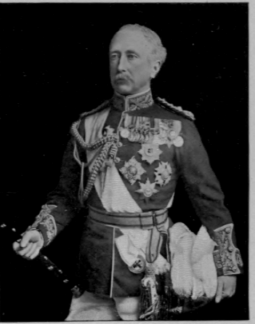
Lord Wolseley.
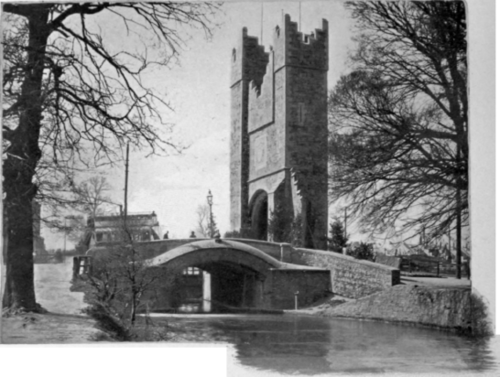
Arch Of Triumph For Queen Victoria, April, I9OO.
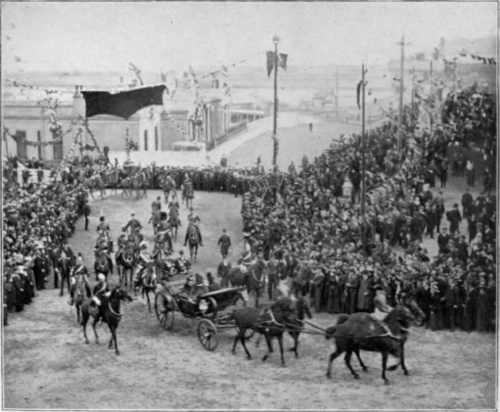
Leaving Kingstown Harbor.
"Are the hotels full ?" I had inquired of my cabby, on arriving in Dublin.
"Axin' yer lave, sor," he replied, "ye'd better save yer time and throw a few stones at a windy."
"What do you mean ?" I asked in astonishment.
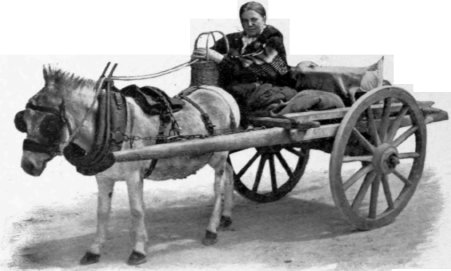
Going To Market.
"Well, sor," answered the driver, " ye'd get locked up thin, and that's the aisyest way to find a room in Dublin this night, Hiven be praised!" Close to the spot where I was standing, awaiting the Queen's coming, was an old woman, busily engaged in selling oranges.
For some time business had been good with her; but, as the crowd grew denser, she could not move about to offer her wares. " Kape back there, Mrs. Flanagan," shouted a policeman, good-humoredly; " her Majesty won't buy any oranges; she hates thim."
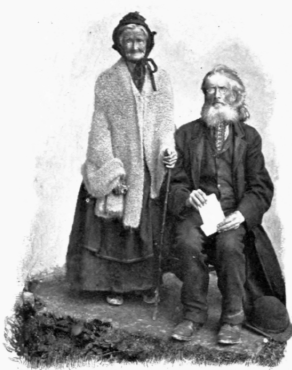
Come To See The Queen, Mother And Son.
"God bless her sowl," replied the old woman, " sure it's only the color of thim she hates. I wish I had some green oranges ! "
At last vociferous cheer-ing in the distance announced the coming of the Queen. I have seen royal advents which were more magnificent, but rarely one that left upon my mind such pleasant memories. The realization that the people round me were inhabitants of an island which had had little previous encouragement to give a hearty welcome to a British sovereign, made the enthusiastic shouts, the clouds of fluttering handkerchiefs and waving hats, and the unfeigned excitement, reverence, and pleasure depicted on innumerable faces, one of the most remarkable public spectacles I ever looked upon; and when, in presence of the gracious lady, so lightly crowned with more than fourscore years, that multitude of Irish men and women began to sing the national anthem," God save our Noble Queen," there came a sudden choking in my throat at thought of the reconciliation of the two peoples, and for a moment I could not join in the grand old harmony, upon whose volume the royal carriage seemed to move along, as on a tidal wave of sound. The fact that not a single act of incivility marred this reception, together with the grand display of loyalty afforded by the Irish troops in Africa, are cheering signs of happier relations between the sister-islands. The " terrible Celtic memory " seems to have been disarmed by the recently adopted means of confidence and kindness; and at the dawn of the twentieth century we see a new significance given to the proverb: "England's difficulty is Ireland's opportunity"; for the old motto has been completed, not with the words, " to do her injury," but with the nobler utterance, "to give her aid."
Continue to:


My Books

