


Ireland. Part 23
Description
This section is from the book "Ireland - John L. Stoddard's Lectures", by John L. Stoddard. Also available from Amazon: John L. Stoddard's Lectures 13 Volume Set.
Ireland. Part 23

An Ancient Celtic Copper Cauldron.
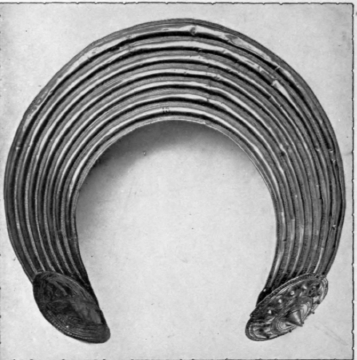
An Old Celtic Necklace.

The Tara Brooch.
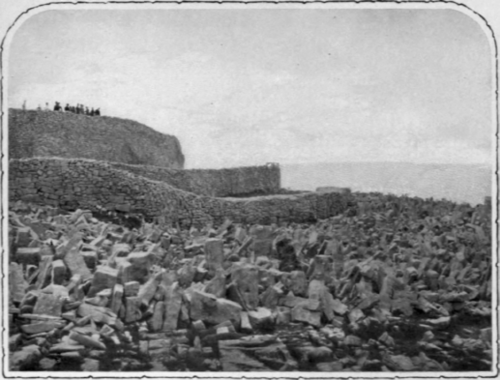
Ancient Celtic Fortress, Aran Islands.
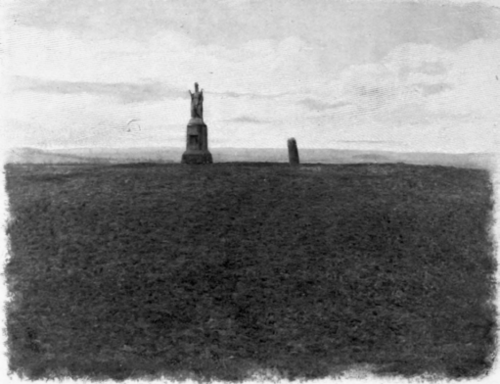
Tara's mysterious stone.

Ancient Celtic Fortress, Interior.
On one of the mounds that crown the Hill of Tara stands a statue of Saint Patrick, which, though possessing little value as a work of art, recalls a memorable episode. It was on Easter morning, in the year 428 a.d., that Saint Patrick came here to the Court of King Laegaire, to expound the Christian faith before the Irish sovereign, his chiefs and courtiers, and the Druid priests. The Saint and his assistant missionaries are said to have advanced into the royal presence, arrayed in white, and carrying crosses in their hands; and such was the impression produced by their appearance and their words that, notwithstanding the opposition of the pagan priests, Laegaire permitted them to preach the new religion through his kingdom. Close by the statue of Saint Patrick, which is of recent origin, stands a mysterious stone, possessing great antiquity. It is a roughly shapen monolith, undoubtedly connected with the early history of Tara. In fact, Professor Petrie, the distinguished Irish archaeologist, who devoted his life to the study of Celtic antiquities, believed this to be the famous "Stone of Destiny," on which for many generations the kings of Ireland were crowned. We know that there was such a stone, and if the supposition of Professor Petrie be correct, it would be hard to over-value this souvenir of Irish sovereignty. The customary belief, however, is that the original stone was removed from Tara to Scotland in 503 a.d., to solemnize the coronation there of the Irish prince, Fergus, who then became the first king of Scots. It is further believed that this remained in Scotland more than seven hundred years and was the block on which all Scottish sovereigns were crowned; and it is well known that, in 1297, it was taken by King Edward I. to
London, where it has ever since been used in the coronation ceremonies of all
English monarchs, and where it still rests under the Coronation
Chair in Westminster Abbey. If, then, the Irish stone was actually removed to Scotland, as seems to me most probable, the lonely monolith on Tara Hill is not the "Stone of Destiny."
It is impossible, however, to regard it as an ordinary ob • ject. Its soli-tary situation, shape and size prove that it must have played some part in Ireland's history, even if not so prominent a one as that connected with the crowning of her kings. Standing erect, as it now does, I could but fancy it a nameless monument marking the tomb of Erin's former greatness, which has been buried here for fourteen hundred years. Hence, as I stood beside this mute memorial of departed glory, I realized, as I never could have done elsewhere, the pathos of Moore's touching lines:
"The harp that once through Tara's halls The soul of music shed, Now hangs as mute on Tara's walls As if that soul were fled.
" No more to chiefs and ladies bright The harp of Tara swells; The chord alone, that breaks at night, Its tale of ruin tells."
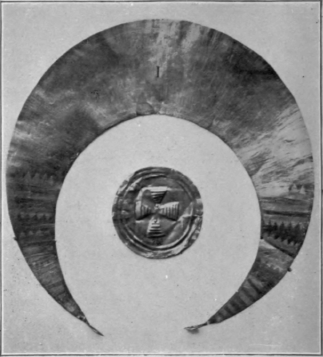
Old Celtic Head Ornament And Clasp.
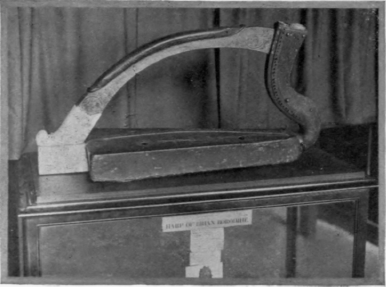
Harp Of King Brian Boru.
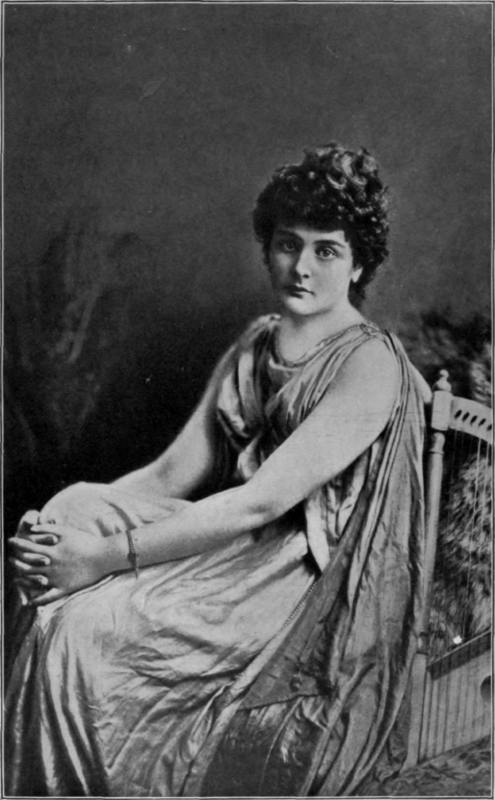
Erin.
When I first read these words, I thought the allusion to the harp was merely symbolic, either of music in general or of Celtic minstrelsy, and hence attached no special importance to harp has played in Erin's history. There is no doubt that Ireland early became famous as a musical country, and that her teachers of music were solicited to give instruction in foreign lands. Thus, in the seventh century, two Irish monks taught music in the convent of Nivelle in Belgium; and at a later date the cloister schools of Saint Gall, Switzerland, were trained in music by an Irishman, until their singing became celebrated. But it was for their skill in playing on the harp in Ireland's feudal castles that her musicians were especially renowned. A writer of the twelfth century states that the Irish harpers of his time were " incomparably more skillful than those of any nation he had ever heard." As recently as one hundred and fifty years ago, Ireland still retained her supremacy in this respect, and students of the harp in Wales and Scotland went, as a matter of course, to take their finishing lessons of Irish masters.
Continue to:


My Books

