


Ireland. Part 24
Description
This section is from the book "Ireland - John L. Stoddard's Lectures", by John L. Stoddard. Also available from Amazon: John L. Stoddard's Lectures 13 Volume Set.
Ireland. Part 24
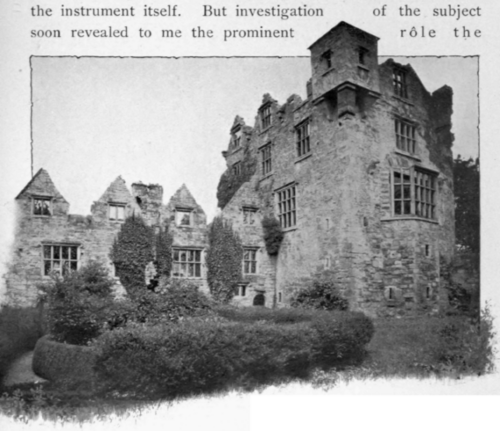
Donegal Castle, The Home Of The O'Donnells.
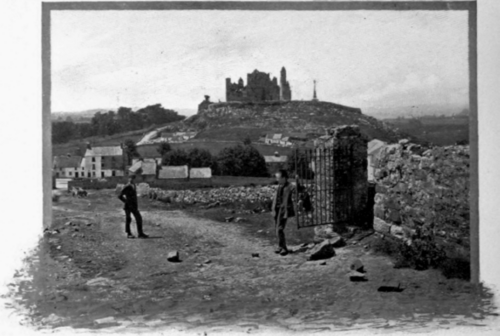
Rock Of Cashel, Residence Of The Kings Of Munster.
The Celtic harpers did not play, originally, merely for money and applause. Their work was serious and important; for they were then the recognized national bards, who, through their close association with the Druid priesthood, were universally reverenced and feared. In fact, the chief bard stood at one time next in importance to the king himself; and even as late as the sixteenth century the malediction of a bard was something to be dreaded and avoided at almost any price. In later years, however, their songs assumed a more political character; and as they traveled through the land, from Court to Court and festival to festival, singing the ancient lays descriptive of the exploits of their race, they stimulated those who heard them to such an ardent love of country and heroic deeds, that they were regarded by the country's conquerors as spies, informers and fomenters of rebellion. Accordingly, these wandering bards were finally driven from place to place and persecuted, until they practically disappeared. About a century ago, however, a few survivors of the order were discovered and brought before a patriotic musical assembly in Belfast. These aged men, on that occasion, decided to name some one who should succeed them, at least nominally, and be the recognized guardian of the harp of Ireland.
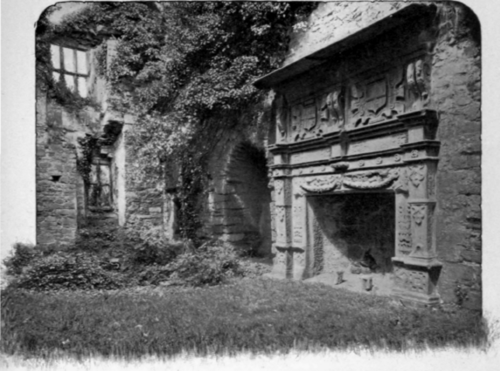
Where Erin's Minstrels Sang, Donegal Castle.
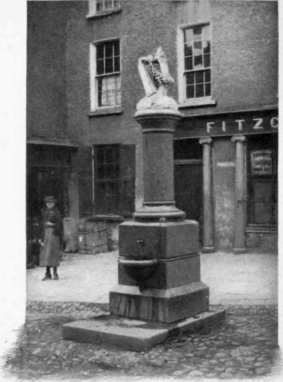
A Harp-Crowned Fountain, New Ross.
They naturally chose for this ideal post her sweetest singer, Thomas Moore, whose beautiful and pathetic "Irish Melodies" (set to old Irish airs, in many cases so ancient that both the authors' names and the dates of their composition are unknown) will live and quicken the emotions as long as English literature exists. Appropriately is the harp emblazoned on the flag of Ireland. Apart from the traditions that endear it to her race, it is an emblem of which any nation might be proud. The harp was one of the earliest of stringed instruments, and has suggested many more. What is the piano but a harp enclosed? It originated one of the most exquisite movements in musical composition, the arpeggio. In its simpler form of the lyre, it served as the distinctive badge of some of the greatest gods and heroes of mythology. For ages it has been associated with the highest exponents of music, poetry and religion. The hands of Orpheus and Apollo swept its strings. David, the King of Israel, was its master. Homer, the Father of Poetry, as delineated in sculpture, often holds it in his hands. We find it represented in mural pictures in the The-ban tombs of kings. It is carved on some of the oldest Celtic crosses, as a sacred emblem. The painters of the Renaissance depicted many of their angels using harps as accessories to their adoration of the Madonna and her Child; and in the Bible's portraiture of Paradise it is upon the harp that many of the heavenly host accompany their solemn chanting to the Deity. Who has not sometimes marveled at the recklessness and waste of Nature? When, in the spring, the soft winds and warm rains, attendant on the northward moving sun, have wooed to life again the dormant powers of vegetation, and leaves and buds have sprung forth at their ardent call, who has not seen a freezing blast turn suddenly the vivifying rain into a winding-sheet of ice, and in a single day transform what was so fair and promising into a blackened ruin? Or, in the fall, who has not felt disheartened and perplexed to see excessive rains spoil splendid harvests ready to be garnered, and bring to naught the output of the entire year? A similar feeling saddens one who looks back at the Golden Age of Ireland. There was a time when she seemed likely to excel, in learning, piety, and culture, all the rest of northern Europe.
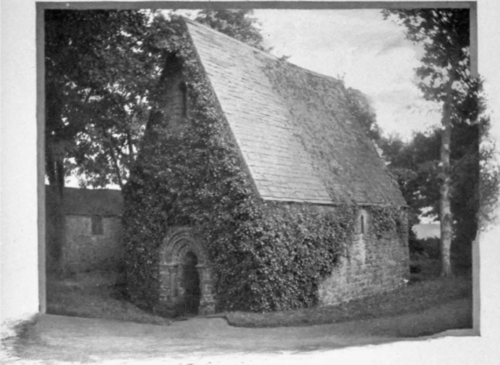
ST. finnian's oratory, killaloe.
During the sixth, seventh, and eighth centuries, especially, this farthest boundary of the Continent held aloft and kept aflame the torch of Christian faith, and glittered like a star upon the dark horizon of the western world. Its hills and valleys were adorned with countless churches and monastic institutions, from which enthusiastic missionaries, burning with the zeal and rapture of new converts, crossed the seas, and preached the Gospel to the pagan tribes of Scotland, England, Germany, and Gaul. Churches were founded by Irish monks in the Black Forest, at Schaffhausen in Switzerland, and at Wurtzburg in Bavaria; and of the students who received their education in the Irish monasteries, free of cost, thousands on returning to their native lands brought back with them the influence and learning of this " Island of the Saints." Even so cautious and reliable an historian as Green, in his " Short History of the English People," says: " For a time it seemed as if the course of the world's history was to be changed; as if that older Celtic race which the Roman and German had swept before them had turned to the moral conquest of their conquerors; as if Celtic and not Latin Christianity was to mould the destinies of the Church of the West."
Continue to:


My Books

