


Ireland. Part 30
Description
This section is from the book "Ireland - John L. Stoddard's Lectures", by John L. Stoddard. Also available from Amazon: John L. Stoddard's Lectures 13 Volume Set.
Ireland. Part 30
One thinks, too, as he stands beside these old millennial crosses, of the aching hearts to which they have been as the shadow of a great rock in a weary land. How many tears of penitence have been poured out before them, and how much sorrow has been solaced there! How many scenes of crime and horror also have they witnessed in Scandinavian conflicts, and in civil and religious wars, while the stars looked down in silent pity for man's weakness, and the wind moaned sadly over the blood-stained fields! The rains of centuries, however, have washed from them all traces of men's sin and suffering; the snows have drifted down and clung to them, winter after winter; the sun has warmed, the night has chilled them; and thus the elements have labored to reduce to the original dust these sculptured bits of the old earth. They have been partially successful. In many instances the figures chiseled on their surfaces have well-nigh disappeared, although the cross itself remains. Is this symbolic of the fact that, while with time the superficial differences in theological beliefs diminish, that which is essential still survives? What is indisputable is the fact that the old crosses are inevitably crumbling into elemental dust. The sharpness of their once distinctive features is gradually softening to the base line, and presently only the simple shape will be discerned, its limbs united yet, perhaps, by the unbroken circle. Then this, too, will disintegrate, and chaos may again claim every grain and crystal of the stone. But in the universe there is no pause. Another world will be evolved from this world's ruins, and the strange story of awakening life and consciousness, with its slow progress, mental, moral and spiritual, will be told once more; and so, perhaps, will a new Ireland be born again, to live in a far happier incarnation, with better opportunities and a kinder fate.
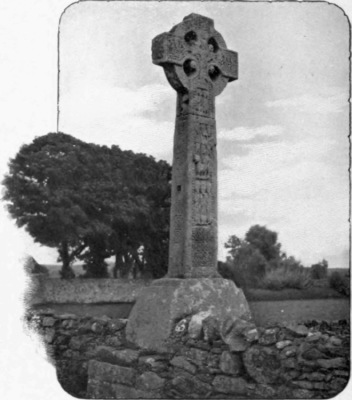
Cross At Drumcliffe.

Consolation, Kilbroney Cross.

Old Cross On Rock Of Cashel.
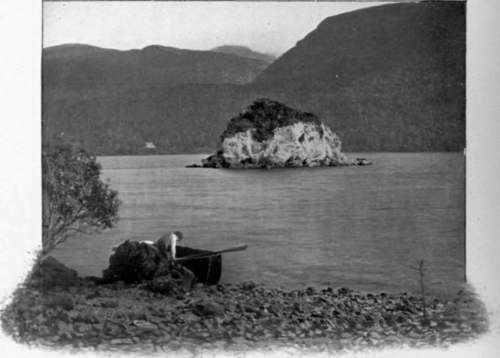
The Middle Lake, Killarney.
A comfortable train conveys the tourist now in four and a half hours from Dublin to Killarney's far-famed lakes, whose crystal waters have few equals. Enchanting as the region is, it is nevertheless unfortunate that the majority of travelers seem to regard it as so much more beautiful than any other part of Ireland, that the remainder is not worth exploring. A greater error could not well be made; and now that traveling conveniences are so much improved in Ireland, and good hotels are found in most of the attractive regions, this notion will soon be dispelled, and tourists will no longer speak of fair Killarney as if it were the alpha and omega of fine Irish scenery. Wherever looked upon, that scenery is unmistakable. Bring back to it, blindfolded, on a magician's carpet, any one who has once reveled in its beauty, and when he is seated on the turf that makes the ground an emerald rug, remove the bandage from his eyes, and ask him where he is, and he will make but one reply. For, as he sees the pure blue atmospheric veil that softens the horizon, blending earth and sky; or views the mountains mantled with the heather's royal purple or notes the laughing river at his feet tenderly twi-lighted by overarching trees; or follows with his vision miles of hedges radiant with blossoms; or traces the entire landscape's undulating background lined with glossy ivy, golden gorse, or glistening laurel; he will not for a moment doubt that he is in the fairest of the three united kingdoms - Ireland. What has not nature done for Erin, and what has not man done to make these gifts of nature null and void? These were the words that rose continually to my lips as I rode on, day after day, through fields that are forever green, by streams that seem to sing for joy, or in the shade of trees which Druids would revere, were the old pagan faith still extant in these peerless glens.

A Characteristic Irish Valley, Ovoca.
What musical names many of Ireland's rivers, villages and valleys have! The Vale of Clara, the Vale of Ovoca, Glenda-lough, Avonmore, Killarney, Adare, Lisdoonvarna, - these, and a hundred others, spoken softly and usually with an unexpected accent, are as melodious as any names in Italy. Measured by the standard of pounds, shillings and pence, Killarney is by no means wealthy, but as a depository of some of nature's choicest treasures it is a Golconda. Happily lovely scenery is a possession of which even Ireland cannot be deprived; and in these days of popular travel, when so many tourists seek the beautiful in nature, a famous landscape often brings more money to a country than a manufactory. Millions of dollars annually flow into Italy because of her artistic and historical attractions, and Switzerland is substantially supported by those who every summer scatter gold and silver with a lavish hand throughout that little paradise which man and nature have combined to make the pleasure-park of half the world. Killarney, though of course less prosperous, owes practically all the revenue it does receive to visitors; and it is safe to say that were it located in England, or on the Continent, the number of these tourists would be quadrupled. A more ideally beautiful situation for a private residence could hardly be imagined than that of Kil-larney House, the Irish home of the Earl of Kenmare. The spacious ivy-mantled house is an imposing mansion, lovely without and sumptuous within. Before it lie elaborate gardens with a luxuriant display of flowers, while, beyond these, the eye, enchanted with the matchless view, strays lakeward over a magnificent park, as well-kept by man's care, as it is glorious through nature's bounty. A charge of sixpence is very properly made for admission to these grounds, the view from which can never be forgotten; but even sixpence is a prohibitive price to most of the poor natives of the district. In fact, the contrast here between the rich and poor disturbed my happiness not a little. I grudge to no man living a reasonable amount of real estate, but there is something radically wrong when one man can enclose and keep from cultivation square miles of fertile territory, while, just outside his gates, in one of the loveliest sections of the earth, such poverty exists that the population of the village between 1881 and 1891 fell from 6651 to 5510. Something assuredly should be changed when in a thinly populated country thousands of able-bodied men and women, unwilling to be drones and yet unable to earn a livelihood, go yearly from the land they love across the seas. Such emigration is like an open wound, from which the nation's freshest life-blood ebbs away. It is precisely what is poorest and least energetic "good morning, your honor." that remains. Nor can one quite forget among these charming scenes that this is a corner of the land where thousands upon thousands have, within sixty years, died literally of starvation. This makes one patient under the annoyance of the beggars at Killarney. For, though less common than it was a score of years ago, begging is met with oftener around these lakes than anywhere else in Ireland, and constitutes a serious drawback to the traveler's enjoyment. Yet Irish wit goes far to reconcile one to a mendicant's persistency. "Will yer honor drop a sixpince into this Amirican hat? " said a Killarney beggar to me, as he held out an old derby full of holes.
Continue to:


My Books

