


Ireland. Part 31
Description
This section is from the book "Ireland - John L. Stoddard's Lectures", by John L. Stoddard. Also available from Amazon: John L. Stoddard's Lectures 13 Volume Set.
Ireland. Part 31

Ross Castle, Killarney.
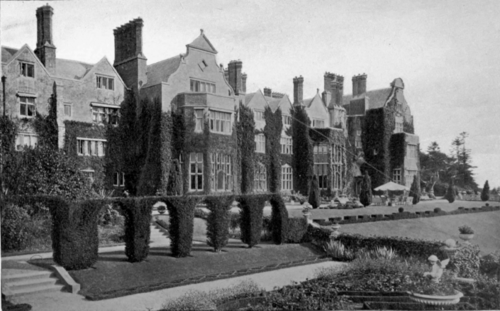
Killarney House, Residence Of The Earl Of Kenmare.
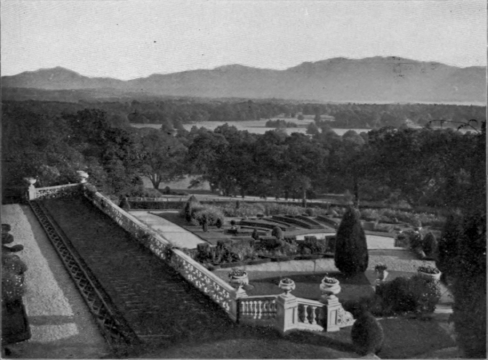
View From Killarney House.

The Industrious Poor.

"Why do you call it an
American hat? " I asked. " Sure," was the reply,
"because there's no Crown in it."
Sometimes a sharp refusal calls out from Irish beggars a biting, though a bright, response.
" You ought to ask for manners, not money," said a traveler to one who had addressed him somewhat brusquely.
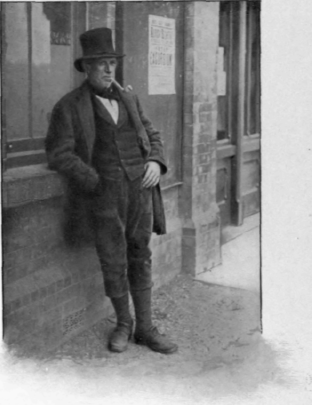
You Will Laugh When He Speaks.
" Faith, I axed for what I thought yer honor had the most of," was the instantaneous reply.
It is hard to explain the prevalence of "Irish Bulls " among a people so indubitably bright and witty; but they are probably the result of mental stumbling. The Celtic wit runs on so fast that it escapes from the control of judgment. If wit is caused by the unexpected association of ideas, an Irish Bull is made by their preposterous association. A dozen instances of this illogical drollery will occur to every reader, but none perhaps will illustrate it better than the Irishman's remark on reading on a tombstone the words: " I still live."
"Bigorra," said Pat, " if I were dead, I'd own up to it."
Such blunders are sometimes perceived and laughed at by their perpetrators, when they have time to think of them. But they may also be unrecognized until a penalty has been paid, as in the case of the two Irishmen who asked how far it was to Dublin. "Twelve miles," was the reply. "Come on," said one of them to his companion;" it's only six miles apiece. Let's walk."
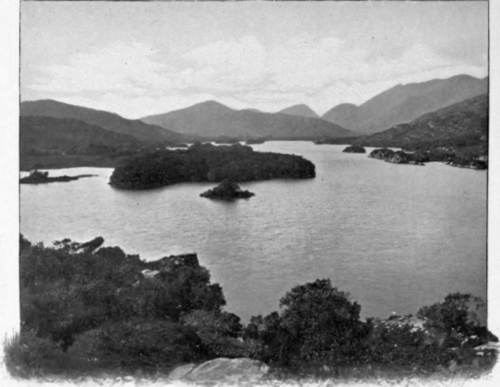
The Upper Lake, Killarney.
Perhaps it was my fault, but I could never quite satisfy myself as to the meaning of the following police regulation, conspicuously posted in the North of Ireland:
"Until further notice every vehicle must carry a light when darkness begins. Darkness always begins as soon as the lamps are lit."
Moreover for several days I saw displayed in a shop window, unchallenged and unchanged, the remarkable notice:
" Our superior butter, ninepence per pound, No one can touch it."
Sweet beyond words are the hours that one spends in floating on Killarney's trio of bewitching lakes, in whose clear waters seems to sleep the replica of all that captivates us in that upper world. Deep are the draughts of peace and pleasure that one takes, as from his boat he looks off on the heath-ered hill-land, aspiring toward summits which continually change, chameleon-like, through shades of purple, blue and gray. Soothing to tired nerves is the soft ripple at the prow or the light dripping of the oar, as one is rowed among the islands covered with arbutus, green in the summer, gemmed with scarlet berries in the fall. Solemn and memorable also are the moments passed in Muckross Abbey, for whose grand yew-tree, wedded now to Time by centuries of slender rings, I always shall retain a tender feeling, because on my initial trip to Europe this was the first old ruin that I saw. What shall I say, too, of the Isle of Innisfallen, as charming in its scenery as it is musical in name ? I can recall few more delightful hours than those enjoyed upon that little wave-encircled garden of green lawns, luxuriant flowers, and bright holly, above which rise a multitude of noble oak and ash trees. I sympathize with the Celtic Druids in their love and reverence for trees. Great groves of stately oaks are said to have formed their temples, and while they worshiped the oak as a representation of the Deity, they taught that the mistletoe, growing on it, symbolized man's dependence upon God. To me the most attractive object in the vegetable kingdom is a majestic tree. Nothing, I think, exists more exquisite in coloring than an apple-tree in bloom; nothing more graceful than an elm, nobler than a rugged oak, or kinglier than a Norway pine. A country without trees is as unpleasant to look upon as a face devoid of eyelashes and eyebrows. Ireland ought to be one of the most richly wooded countries in the world, and despite much that man has done to injure it in this respect, the Emerald Isle still wears its leafy crown. The trees of Innisfallen would of themselves suffice to make the island linger in the memory; but in addition to its natural beauty, the ruins of an ancient abbey give to it a human interest, and perfectly complete its charm.
Continue to:


My Books

