


Ireland. Part 33
Description
This section is from the book "Ireland - John L. Stoddard's Lectures", by John L. Stoddard. Also available from Amazon: John L. Stoddard's Lectures 13 Volume Set.
Ireland. Part 33
Between Killarney And Glengariff.
The scenery around Bantry Bay is a mild introduction to the bolder views which characterize the western coast of Ireland, for it unites the two distinct and widely different types of Irish landscape: that of the coast and that of the interior. Both possess features that I have never seen equaled in any quarter of the globe. Beauty, surrounded by sublimity, would be a concise and truthful description of the island. Nowhere has Earth surpassed in peaceful loveliness some of Ireland's valleys, and no- where else does she display such a stupendous battle-ground of land and sea as on its western rim. Erin's "emerald " has a magnificent setting. Around its edge a range of mountains, sometimes twenty miles in width, almost encloses it, outside of which is the indented shore, cut by the ocean's bold artificers into a frame that is in sunshine beautiful, in storm sublime. There was a time when these unrivaled headlands were difficult of approach, and when the tourist, even if he knew of them, was not disposed to pay the price of dirt, discomfort and fatigue in order to behold them. That time has passed away. Railways, extended from such cities as Galway, Limerick, and Sligo, now convey the traveler to good hotels in the vicinity of the finest points, whence one can walk or drive to the bluffs themselves. But, not content with viewing them from the land, were I a yachtsman, my first cruise would be around the Irish coast, in order to examine leisurely its wonderful formation. For, through unnumbered ages, the Atlantic's billows, with an unchecked impetus of thousands of miles, have been engaged in beating into a fantastic fretwork monster cliffs, which it would seem no violence of wind or wave could possibly affect. A glance at even an ordinary map of Ireland shows how its western edge bears traces of this conflict with the elements. Wherever the sea has found a weak spot in the island's bastions, it has made a breach, and forced its waters through it, widening the gap, and forming what are here called "bays," although a more appropriate name would be fjords.
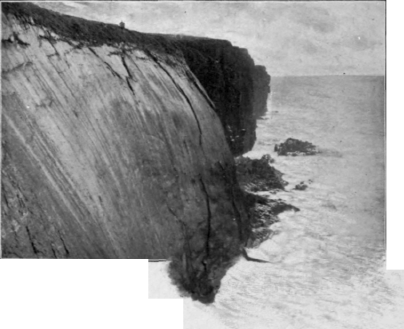
Loop Head, County Clare.

In County Galway.
Even where the rock formation has been firmest, the impact of the sea has wrought incalculable injury; sometimes detaching masses from the mainland, to gradually gnaw them into tiny archipelagoes; at other times undermining mountain walls with caverns, in whose gloomy solitudes the billows shout in anticipation of the day when the entire precipice will fall. At other points the waves have carved colos-sal prototypes of man's best architectural achievements. Towers, spray-swept and glittering in the sun; huge, solitary monoliths whose ledges are the homes of countless screaming birds; arches surmounting chasms white with flying foam; cathedrals where the winds and waves chant weird responses in an unknown tongue; vast, empty amphitheatres haunted by the spirits of the storm; fragments of detached cliffs, worn by the waves to table-lands which rise from out the seething flood like altars reared to gods, who, like their lights and worshipers, are gone forever; and temples, whose long, narrow aisles are paved with the pure sapphire of the sea: these and a thousand other forms encompass Ireland in infinite variety and awful majesty. To give detailed word-pictures of the scenes presented, especially after a tempest, on the Cliffs of Moher, by the shores of Clew Bay, and in Connemara, would require a volume. They seem innumerable, because at every turn the panorama changes, and even the same view assumes a different aspect under a clear or clouded sky. At times, as I advanced, each vista in succession seemed to me more marvelous than the last, until the cumulative splendor crushed me into silent awe. Though the materials that compose these scenic pictures are but few in number, and invariably the same, - rock, sea, and sky, - to criticise their paucity would be like finding fault with the small number of notes that form the scale. In either case it is the wonderfully varied combinations of these elements that give to eye and ear the realization of the beautiful or the sublime. Nor do these scenes, because of their great number, leave a confused impression on the mind. They are sufficiently unlike for each to reproduce under the lens of memory its special individuality; just as the Milky Way, which to the naked eye seems nebulous and uniform, resolves itself beneath the telescope into a zone of countless, separate and brilliant suns.
Continue to:


My Books

