


Ireland. Part 34
Description
This section is from the book "Ireland - John L. Stoddard's Lectures", by John L. Stoddard. Also available from Amazon: John L. Stoddard's Lectures 13 Volume Set.
Ireland. Part 34

Temple Arch, Horn Head.
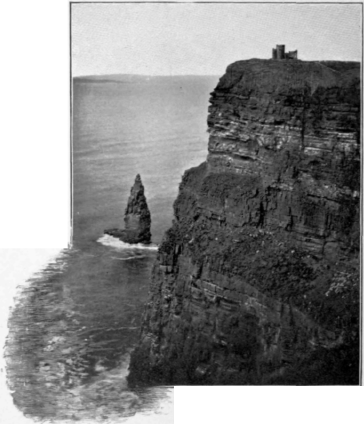
On The Moher Cliffs.
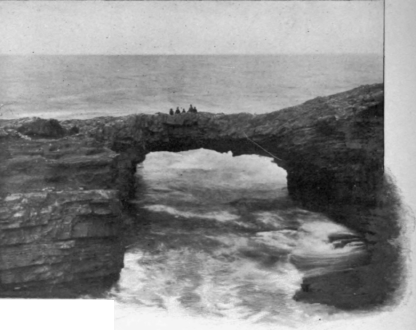
A Sea-Sculptured Bridge, Kilkee.

The Giants Causeway.
If Wind and Water are the agents that have carved out Ireland's western coast, upon its northern rim another element has left its mark. As if determined not to be surpassed here by these rivals, Fire, at one time, poured upon a corner of the island molten lava, and pressed upon it a majestic seal which will endure until the isle itself has passed away. Water and Wind are still at work in carrying out their plans; Fire concluded his task thousands of years ago, and then withdrew, leaving the world to marvel evermore at his mysterious cartouche, known as the Giant's Causeway. This wonderful phenomenon will either delight or disappoint the visitor, according to his previous conception of it. Those who anticipate stupendous headlands, shattered by the sea, will find the Causeway tame, and time will be required before appreciation can replace the first surprise of disillusion. It should be, therefore, borne in mind that in general the Causeway is to be looked down upon, not up to. It is, as its name indicates, a path, and this particular pathway is a mighty platform of basaltic columns extending seaward from the base of neighboring cliffs, and disappearing northward under the Atlantic. Nevertheless, no traveler, whatever may have been his expectations, can fail to be profoundly moved by the immensity and marvelous formation of this columnar mass. Here are no less than forty thousand pillars, fitted together into a vast pavement, the joints of which are so exact that neither falling rain nor beating billows can find space for penetration. The more these columns are examined, the more remarkable they appear. Not only are they fashioned into pentagons and hexagons of perfect geometrical construction, but they are also divided into sections like a bamboo rod, each with a convex surface joined with the utmost nicety to the concave meeting it. Moreover, as if to show her versatility, nature has made here a few special blocks, with nine or seven sides. There are also, in the entire multitude, one column with three sides, one with four, and one with eight; the latter being called the Keystone of the Causeway. In places this volcanic platform is irregular in height, as if an earthquake wave had passed beneath it, leaving it fixed in undulations, never to subside. In general, however, it suggests the mosaic floor of a gigantic temple, the roof and walls of which were never finished or have disappeared. One feels this still more strongly when one goes a little inland, and finds the same formation reaching greater heights. For on the cliffs, as well as on the plain, the molten lava, shrinking as it cooled, produced with no less geometric skill and accuracy groups resembling amphitheatres, chimney-tops, and organ pipes, or massive walls between which one can walk as through the roofless halls of Karnak. Standing upon this pavement, laid so many ages ere a human foot was pressed upon its surface, the unseen was to me more marvelous than the seen. For, far away across the water, off the coast of Scotland, lies the island of Staffa, pierced by the far-famed Fingal's Cave.

The Causeway Gate.

Geometric Blocks.

Chimney-Tops, Great Causeway.

Where Smuggling Is Easy.
That cavern (see the Scotland Lecture, Vol. IX.) is lined with just such igneous columns as those upon whose tops we walk in traversing the Giant's Causeway. The latter disappears beneath the ocean in the direction of that island eighty miles away. It is well-nigh certain, therefore, that on the shores of Ireland we see one end of this basaltic viaduct, the other end of which is visible at Staffa. The intervening portion, like an ocean cable, has sunk into the sea. Pathetic symbol of the fate of Ireland ! The natural bond uniting Erin and Great Britain was long since overwhelmed by the rapacious waves of jealousy and passion; and though we see to-day the corresponding termini, the path of union has been lost.
Continue to:


My Books

