


Ireland. Part 4
Description
This section is from the book "Ireland - John L. Stoddard's Lectures", by John L. Stoddard. Also available from Amazon: John L. Stoddard's Lectures 13 Volume Set.
Ireland. Part 4

Kilkenny Castle.
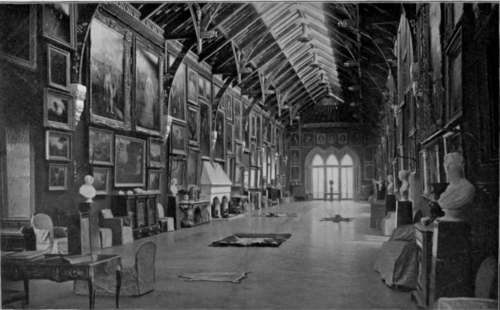
Picture Gallery, Kilkenny Castle.

Shane's Castle.

A Low-Back Car.

Ready To Emigrate.

Grey Abbey, County Down.
It makes one sick at heart to read of the atrocities committed on both sides, either in the fanaticism of misguided zeal, or in the fury of retaliation. Moreover, to dwell upon such dreadful scenes as those of the siege of Londonderry and Cromwell's massacre at Drogheda, is worse than useless. Both Protestants and Catholics are now emancipated from their disabilities, and any repetition of such cruelties is no longer possible. Not only in Ireland, but everywhere, a spirit of toleration for all creeds, and in some instances even a spirit of fraternity among religions, have virtually created a new heaven and a new earth. The Catholics of Ireland to-day admire much that the Protestant Government of Great Britain stands for in the world, and are not only-loyal subjects of her Majesty, but also brave defenders of the Empire; while English Protestants in their turn render homage to the Catholic soldiers, scholars and statesmen that Ireland has produced, and gratefully acknowledge that much of the Christianity of their island was brought to it by Irish monks, who hastened thither to revive a faith which had almost expired there. Among the many hopeful signs of Ireland's brighter future I find none more encouraging than the fact that on its soil the blessing of religious freedom has been gained at last; and if one shudders at the long and bloody struggle it has cost, let him remember that it is apparently a universal, though mysterious, law, that man is powerless to produce anything permanently good or beautiful, unless he pays with death or suffering for the triumph of his dream.

Old Irish Cross And Tower, Lough Erne.

The Same Faith Still.
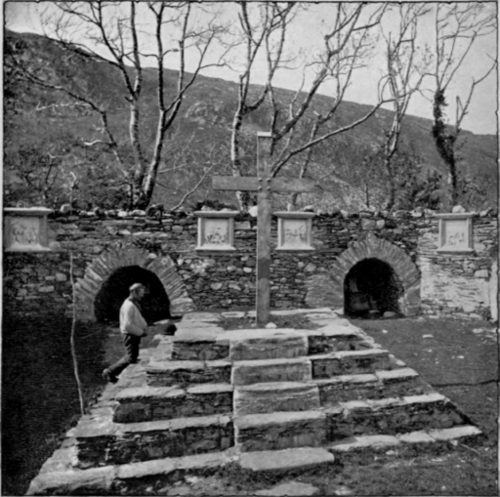
A Hallowed Shrine.

The Treaty Stone, Limerick.

The passage of the Irish Sea from Holyhead to Dublin no longer excites the horror that it once inspired. Four powerful, twin-screw steamers make the- transit in all weathers, every day and night, the whole year round, the usual time of crossing to Kingstown, the port of Dublin, being two and three-quarters hours. The Irish express from London runs directly to the steamer's side at Holyhead, and the instant that passengers, mails, and luggage have been transferred from rail to boat, the ocean greyhound's leash is slipped, and off it starts at full speed on its westward run of fifty-three miles. Built for encountering the roughest seas, these stout mail steamers of the Dublin Packet Company are nearly four hundred feet in length, with engines of nine thousand horse-power, plenty of deck room, luxurious cabins, and attentive servants. A practical illustration of the average Englishman's ignorance of Ireland was given me during a voyage in one of these boats across the Irish Sea. Seated beside me on the deck were three rather elderly gentlemen bound for Dublin to attend an archaeological convention. They were evidently men of education, and one of them was congratulated in my presence on some honor recently conferred upon him by the Queen. Yet, when one of the trio asked his companions what the distance was between the English and the Irish coasts, both were unable to tell him; and he himself remarked: "Well, I too haven't the least idea how far it is."
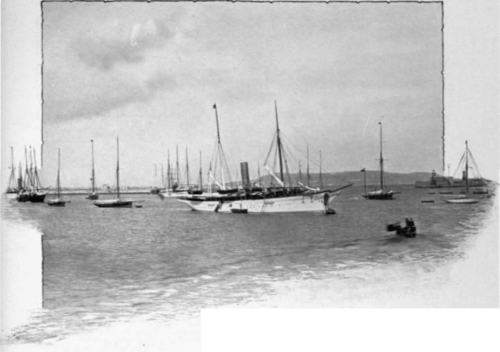
Kingstown Harbor.
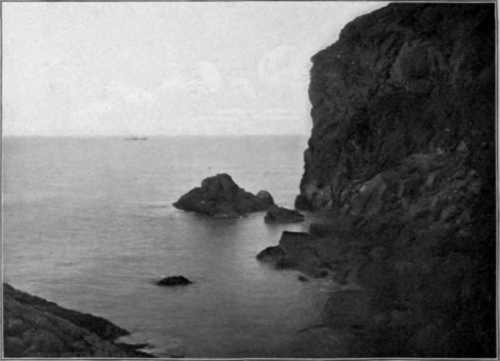
The First Headland.
Continue to:


My Books

