


Ireland. Part 5
Description
This section is from the book "Ireland - John L. Stoddard's Lectures", by John L. Stoddard. Also available from Amazon: John L. Stoddard's Lectures 13 Volume Set.
Ireland. Part 5
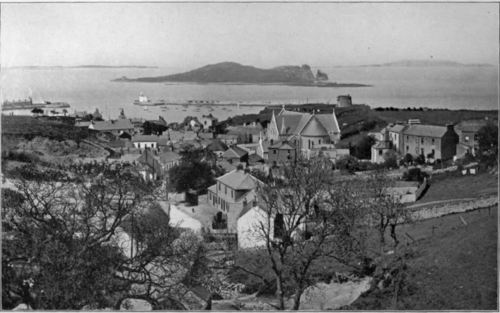
"Ireland's Eye"-Off The Bay Of Dublin.
The Bay of Dublin is very similar in form to that of Naples, and if it faced the west instead of the east, and could one look across its semicircular expanse out to the glory of the setting sun, I am not sure but it would merit as high praise as its Italian rival. The climate of Ireland, however, although mild, is very different from that of Italy; and as the Bay of Dublin, like all northern waters, is often subject to bad weather and dull skies, its appearance varies greatly. I have myself beheld it under at least a dozen different aspects; and had I formed my opinion of it merely from a few unfortunate experiences, I should have wondered whence it derived its fame for beauty. But if one looks upon it, on a lovely summer evening, from either of the points that terminate its curving shores, the sight of its majestic amphitheatre, walled in by the enchanting background of the Wicklow Mountains, will leave an ineffaceable impression on the memory. Equally enduring, too, will be for me the recollection of a rich contralto voice, heard at the sunset hour and in presence of that surgeless sea. The melody was that of "The Last Rose of Summer"; the song, the touching poem of Lady Dufferin; while there was just enough of the soft Irish brogue in the singer's pronunciation to make the rhyming of the lines in the first stanza perfect, as she sang:
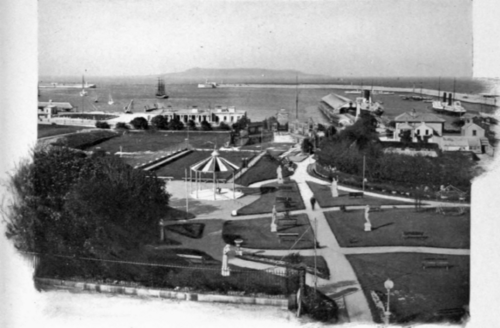
The Bay Of Dublin.
"O Bay of Dublin ! my heart your troublin',
Your beauty haunts me like a fevered dream; Like frozen fountains that the sun sets bubblin'
My heart's blood warms when I but hear your name. And never till this life-pulse ceases,
My earliest thought you'll cease to be; Oh! there's no one knows how fair that place is,
And no one cares how dear it is to me.
"Sweet Wicklow Mountains! the sunlight sleeping
On your green banks is a picture rare; You crowd around me, like young girls peeping,
And puzzling me to say which is most fair; As though you'd see your own sweet faces
Reflected in that smooth and silver sea. Oh! my blessin' on those lovely places,
Though no one cares how dear they are to me."
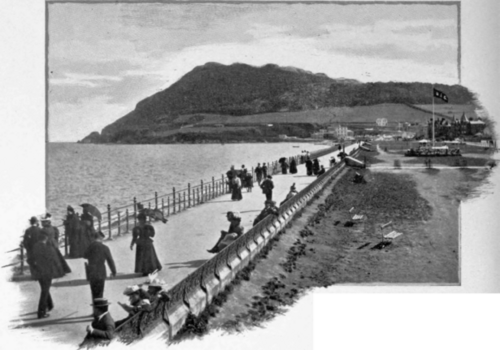
A Corner Of The Bay, Bray.

One Of The Wicklow Mountains, Sugar Loaf.
It is appropriate that these simple yet pathetic words should be set to the melody of "The Last Rose of Summer," for not only was that song composed by the Irish poet, Thomas Moore, but the air itself is the work of an unknown Irish musician, and was sung generations ago by Erin's wandering bards. It is probable, too, that the opera, " Martha," would never have acquired its long-continued popularity, but for this sweet old Irish tune, introduced into it by Flotow.
Dublin is often spoken of by Englishmen as being ugly and dirty; but, as a whole, I did not find it any more lacking in beauty and cleanliness than the great world-metropolis, three hundred and thirty-five miles away. Moreover, as the area of Dublin is much more limited, the actual amount of ugliness and grime within its walls is vastly less. Its squalor is perhaps more noticeable, because in smaller cities the extremes of wealth and penury meet more readily. But, on the other hand, the misery of Dublin is in a certain way less painful to contemplate, because the Celtic poor appear less sullen and degraded than the Saxon, and often show for the least kindness a gratitude that warms the heart with tenderness and pity. "God bless ye', Sor, for a noble gintleman," said a pathetically humble woman to whom I had given an extra penny or two for a bunch of flowers; "may you and yours have plinty in heaven ! An' ye' will have; fur a kind heart niver wants." Such an expression, genuinely felt and softly spoken, or merely a bright smile and joyful look of shy surprise given me by some ragged little boy or girl in Dublin, have often made me feel both kindlier and happier all day long. For even in the city streets of Ireland one can find many illustrations of the proverb: "Sweet as an Irish smile." The better class of dwelling-houses in Dublin, particularly in the vicinity of the handsome park known as St. Stephen's Green, also compare very favorably with those of London. This, it is true, is not excessive praise; for the architecture of both cities, save in a few fine public edifices, is painfully plain, compared with that of the large Continental cities; Great Britain's private dwellings having usually the appearance of narrow, upright tanks of smoke-stained brick or stucco, without bow windows, balconies, or even cornices to break their dreary uniformity. The only ornaments visible on the facades of London or of Dublin homes are one or two highly polished knobs of brass, and rows of flower-pots on the window-sills. It should, however, be remembered that almost all the dwellings on the Continent are large apartment-houses, which have of course a more palatial air, and admit of much more sumptuous decoration than most private residences. In Great Britain, on the contrary, the stately apartment-building is a rare exception; the individual dwelling-house the rule. In means of street communication ventilated omnibuses to roll along its thoroughfares, threatening life and limb, like Occidental Cars of Juggernaut, with scarcely space enough between them to let the terrified pedestrian dart from the curbstone to one of the places of refuge provided at intervals in the centre of the streets. Nor does the Irish capital imitate the English metropolis in subjecting its citizens to semi-asphyxiation in an underground railway; where, since the motive power still employed is soft coal, the sooty passengers can ride, in the appropriate words of Mrs. Partington, " with perfect impurity."
Continue to:


My Books

