


Ireland. Part 6
Description
This section is from the book "Ireland - John L. Stoddard's Lectures", by John L. Stoddard. Also available from Amazon: John L. Stoddard's Lectures 13 Volume Set.
Ireland. Part 6
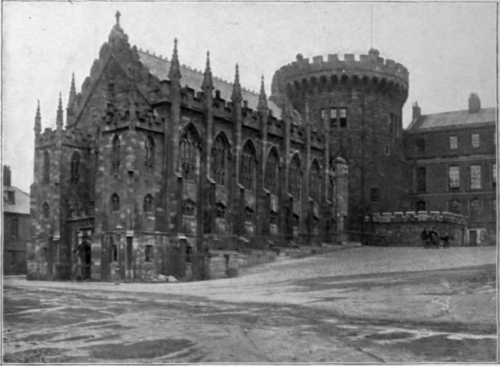
The Royal Chapel, Dublin.
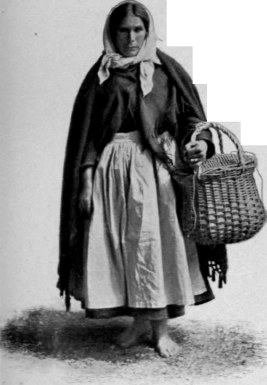
A Daughter Of Toil.
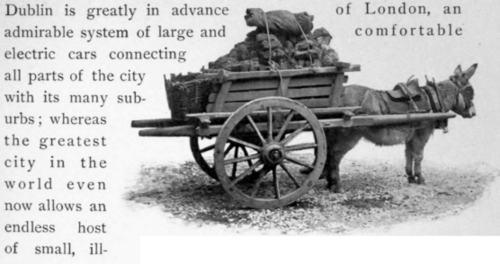
A Turf Cart.
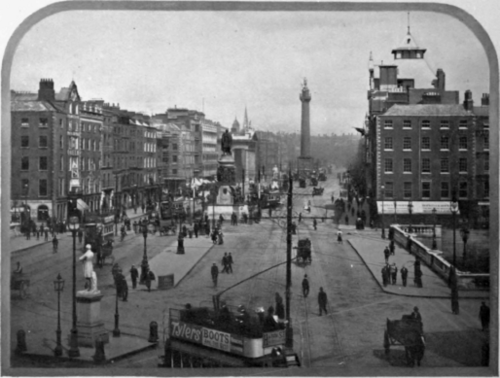
Sackville Street.
Dublin contains a number of handsome edifices, one of the most remarkable of which, though but one story high, is nevertheless imposing from its broad, sturdy frame, supported by a multitude of stately columns. Though neither a prison nor a fortress, it has a little the air of both, since not a single window of the massive structure fronts upon the adjoining streets.
Numerous niches ornament its outer walls, but these are as insensible to the sun as eyeless sockets. Only the roof and inner rooms are pierced with openings to admit the light. When its bronze doors are closed, it looks, in its inscrutable reserve, as silent and mysterious as an Egyptian tomb. Yet in reality, at certain hours, visitors are welcome to this seemingly exclusive building. In fact, without them it could not exist, for this great granite strong-box is the Bank of Ireland. It is not as a monied institution, however, that it especially interests the traveler. What constitutes its glory is the fact that, previous to the union of the legislative bodies of Great Britain and Ireland, in 1802, it was the meeting-place of the Irish Parliament. The interior of the House of Lords has suffered little change, in the transformation of the building; the long table which adorned it a century and a half ago, still occupies the centre of the room, and in the ancient chairs the Bank directors sit while holding their discussions. But the old House of Commons presents nothing of its former appearance. That famous theatre of forensic eloquence has become a centre of finance, where to the flow of oratory has succeeded that of commerce, and where the chink of coin has replaced the silvery speech of Erin's statesmen. Directly in front of this old House of Parliament, where he so often pleaded for the good of Ireland, stands an admirable statue of the celebrated orator and advocate, Henry Grattan. Were I an Irishman, I should regard that statue as a shrine; for a purer patriot and more loyal son of Ireland never lived. From the beginning of his parliamentary life, in 1775, at the age of twenty-nine, until he died in 1820, his body, mind, and soul were all unswervingly devoted to the service of his country. If I were asked to name the quality I most admire in Grattan's character, I should select the impartiality of his love and labor for his fellow-countrymen. He sought to improve their condition, irrespective of all religious and political differences. In an age when religious controversy was so bitter that no Catholics in Ireland could sit in Parliament, or even vote, and when to treat them with injustice was a sure path to favor with the Government, Grattan, although a Protestant, steadily and courageously worked for the emancipation of his Catholic countrymen; and it was while endeavoring to go to the House of Commons in London, to make a last supreme effort in their behalf, that he was stricken down by a fatal illness, and died without beholding the consummation of his hopes. His last words were of the land he had so dearly loved and nobly served; and in view of the successor who was already appearing on the stage to carry on the struggle to a glorious victory, the dying veteran might appropriately have uttered the lines:
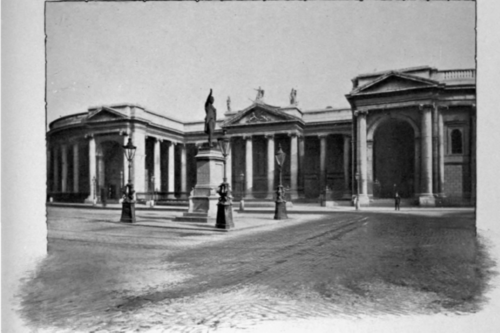
The Bank Of Ireland.
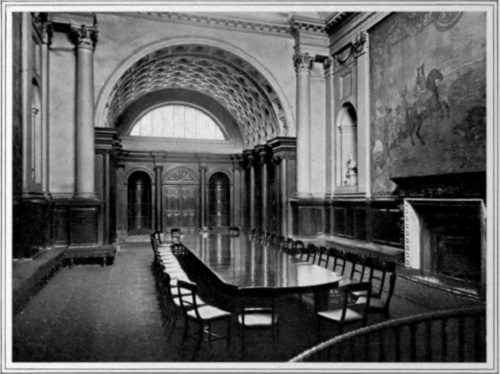
Former House Of Lords.
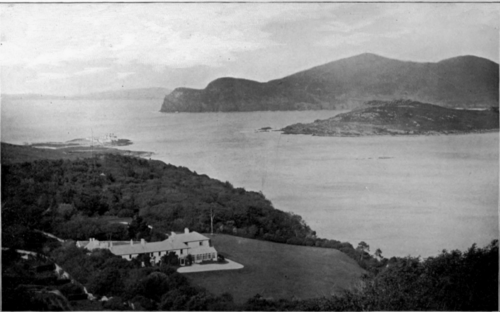
Where The Cable Lands, Valentia.
'•Others shall sing the song: Others shall right the wrong; Finish what I begin, And all I fail of win."
That successor was Daniel O'Connell. If there be any Irishman whose memory is more revered than that of Grattan, it is O'Connell. Adored in life, he is not less beloved in death. The monument in Sackville Street, erected in his honor, consists of a fine statue of the hero, beneath which Erin, freed from chains, is represented as grasping with one hand the Act of Emancipation, while with the other she points upward to her "Liberator." At the corners of the pedestal are also other statues, typical of O'Connell's prominent characteristics, Eloquence, Courage, Fidelity, and Patriotism. When I was a youth, in the days of the old "Lyceum," I heard with great delight that model of forceful and elegant oratory, Wendell Phillips, deliver a lecture on the life and times of O'Connell, and I forthwith conceived an admiration for the Irish leader which a subsequent study of his career and travel in the country of his birth have but intensified. It is not strange that Phillips grew enthusiastic over O'Connell. The Yankee was the disciple of the Celt. The Irish patriot had invented, and for nearly forty years maintained, the system of attacking political abuses by means of peaceable but persistent agitation; and to a similar course of action the American reformer also gave his heart and soul. Nor is it difficult to understand why O'Connell was idolized by the people of Ireland. They knew that to their betterment and defense he was devoting all his energies, and that for them he had sacrificed his lucrative profession, exposed himself to assassination, and suffered imprisonment in an English jail. But, even had he never been the political champion of his countrymen, he would, as a brilliant barrister alone, have always been immensely popular. He was a typical Irishman of the best stock - wily, witty, eloquent, emotional, and magnetic. His arrival in a town was often an occasion for public rejoicing. His clever repartees were passed from lip to lip, until the island shook with laughter. In court, he sometimes kept the spectators, jury, judge, and even the prisoner, alternating between will "while life was in him." O'Connell felt intuitively that the man, afraid to tell a lie, was trying to soothe his conscience by a quibble of words. Accordingly, he suddenly turned upon him and cried, " By virtue of your oath, did not some one write that signature with the dead man's hand, while a live fly was in his mouth? " The astounded witness confessed it in confusion, and the case was won.
Continue to:


My Books

