


Ireland
Description
This section is from the book "Ireland - John L. Stoddard's Lectures", by John L. Stoddard. Also available from Amazon: John L. Stoddard's Lectures 13 Volume Set.
Ireland

The buffer-State of Europe, the first of Old World countries to confront and check the surges of the North Atlantic, which have till then felt no curb for two thousand miles, Ireland looks, half lovingly, half sadly, over the waste of waters toward the distant continent that has received so many of her children, having long held her face averted from that nearer land where few of them have found a home.

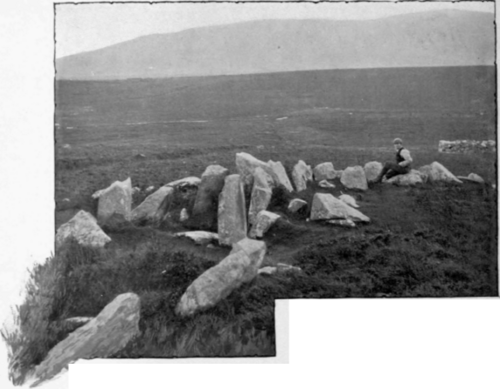
An Overthrown Druid Altar, Achill.
When one reflects that during the last eighty years more than four million Irish men and women have landed in the United States, it is surprising that Americans know so little of a country whence have come such numbers of their citizens.
Of all the thousands of American tourists who every year sail by the coast of Ireland, few care to pause there, and probably still fewer think of the island otherwise than as a poverty-stricken place from which all those who can escape, do so as soon as possible. A study of its history, however, and above all a sympathetic visit made to it, better to understand its cities, villages, scenery, and people, reveal a multitude of attractions, to which the great majority of mankind are totally indifferent, and of whose very existence few save its loyal children seem aware. My first trip through Ireland was like the tour usually made by those who, in their eagerness to reach Great Britain and the Continent, rush through the Emerald Isle as through the shabby, insignificant portal of a splendid palace. My recent tour convinced me that on the first occasion I had ignorantly passed by objects of transcendent value, as one unskilled in mineralogy might live above the gold fields of South Africa, yet die in poverty. The fact is, that for certain forms of natural scenery, memorials of Druid paganism, wonderful prehistoric relics, and priceless souvenirs of primitive Christianity, Ireland has no equal in the world. If one begins by pitying her, one ends by loving her. Certain countries, like certain individuals, possess a power of winning our affection, when we come into their presence, and Ireland is one of them. The fascination exercised upon the traveler and student by such lands may be compared to that exerted by a charming woman; for, as a rule, these countries are essentially feminine in character. This is by no means equivalent to calling them effeminate. Effeminacy is degeneracy. It shows a weakened type, a sex deformity. True femininity, however, may be as noble and heroic, as it is beautiful and winsome; and it is worth remembering that nations which are distinctively masculine in their aggressiveness, indomitable energy, and indefatigable pursuit of the practical at the expense of the ideal, may be most feared, but they are not the best beloved.

A Feminine Landscape.
Now, whether we consider the graceful undulations of her verdant hills, her quickly varying climate of alternate sun and showers (so typical of human smiles and tears), or her sensitive, warm-hearted people, tinged with the trace of melancholy insepa-rable from impressionable natures, Ireland appears indisputably feminine. As such, the vision of her beauty charms us, the story of her heroism thrills us, and the long record of her suffering saddens us, until we often view her ruins through a mist of tears.

What Ireland Needs.
When the delighted tourist in Ireland looks around him on an exquisitely beautiful and naturally fertile land, capable, under proper cultivation, of supporting twenty million people; when he is made aware of many industries which might be profitably managed there with capital and suitable encouragement; when he beholds her many noble harbors, rarely furrowed by a keel, or her magnificent river, Shannon, seldom shadowed by a sail, though rolling oceanward a greater volume than the Thames or Mersey; and when he finds in art and architecture abundant proofs of Ireland's illustrious past; he asks himself in sorrowful surprise: What is the cause of all the poverty, starvation, cruelty, and massacres which have for centuries stained the annals of this lovely section of Earth's surface, and left to generation after generation an enduring legacy of hatred? This question is persistent. Like Banquo's ghost, it will not down. Some terrible vampire has for a thousand years been draining the life-blood of Ireland. What is it? Can it be idleness, as is so often stated? The accusation is disproved by facts. The Irish are a race of workers, if there ever was one. The earth is full of their labors, ecclesiastical, mechanical, military, and manual. America to a large extent has been built up by Irish brawn. Englishmen have repeatedly said to me, "The Irish do well everywhere except in their own country." But what a confession is this? What can it mean but that the conditions of their life and labor there have been made practically intolerable? If they work elsewhere strenuously and successfully, is it not fair to suppose that they would do as much in Ireland, if they found adequate incentive there? A sense of unjust treatment robs work of its joy, and what is superficially called idleness is often only the paralysis of hope deferred.
Continue to:


My Books

