


Florence
Description
This section is from the book "Florence - John L. Stoddard's Lectures", by John L. Stoddard. Also available from Amazon: John L. Stoddard's Lectures 13 Volume Set.
Florence

"I Like a well-made, modern building better than any ruin in the world." "And I would rather see a ruin, if it possessed historic interest, than the best modern structure ever framed." They were Americans, walking the deck of an Atlantic steamer. Both were intelligent, outspoken, and sincere. They represented in these words two widely different classes of their fellow-countrymen. The first speaker expressed the view of those who are intensely practical and progressive. They are "weary of kings," emancipated from the past, impatient of Old-World conservatism, and so exultant in the building up of new and prosperous communities that they consider it almost sacrilege to waste their time on men, events, and buildings of antiquity. The second represented those Americans whose patriotism is no less strong than that of the first-mentioned class, and who concede that the Old World looks rather toward the Past, while the New World is gazing toward the Future. They cannot forget, however, that we are the descendants of the Ages, and that, as Lowell admirably says, "Ride fast and far as we may, we carry the Past on our crupper, as immovably seated there as the black Care of the Roman poet." That Americans should desire to travel abroad is not, therefore, as some are wont to say, indicative either of a want of patriotism or of a foolish effort to be fashionable.

Leonardo Da Vinci.
A justifiable and even praiseworthy motive for a foreign tour is the wish to see with our own eyes, and to tread with our own feet, places which make the great events of History, the heroes of Biography, and the masterpieces of Art more vivid to our consciousness than they can ever be while a great ocean intervenes, and they are merely read of and imagined. Hence, all who visit the Old World with true, appreciative interest, are really pilgrims to the homes of genius, shrines of art, sites of epoch-making action, and tombs of the illustrious dead. Moreover, this desire, though naturally strongest among us of the New World, is shared by lovers of the historic and the beautiful in every land. Whatever be their language, nationality, or faith, all students of the Past are heirs together in the heritage of History; and under the broad dome of heaven the homes of noble minds and the scenes of heroic deeds become our universal sanctuaries.

Savonarola.
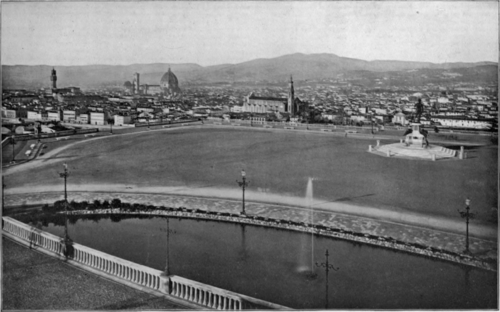
Florence From The Square Of Michelangelo.
One of the most important of these sanctuaries is Florence, the cradle of the Renaissance. Reclining in her amphitheatre of vine-clad hills, cleft by the golden current of the Arno, and guarded by the Tuscan Apennines, Florence is not alone one of the most attractive cities in the world, she is a beacon light of history. How priceless is the debt of gratitude we owe her! After the appalling gloom of the Dark Ages which, on the downfall of Imperial Rome, enfolded Europe like a shroud, the first pale streaks of light, announcing the dawn of a new age, appeared above the towers of this Tuscan Athens. It is true, the glory which succeeded that bright dawn did not last long; but during its continuance Italian art and literature reached their zenith, and Florence ever since has been a treasure-house for those who prize inspiring memories and forms which, though imprisoned upon canvas or in marble, seem endowed with life.
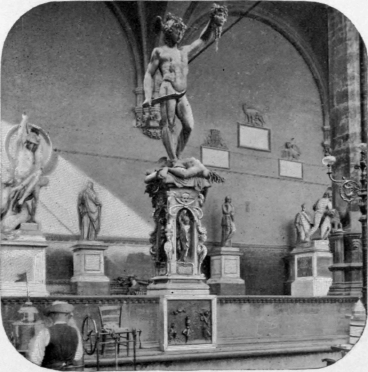
The Perseus Of Cellini.
The place toward which the visitor to Florence usually first directs his steps is the Square of the Senate, where, with mingled feelings of awe and pleasure, he recognizes the imposing form of the Palazzo Vecchio, or Old Palace, which has been standing here in massive grandeur for six hundred years. It served as the Senate-House during the Republic, and afterward as the official residence of the Medici, - that famous family which gave eight dukes to Tuscany, two queens to France, and four popes to the Vatican. The shadow of its stately tower fell upon this Florentine forum two hundred years before Columbus sailed for the New World; and, every day since then, has traced its sombre pathway on the ancient pavement, as if Fate's "moving finger" were writing there the city's destiny in lines which none can understand. What an amount of history these frowning battlements enclose ! Thus, in the lofty tower there may still be seen a dismal cell possessing mournful interest, as having been for forty days the prison of Savonarola, whose delicate frame was racked with anguish from the torture to which he was at intervals subjected. Only a few years since, there was discovered in this tower an opening into a secret shaft, communicating with a black pit two hundred feet below; and no doubt many a prisoner, as he came down the staircase from the tower dungeon, was suddenly pushed through the aperture into it, to fall with a wild shriek of horror, through the darkness, to an unknown, subterranean tomb. Poor Savonarola was, at least, spared such an ignominious and mysterious exit from the world; for these old palace walls, in 1498, were reddened by the glare of the reformer's burning form, and echoed to the curses of the fickle multitude which had so often listened spellbound to his words when he virtually ruled the Florentine Republic from his pulpit, but which, that day, as eagerly thronged every window, roof, and balcony in the vicinity to witness his death agony. Yet, when the reaction came, this same Palazzo Vecchio, above the gate of which Savonarola had affixed the words, "Jesus Christ is the King of Florence," beheld for centuries, annually, on the anniversary of his death, this area strewn with violets, in memory of the good which Savonarola had achieved and in atonement for his martyrdom.
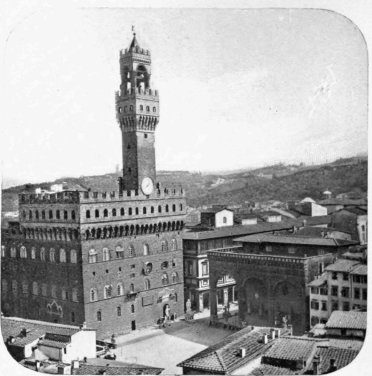
The Palazzo Vecchio.

The Courtyard Of The Palazzo Vecchio.
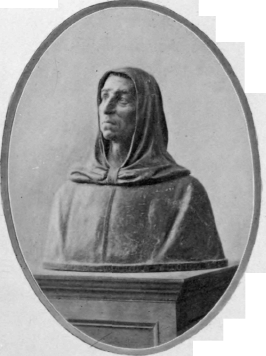
Savonarola.
Continue to:


My Books

