


Florence. Part 2
Description
This section is from the book "Florence - John L. Stoddard's Lectures", by John L. Stoddard. Also available from Amazon: John L. Stoddard's Lectures 13 Volume Set.
Florence. Part 2
"For Humanity sweeps onward; where to-day the martyr stands, On the morrow crouches Judas with the silver in his hands. Far in front the Cross stands ready and the crackling fagots burn, While the hooting mob of yesterday, in silent awe return To glean up the scattered ashes into History's golden urn".
From 1504 till 1882, Michelangelo's famous statue of David stood beside the entrance to the Palazzo Vecchio - the situation chosen for it by the sculptor himself - but, after three hundred and seventy-eight years of exposure to the elements, it was thought wiser to remove it to the Academy of Fine Arts. Old travelers, therefore, who revisit Florence miss it sadly as they look for it in its accustomed place; for the David is a statue that one never forgets. Like most of Michelangelo's productions it is a figure of heroic size, and was intended, doubtless, to be placed at a considerable height and to be observed from a distance. As we view the grand proportions and the stern, resolute expression of the youthful shepherd going forth to battle with Goliath, we cannot wonder that the creation of this statue was such an event in Florence that, for many years, it was the custom of the Florentines to reckon occurrences as happening so long "after the completion of the David." The work was the more remarkable because its author was obliged to cut it from a block of marble, eighteen feet in length, which had been injured by a clumsy sculptor and had lain useless more than fifty years; but he, struck with its beauty, and longing to achieve what others had believed to be impossible, resolved to carve from the block a colossal statue, representing the future king and psalmist of Israel in the first great crisis of his life. Up to that time, people had been skeptical of Michelangelo's genius; but when, in 1504, this figure had been completed, there was no longer any doubt. He had become the foremost living sculptor of the world.
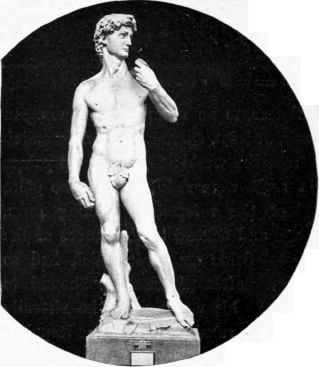
The David.
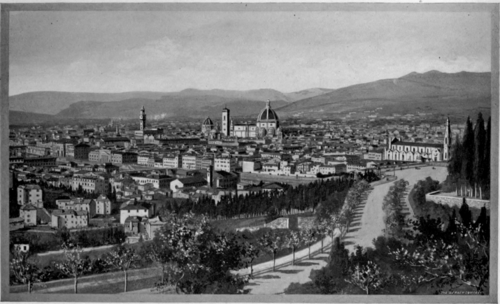
Florence From The Hill.
One of many anecdotes connected with the David shows that human nature is much the same in all ages. After it had been placed upon its pedestal, a pompous Florentine official came to see it and, after deigning to express great admiration for the work, suggested that the nose appeared to him too large. Hearing this, Michelangelo gravely mounted a ladder and pretended to work at the face for a few moments, dropping meantime some marble dust which he had in his pocket. At last (having really made no change) he turned with a questioning glance to his critic, who responded: "Bravo; bravo; you have given it life!"

Michelangelo.
On another side of the Square of the Senate, at right angles to the Palazzo Vecchio, stands a marble portico of grand proportions. It is called the Loggia of the Lancers, from the fact that the ducal guard was formerly stationed here; but the original purpose of its construction was to afford a place of shelter, where citizens could assemble for the discussion of public affairs. For more than five hundred years, this beautiful arcade of lofty arches has charmed all visitors to Florence, from the most casual observer to the accomplished architect. When Lorenzo de' Medici asked Michelangelo to design another splendid ornament for the square, the sculptor answered: "Carry the Loggia entirely around it. Nothing finer can possibly be invented." The duke, however, shrank from the expense of the undertaking. To-day this portico has a nobler use than that of sheltering Medicean lancers, since at present it forms an imposing canopy for works of art, which are so numerous in Florence as to overflow, apparently, from her great sculpture galleries into the streets, where they command the admiration of every passer-by.
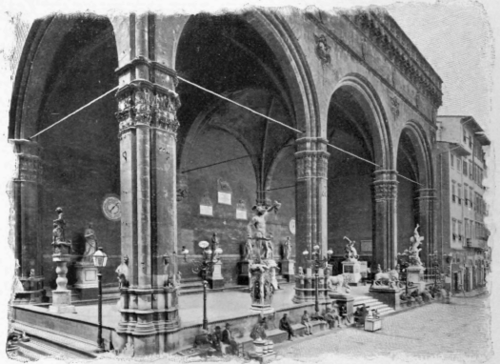
Among them are John of Bologna's celebrated work, - the "Rape of the Sabines," and the famous group in bronze by Benvenuto Cellini, representing the hero, Perseus, holding up in triumph the head of the monster, Medusa, whose lifeless body he tramples under foot.
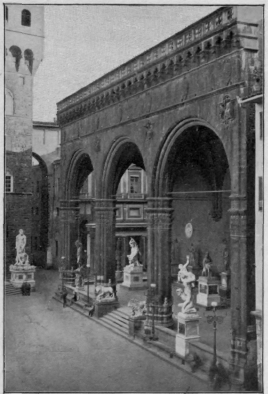
The Portico Of The Lancers.
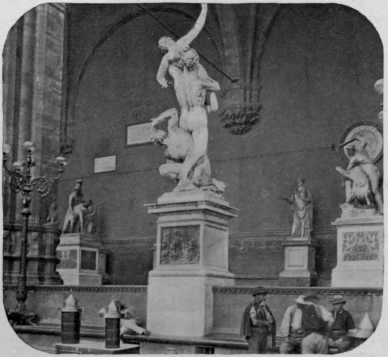
The "Rape Of The Sabines".
Continue to:


My Books

