


Florence. Part 3
Description
This section is from the book "Florence - John L. Stoddard's Lectures", by John L. Stoddard. Also available from Amazon: John L. Stoddard's Lectures 13 Volume Set.
Florence. Part 3
Nor is modern art wanting here. In the rear of Cellini's masterpiece stands a magnificent group completed by the Florentine sculptor, Fedi, in 1865. It represents a painful subject in mythology, - the seizure of Polyxena by Achilles. The conqueror, whose form is a superb combination of strength and beauty, is bearing away the captured girl; while at his feet the maiden's brother, who has tried in vain to rescue her, lies in the agony of death. Clinging alike to the relentless captor and her child with feeble hands, is the half-prostrate mother, Hecuba, whose face and attitude are wonderfully effective. The ardor of Achilles is easily comprehended, for the girl's form is of remarkable beauty, none of its rounded outlines being lost beneath the drapery, creased by her struggles into a thousand folds.
My instinctive admiration of this work was increased when I perceived that, large and complicated as it is, its four figures were carved from a single block of marble. Before producing it, Fedi had toiled for years in poverty and obscurity; but after this achievement, he sprang at a single bound into celebrity, and his masterpiece was placed in the Loggia, as on a throne of honor, among the statues of some of the greatest sculptors of the Renaissance. Moreover, so jealous was Florence of her new possession, that she exacted from Fedi a promise never to duplicate the group.
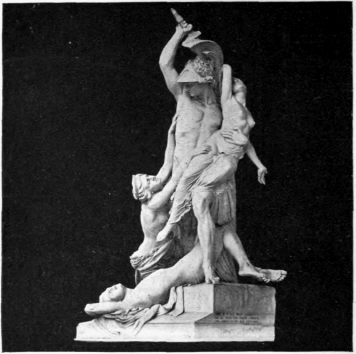
Polyxena And Achilles.
The production of a modern work, like this of Fedi, is an example of the indestructible talent and fondness for sculpture which the Italians possess. One day, while lingering in the Loggia, I saw a little ragged urchin selling flowers. He had the beautiful, pathetic eyes which are so rarely seen outside of Italy, and I called him to me that I might look admiringly at them while I questioned him. "What do you wish to be, when you grow up to be a man?" I finally asked. Without a moment's hesitation, the little fellow fixed his expressive, lustrous eyes upon me and replied, "Uno scultore, signore".
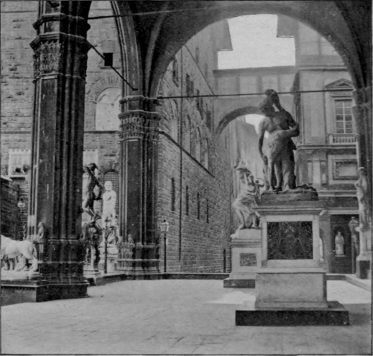
Inside The Loggia.
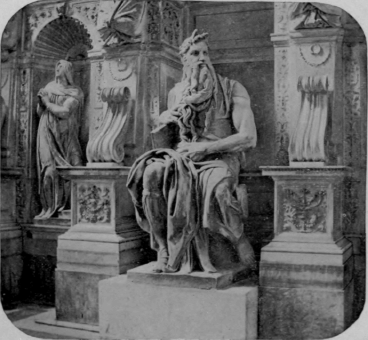
Michelangelo's "moses".
Close by the Loggia is a narrow passageway, extending from the Palazzo Vecchio to the river Arno, between the parallel arms of the Uffizi Palace, which Medicean princes built to contain the government offices and the archives of the state, together with their vast collection of rare works of art. I felt, however, in no haste to mount the marble staircase of the palace and view its halls of painting and of sculpture. It was enough for me to saunter back and forth in its historic portico, and give my mind completely to the inspiring memories awakened by the place. Such memories readily suggest themselves to any one; for on both sides of this long corridor stand many life-sized marble statues of illustrious Florentines. The figure before which I first halted was that of Leonardo da Vinci. The sight of it fairly thrilled me; for it is one thing to see a portrait of this mighty genius in our homes, and quite another to come suddenly face to face with him, as if in life, within the city of his birth and triumphs. As I surveyed the form of the immortal Leonardo, whose influence in the domain of art was so incalculably great, I felt that it would have been sufficient glory for Florence to have produced this man alone; yet, glancing down the long array of statues, I saw that his was only the commencement of her sculptured heroes. To walk attentively before these marble effigies is to receive a memorable lesson in Italian art and literature; for each of these superbly modeled forms invests with life and personality some name, which may have lain for years half dormant in our memories.

Portico Of The Uffizi.
What a perpetual source of pride and inspiration to the Florentines must these long lines of Masters be, confronting one another thus beneath the portals of this shrine of Art, and looking calmly down upon the crowds that pass and repass constantly between them, with many an upward glance of love and pride! It stirs the blood of even a stranger from beyond the sea to look upon them; and I should think the sight would make a true-born Florentine as proud of the fair city of his birth, as were the dwellers by the Tiber in the days "when to be a Roman was greater than to be a king"; for in the list of those whom Flor-rence can claim as her own, an entire nation - much more, a single city - might exult.
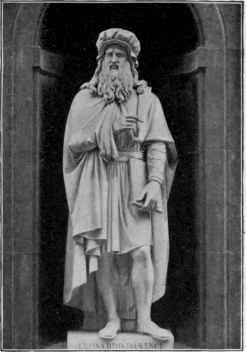
Leonardo Da Vinci.
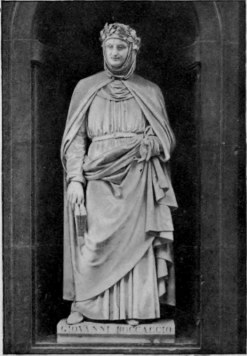
Boccaccio.
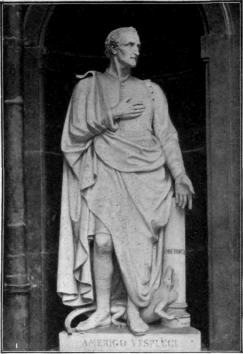
Amerigo Vespucci.
Continue to:


My Books

