


Genoa
Description
This section is from the book "Genoa - John L. Stoddard's Lectures", by John L. Stoddard. Also available from Amazon: John L. Stoddard's Lectures 13 Volume Set.
Genoa
If Genoa in the person of Christopher Columbus discovered America, America in its turn may be said to have discovered Genoa. A dozen years ago comparatively few Americans ever visited the place, unless on the way to Italy from the Riviera. But now that steamers regularly run between the Mediterranean and New York or Boston, Genoa has become the favorite European port of entry or departure for thousands of American tourists yearly. Moreover, since the average traveler is not inclined to rush directly through the terminal of a voyage of fourteen days, and likes even less to start upon his homeward journey without a few last preparations and impressions at the point of embarkation, Genoa, for a time at least, attracts and holds a great majority of these arriving and departing guests.

Portrait Of Columbus, Municipal Palace.
Whether one reaches it by land or water, the first conspicuous feature of the city which one usually notes - since it is near both port and railway station - is the impressive monument to Christopher Columbus. It gives a newly landed citizen of the Great Republic a curious sensation to look down from his hotel window on this stately figure, and let his thoughts roam backward over the waste of waters he has lately traversed. He thinks of the vast continent, now teeming with the energy of millions, girded from sea to sea by many lines of railway, and gemmed with cities rivaling in wealth and size the oldest in the world, and it is difficult for him to imagine that great area as ever having been other than it is. But this memorial of the great Discoverer reminds him that there was a time (and not so very long ago) when that huge western world did not exist, - for in its primitive state of savagery it cannot truthfully be said to have existed, - and when men walked these winding streets of Genoa and lived within its still imposing palaces with no conception of the continents of North and South America, sleeping in their gigantic solitude three thousand miles beyond the exit of the Inland Sea. And yet it was the man commemorated by this statue, whose probable birthplace is the neighboring village of Cogoleto, whose childhood's home is still preserved here, and whose eyes unquestionably looked on many of the edifices that we see to-day, who brought the knowledge of that western hemisphere to an astonished world!
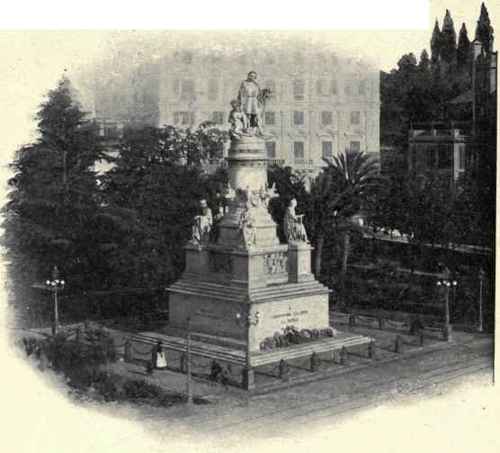
Monument To Christopher Columbus, Genoa.

Cogoleto, Birthplace Of Columbus.
Significant, also, is the fact that Genoa has paid this tribute to Columbus, although, having been the first to receive from him the offer of his plans, she was the first - to decline them! Alas, how many other cities, either from a sense of shame or from a wish to share a little in the glory of their offspring, have been forced to honor, posthumously, those they have in life rejected! What a fine theme for speculation is the question of how differently the course of human history might have run, had Genoa accepted the proposals of her gifted son, and if the New World had become thus the possession of his native state, instead of falling into the hands of Spain! For Genoa was not then, as now, a subordinate city of United Italy.
Like Venice, its great enemy, it was for centuries an independent, prosperous Republic, governed by Doges or a powerful oligarchy, and guarded by its celebrated galleys, one hundred and seventy-four feet long and thirteen feet in breadth, which, with a well-trained crew of more than two hundred veterans for each vessel,, furrowed the seas in all directions, and hurled themselves repeatedly against the ships of Venice, contending for the mastery of the Mediterranean. By means of these, in 1284, defeating-Pisa - until then another fierce competitor - Genoa gained supremacy over Corsica and Sardinia, and founded numerous, colonies in places like Marseilles and Nice in France, Tortosa and Almeria in Spain, and Tunis on the coast of Africa, as well as on a series of important islands, from Cyprus in the east to Minorca in the west. Its symbol, meanwhile, was the griffin, - that grewsome creature of mythology, whose duty was to watch over hidden treasures, and which combined an eagle's head and wings with the sharp claws and powerful body of a lion. Nor was this all; for in the thirteenth century the Emperor at Constantinople ceded to the Genoese the most important suburbs of that city, Galata and Pera, which they retained as bases for their commerce until the capture of Constantinople by the Turks, two centuries later. To Genoa also fell the valuable port of Smyrna, and her adventurous galleys penetrated the Black Sea, and carried colonists to the Crimea and the Caspian; while even on the banks of the Euphrates ambitious Genoese built massive fortresses to keep and to defend their city's trade with India.
Continue to:


My Books

