


Around Lake Garda. Part 5
Description
This section is from the book "Lake Garda - John L. Stoddard's Lectures", by John L. Stoddard. Also available from Amazon: John L. Stoddard's Lectures 13 Volume Set.
Around Lake Garda. Part 5
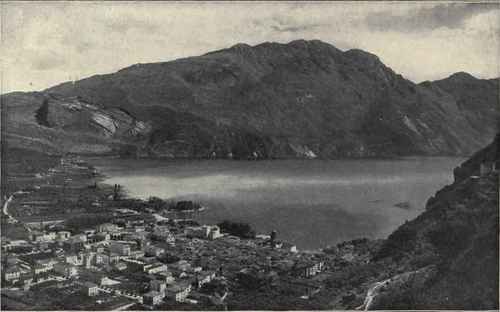
Riva And Monte Baldo.
The scene of desolation that presents itself a little below the summit of the pass is both surprising and impressive. Contrasted with the vales of paradise on either side, the apex of this watershed resembles an abode of demons. In fact, more than five hundred years ago the poet Dante found the scene so grewsome that at the opening of the twelfth canto of his "Inferno" he compared the place to the part of Hell he was describing. For, as he passed a portion of his exile under the protection of his friends, the Scaligers, near Trent and on the border of Lake Garda, he knew this region well, and likened it appropriately to the rough descent into the seventh circle of the nether world. The language which he used in reference to these rocky fragments, "Loosened by earthquake, or for lack of prop," shows that he deemed this devastation due to a landslip; but, as we soon shall see, a part of it, at least, was caused by glacial moraine. The earth has undergone some terrible convulsions here. Some of the mountain strata have been folded back toward one another like the letter S; and not a few of their gigantic layers writhe, rear, and crawl away, like hideous, primeval monsters, wounded unto death. Between these tortured cliffs the carriage road and railway coil and uncoil, like two friendly serpents, through a labyrinth of boulders, now piled in heaps, now scattered broadcast, as if a host of heaven-scaling Titans had been here bombarded by the angry gods. Yet, happily, the horror of the place is not without alleviation.
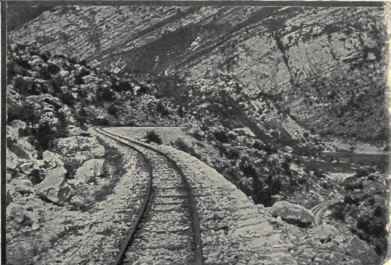
A Wilderness Of Stone.
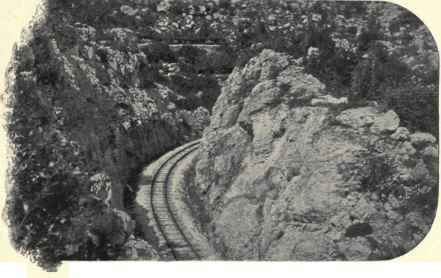
The Narrow-Gauge Railway Between Mori And Riva.
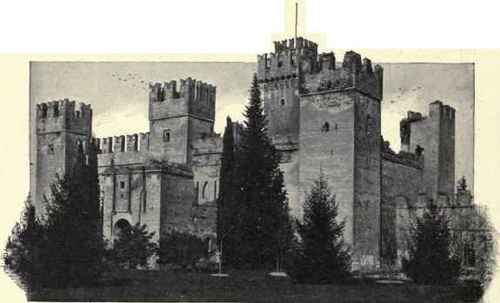
An Ancient Castle Of The Scaligers, Near Lake Garda.
A pretty sheet of water, called Lake Loppio, lies in the midst of all this chaos, reflecting faithfully the world of stone, and yet so brilliant in its color, and so artistically marked by curving channels, cut between its tiny islands, that it suggested to my mind an emerald intaglio - a flawless masterpiece of Nature, dropped and forgotten here amid the vaster and more serious works on which she was engaged. For very serious was the work accomplished in this region during that epoch of our planet's life preceding or attending man's appearance on its surface.
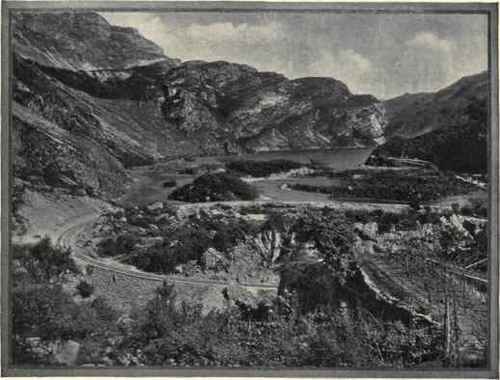
Lake Loppio And The Serpentine.
The country near Lake Garda is a spot where one may read in the rolled pebble and the traveled boulder, in slanting strata and in grooved ravine, a portion of the story of our cooling globe, and some of the mysterious secrets of its awful past. Thus the first view of Arco and the valley of the Sarca, terminating in Lake Garda, is geologically as interesting as it is enchanting in its beauty. A richly cultivated plain of semi-tropical vegetation is outspread before us, framed on three sides by rugged picturesque mountains; while on the fourth, beyond a rock-ribbed hill, which lies tipped over on its side like a dismasted wreck, laughs in the golden sunshine of the south the dimpled surface of the lake. Its water covered once the entire valley. Where Arco's dainty villas stand, fish sported in the waves; and the precipitous rocks, which form a startling feature of the landscape, were then small islands, whose sheer cliffs, five or six hundred feet in height, towered above the lake's blue mirror as they do to-day above the plain. Gradually, however, the river Sarca, which is born among the glaciers of the Ortler range, built up this broad, alluvial expanse by bringing hither during many centuries debris and rubble from the Tyrolese mountains. Spreading this out in layers, with a steadily increasing slope, it forced the water to retreat.
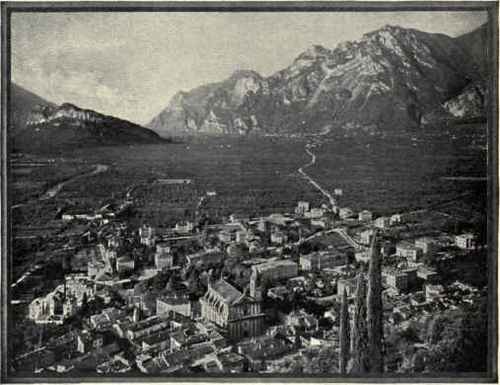
Arco, And The Valley Of The Sarca.
But this is nothing to the earlier changes in the valley's history. There is perhaps no part of Europe where the results of the great Ice Age are more clearly marked, and make a deeper impression on the mind, than South Tyrol. What an appalling picture it presents when one imagines the stupendous sheet of ice that covered once the whole of northern Europe and the corresponding latitude of North America! This ice cap is computed to have been a mile and a quarter thick in Norway, and even in northern Germany to have had a depth of fifteen hundred feet. The amount of ice among the Alps at that time is almost inconceivable, unless one can in fancy transport himself in a balloon to such a height that the earth's crust appears to him like the skin of a wrinkled apple. Only the highest peaks then rose above the glacial sea enshrouding Switzerland, much as we may have seen them, from the summits of the Rigi or Pilatus, piercing an ocean of sun-tinted clouds ere the day's warmth had caused the vapors to retire. The glaciers of today appear gigantic when we, pygmy-like, attempt to cross their riven surfaces, and with reason, for some of them even now are more than thirteen hundred feet in depth, and it has been calculated that the ice of the Gorner glacier at Zermatt would be sufficient to build three cities of the size of London!
Continue to:


My Books

