


The Dolomites. Part 4
Description
This section is from the book "The Dolomites - John L. Stoddard's Lectures", by John L. Stoddard. Also available from Amazon: John L. Stoddard's Lectures 13 Volume Set.
The Dolomites. Part 4
When we confront such awful monsters of the stony world, repeatedly attaining heights of more than ten thousand feet, it seems at first incredible that they should ever have been submerged reefs, built up by countless billions of small insects, whose microscopic skeletons still persist in the stupendous cliffs, although long since chemically transformed into an indistinguishable mass. Yet we all know that in the southern oceans similar reefs exist, upon which thousands of human beings live to-day, and on whose jagged crags, composed almost exclusively of fossils, many a mighty ship and gallant crew have dashed themselves to death. Nor does the theory that the Dolomites were once submerged seem so untenable when we remember that the whole of Switzerland, save possibly a few of its highest summits, was, till comparatively recent geologic times, completely covered by the sea. For it should never be forgotten what a role the ocean floor has played by its repeated elevations and subsidences in the slow metamorphosis, which in the course of possibly one hundred million years has changed our earth from a convulsive mass of cooling fire to the coraparatively tranquil globe on whose still thin, and in some places still precarious, crust we walk to-day:
"Oh earth, what changes hast thou seen ! There, where the long street roars, hath been The stillness of the central sea".
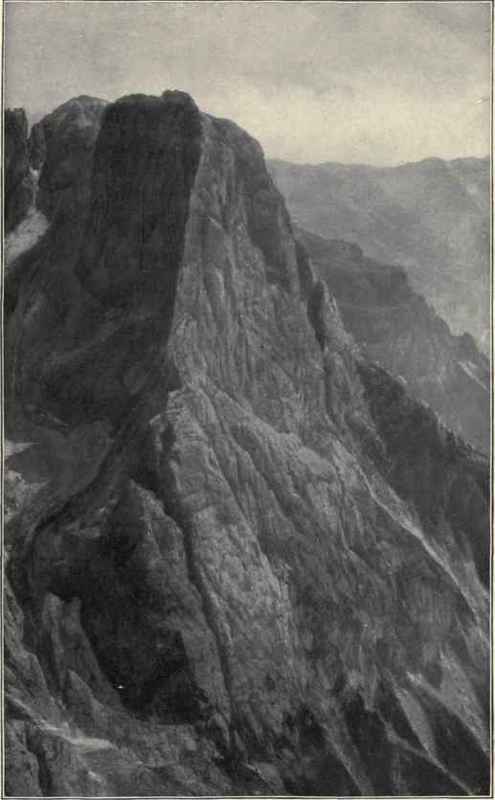
A Famous Dolomite Peak, "Sasso Maggiore" - 9,240 Feet.

Fantastic Fragments.
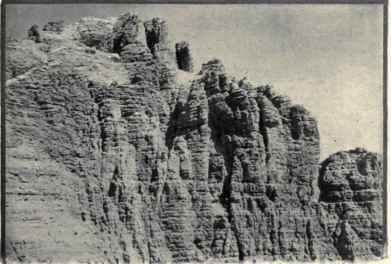
A Storm-Beaten Reef.
It is indeed a wonderful panorama of past ages that unrolls itself before us, as we thoughtfully survey these Dolomites. As in a vision, we behold our earth in the Triassic period of its evolution. A moderately heated and comparatively shallow ocean covers much of Europe's area, and on its vast floor layer after layer of sediment is being deposited. Gradually, in suitable places and under favorable conditions, coral reefs are formed, which, with an increase of marine life, spread extensively. Lower and lower sinks the ocean floor, as the hot, central mass continues to contract; but with its gradual subsidence the upward-growing coral reefs keep pace, and still maintain their relative position near the surface, for their industrious builders cannot live below a depth of twenty fathoms. It is for them a struggle for existence. At times terrific outbursts from earth's fiery heart disturb this reef-building, and mighty masses of volcanic porphyry are thrown out, cleaving and separating what has thus been formed. But, on the whole, the work progresses, until in consequence of the cooling of the water the coral insects die. For, just as they cannot exist too far beneath the surface, so they cannot survive a temperature that falls below sixty-six degrees, and therefore at the present time are limited to a zone extending north and south of the equator about eighteen hundred miles.
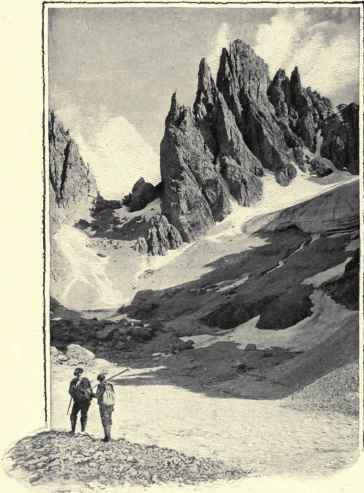
The " Five Finger Points".
Then came a gradual elevation of the ocean bed, whereby these coral reefs of South Tyrol were lifted slowly far above the waves. Such changes are incomprehensible, so long as we consider them merely from our physical standpoint; for, measured by our puny frames, the lofty mountain ranges of our globe appear to us as huge as trees and houses must appear to ants. To understand their relative proportions, therefore, we must mentally place ourselves at a distance from our planet, and then remember that even the magnificent Himalayas, although six miles high, are, in comparison with the earth's diameter of eight thousand miles, no larger than the netting on the surface of a cantaloupe. Yet these, like the Dolomites, were once much larger than they are to-day; for indefatigable atmospheric agents have been ever since at work denuding and decreasing them.
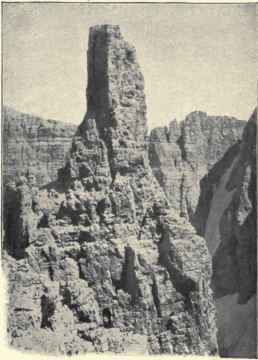
A Cathedral Tower.
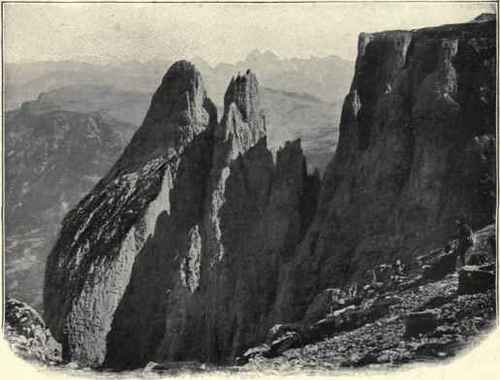
In The Heart Of The Dolomites.
It is a most impressive fact in the strange history of our cooling orb, that, just as soon as land has ever risen from the shelter of the ocean, the forces of the air have grappled with it as an enemy; and aided by the waves, which are forever gnawing at its shores, these elements combine in a persistent effort to wear down the continents to a common level under the surface of the sea. The very first shower that fell upon the newly elevated crests began the work of denudation by forming countless rivulets, whose channels were determined by the inequalities already existing in the shape or hardness of the stone. These, lower down, becoming swollen and united streams, plowed out deep valleys, through which fragments of the storm-swept cliffs were brought, either in minute particles by the rushing water, or in vast masses pried off by the frost, and pulled down by the force of gravitation in the form of boulders, avalanches, or tremendous landslips.
Continue to:


My Books

