


The Dolomites. Part 6
Description
This section is from the book "The Dolomites - John L. Stoddard's Lectures", by John L. Stoddard. Also available from Amazon: John L. Stoddard's Lectures 13 Volume Set.
The Dolomites. Part 6

Frescoes On The Hotel Aquila Nera, Cortina.

Hotel Bellevue, Cortina, With Mt. Pomagagnon.
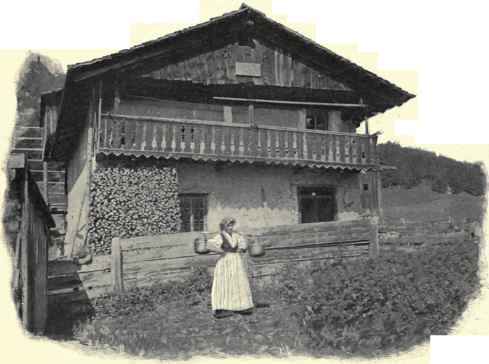
Titian's traditional birthplace, near cortina.

Mountain Flowers.

The Italian Frontier, Ampezzo Thal.
Even though all historians should decide that Titian was a native, not, as had been supposed, of Pieve di Cadore, but of this little hamlet near Cortina, a journey to the former place would still be well worth making if only for the reason that the excursion itself is full of interest and beauty. The smooth and admirably graded road on which we drive thither is the already mentioned international highway to Belluno; and the grand scenery which it affords is a continual source of joy and inspiration. Moreoyer, the history of this portion of the Dolomite country is exceedingly attractive; for only three and a half miles south of Cortina we cross the frontier into Italy and enter that historic borderland known as Cadore, which has so often been the scene of desperate fighting between Austrians and Italians.

On The Road To Pieve.
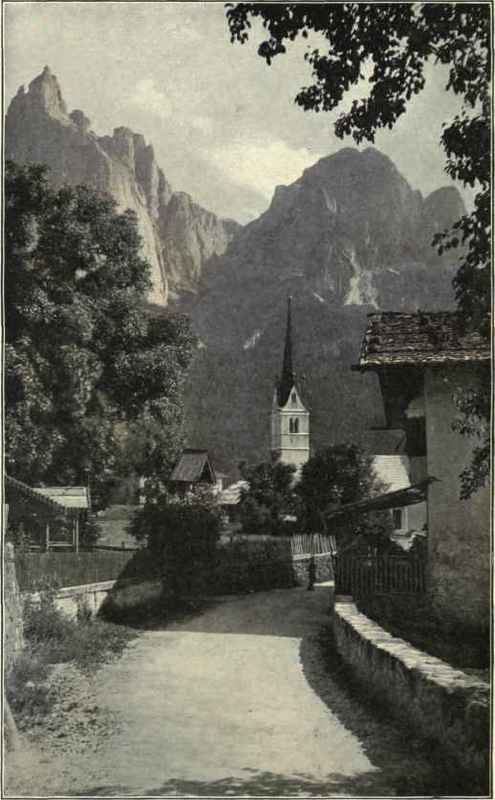
The Village Of Seis, And Mt. Schlern.
The city of Pieve is rarely spoken of alone, but usually has the affix, "di Cadore," to distinguish it from other towns of the same name in different parts of Italy; and Titian also, when not alluded to as "II Divino," was commonly called "Titian da Cadore," as indicating that he was a native of that country. What, therefore, is or was Cadore? To one who has never investigated the subject, the answer to this question comes as a complete surprise. Few sections of our earth, of equal size and similar remoteness from the outer world, possess so many golden threads of precious memories and traditions woven with an heroic past. During the first millennium of the Christian era, it is true, its history does not differ greatly from that of other portions of the Alpine region separating Germany and Italy. That is to say, the conquering Romans naturally pushed their legions northward through its valleys, and subsequently, when the lifeblood of the dying empire left its pinched extremities and ebbed back feebly to its failing heart, there surged through these ravines and passes billow after billow of barbarian invasion, as the unlettered hordes of Goths, Huns, Ostrogoths, and Franks broke through the bar- riers of Cisalpine Gaul and thundered at the gates of Rome.

A Scene In Old Cadore.
At last, however, about the year 1000 a.d., the inhabitants of Cadore formed themselves into a republic, which gradually shaped itself into an admirable government, consisting of ten provinces, each of which sent three deputies to a parliament whose meeting-place was the capital, Pieve. Marvelous to relate, this sturdy little republic, founded five hundred years before America was discovered, and nearly eight hundred years before the birth of the United States, existed for about eight centuries, expiring only in 1797, when Bonaparte changed this portion of the map of Europe by the peace of Campio Formio.

A Wayside Farm, With Frame For Drying Beans.
During the last four centuries of its history the government of Cadore maintained a close alliance with the. Republic of Venice, caused not by conquest on the part of the Venetians, but by a mutual agreement, following on a free vote of the people of Cadore. That was indeed a time when friendship with the Lion of St. Mark was well worth striving for. It was the golden age of Venice, when "Her daughters had their dowers From spoils of nations, and the exhaustless East Poured in her lap all gems in sparkling showers. In purple was she robed, and of her feast Monarchs partook, and deemed their dignity increased".
Continue to:


My Books

