


The Dolomites. Part 7
Description
This section is from the book "The Dolomites - John L. Stoddard's Lectures", by John L. Stoddard. Also available from Amazon: John L. Stoddard's Lectures 13 Volume Set.
The Dolomites. Part 7
Yet, on the other hand, so much did the Venetian government prize the fidelity and honesty of its allies in the Dolomites that it conferred on them the rights and privileges of Venetian citizenship. Hence, Titian, though Cadorian by birth, was also a Venetian. The archives of the past recount a number of favors given and received by one republic or the other. Thus the Cadorians, in 1578, contributed one hundred larch trees toward the restoration of the Doges' Palace, which had been destroyed by fire; and again, in 1645, these mountaineers sent as a present to the arsenal of Venice two hundred and twenty larches and two hundred pines, specially chosen for their size and beauty, to be used in shipbuilding. This leads me parenthetically to pay a word of tribute to the splendid forests of the Dolomites. Two thousand years ago they furnished planks for Roman galleys, and their grand, stately trunks have been for many centuries cut and floated down the rivers to all parts of Italy. Out of the finest of these noble trees were built the great Venetian fleets, whose sailors conquered Constantinople, Crete, and the Dalmatian coast, and won the glorious victory over the Turks at Le-panto. At that time Venice had the most extensive dockyard in the world, and kept in it some sixteen thousand artisans constantly employed in working up material furnished by Cadore. The forests of the Dolomites, therefore, aided not a little in making the Republic of the Wingèd Lion mistress of the seas. Nor was this all; for thousands of pines and larches, which had reached enormous stature in the shadow of these mountains, were likewise sent down to the Queen of the Adriatic, to serve her, not as war ships on the open sea, but in the humbler capacity of standing steadfastly within the mud of her lagoons. There patiently and ingloriously, yet no less effectively, they have for centuries been the pedestals on which have rested the magnificent bridges, palaces, and churches, which lift their mediaeval marbles in the jeweled City of the Sea, and even in their faded splendor fascinate the world.
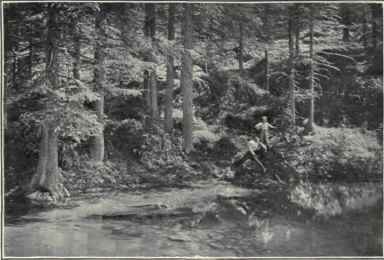
A Forest In Cadore.
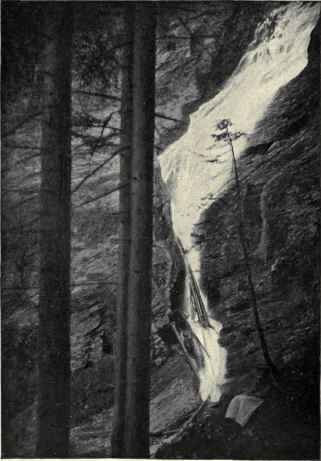
Destined To Serve As Masts.
If, therefore, Venice may be said to have upheld the Republic of Cadore, Cadore may be said with equal truth to have supported Venice. In many ways the two republics helped each other in arms as well as in the arts. For, like the pines that wrestle on the mountains of Cadore with the winter storms, the people of the Dolomites were forced to fight repeatedly for their independence, and many are the national and individual deeds of valor which adorn their annals. One of the victories gained in 1508 by the Venetians and Cadorians over the Germans occurred when Titian was thirty-two years old, and he immortalized it by his famous painting called "The Battle of Cadore," which was un-fortunately burned in the fire that destroyed the Doges' Palace in 1577. The loss was irreparable; for though the palace soon rose from its ashes in fresh glory, the art of Titian was no longer available, since he had died the year before. Accordingly, Francesco da Ponte was selected to replace the work of the master with a painting on the same subject; and this it is which now adorns, with the old title, the Hall of the Greater Council in the Ducal Palace.
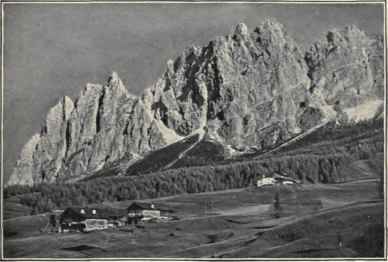
A Mountain Farm, Ampezzo Thal, With Mt. Pomagagnon.
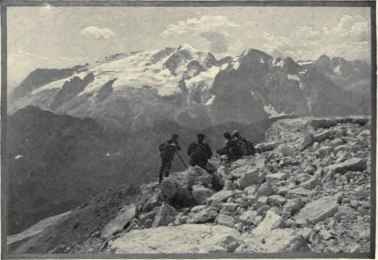
MT. Marmolada, The Highest Of The Dolomites - 11,020 Feet.
With such a past behind them, it is not strange that many of the towns and villages between Cortina and Belluno still have interesting relics of the days of the republic and numerous trophies of the victories of fathers, sons, and brothers in the fierce wars of 1848, 1859, and 1866, when, in successive stages toward their goal, so many brave Cadorians sacrificed their lives for a united Italy. On some of the houses may be seen the family coats of arms carved in the great stone lintels of the doors; and many a substantial mansion has for its inmates the descendants of once famous statesmen, judges, lawyers, priests, or soldiers of the olden time, whose portraits hang upon the walls. These dwellings, too, though unpretentious, are often rich in antique furniture, paintings, books, and manuscripts, a few of which are sold occasionally under stress of poverty, but most of which are treasured by their owners. Some of these old Cadorian families can produce with pride from ancient chests or quaintly sculptured cupboards deeds, wills, and other documents, written on vellum, and bearing not infrequently the signatures of popes and doges - sometimes even that of an emperor.
Continue to:


My Books

