


The Dolomites. Part 8
Description
This section is from the book "The Dolomites - John L. Stoddard's Lectures", by John L. Stoddard. Also available from Amazon: John L. Stoddard's Lectures 13 Volume Set.
The Dolomites. Part 8
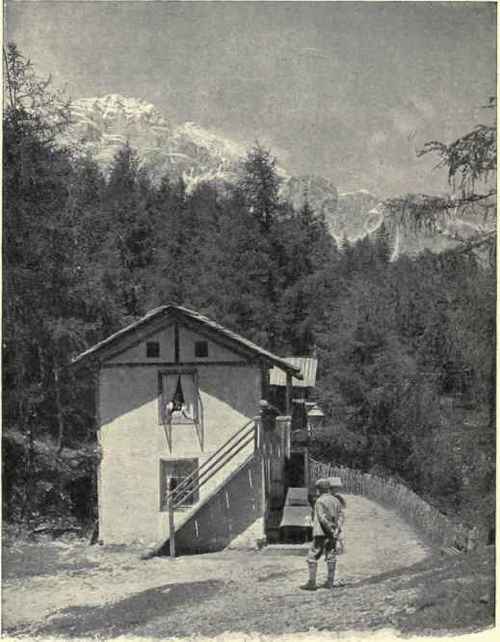
A Wayside Inn Among The Dolomites.
In one of these villages, while we were waiting for our horses to be watered and to be fed, as usual, with black bread, the innkeeper, who was cutting up the loaves, surprised me by-addressing us in English; and when I asked him where he had learned the language, I was still more astonished to have him answer, "In Raritan, New Jersey." Of course I was well aware that thousands of Italians migrated yearly to the United States, but somehow I had naively taken it for granted that they never returned. An interesting conversation, however, revealed to me the fact that many of the emigrants from Cadore - particularly those who are unmarried, or who have not taken their children with them - not only send home money to their mothers, wives, and sisters here, but also come back from America, occasionally on a visit, and finally "for good," to buy a farm or a modest business enterprise, and end their days in their beloved fatherland.
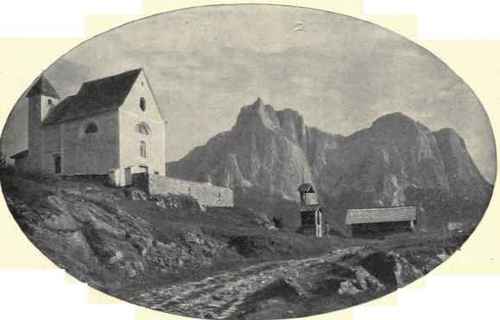
A Study For A Painter.
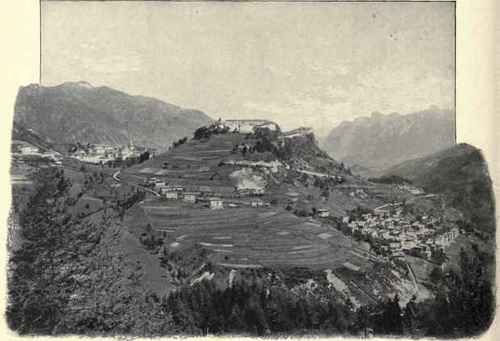
Pieve Dl Cadure.

A Peasant's Balcony, Near The GRÖDner Thal.
For, after all, as my informant told me earnestly, it is not lack of love for kindred and for native land that causes them to seek their fortunes over the ocean, but simply the necessity of earning a living elsewhere than on a soil incapable of supporting the naturally increasing population. Thus, of the seven hundred inhabitants of one village not far from Cortina, about one hundred and fifty are at present in America; and many other towns, I was assured, could show a similar proportion of absentees in the great republic, some of whom are at work in the mines of Pennsylvania and West Virginia, while others are employed in woolen mills and factories. Significant indeed is the fact that all the thrifty ones among them save their money, and either send it here, or bring it back with them. For such is the charm of this beautiful country of the Dolomites that it draws many of its children back to the often perilous work of cultivating farms along the bases of its mountains. Yet the profits from such farming must be small at best; and harvesting and planting here, on dangerous slopes and near the edges of steep precipices, are frequently attended with fatalities. Moreover, the friable nature of the Dolomites makes landslips and rock avalanches always to be dreaded. One sees repeatedly the terrible "stone rivers " which have rolled down from the crumbling cliffs. Some have been swift and thorough in their deluge, burying villages and their inhabitants instantly under a mass of rubble, perhaps a half a mile in breadth and fifty feet in depth; while others creep along at the rate of a foot or two a month, allowing the people plenty of time to escape, but leaving them abundant leisure also to behold the irresistible advance of a whole mountain slope of mud and earth, twenty or thirty feet in thickness, descending as remorselessly and pitilessly as a glacier, to turn a score of fertile farms or lovely meadows to a stony wilderness. The evidences of these terrible catastrophes are all too numerous on the road between Cortina and Pieve di Cadore, and grewsome are the ghastly records of the lives and property they have destroyed. Why is it that, when Nature has produced a landscape of unusual beauty, she seems so frequently to take delight in ruining her masterpiece ?
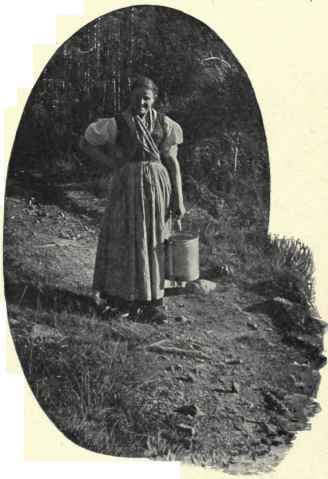
Her Husband Is In America.
Eight of the villages of Cadore have genuine paintings from the brush of Titian; for he was fond of his native land, and came to it nearly every summer for more than fifty years of his eventful life. Can we not, therefore, in a measure understand the marvelous results achieved by him, when we reflect that on a nature, gifted originally with transcendent genius, was built up, year by year, a wonderful experience, gained by dividing thus his life between the exquisitely tinted Dolomites and a city where almost every group of buildings strikes a chord of perfectly harmonious colors ? These were the schools in which he studied and from which he emerged the undisputed master of the art of coloring; and if, as all concede, he is indebted for some of his finest traits to the peculiar splendor of Venetian atmosphere, whose only dust seems golden powder brushed from its mosaics, no less did he gain many useful hints, as well as inspiration, from the unique and startling colors of the Dolomites.
Continue to:


My Books

