


Japan. Part 20
Description
This section is from the book "Japan - John L. Stoddard's Lectures", by John L. Stoddard. Also available from Amazon: John L. Stoddard's Lectures 13 Volume Set.
Japan. Part 20

At Miyanoshita.
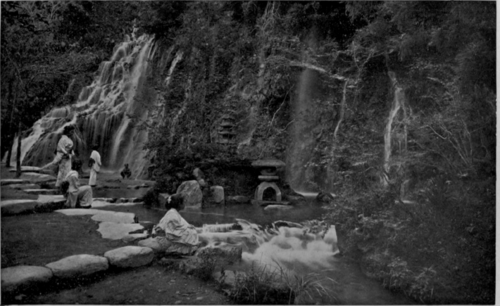
Rural Scenery.
From this point on, the beaten roads are left, and only narrow paths ascend the hills. Hence, on the morning after our arrival, we found ourselves confronted by the most novel style of conveyance we had thus far seen. "What under heaven is this?" I cried, as I caught sight of it. "Must I get into this thing, and haven't you any blankets for these horses?"
My friend sat down upon a rock and vowed he would not go. "Give me a jinrikisha," he moaned; "I'd rather be once more a baby-jumper in my little carriage than a mere stone in a sling, as you will be in that!" He finally compromised on an armchair, hung on bamboo poles and carried by four men; but I resolved to give this vehicle a thorough trial. So crawling in, like a dog into its basket, I crossed my legs after the fashion of a Turk who had fallen over backward, and told my well-groomed steeds to go ahead. The unique and novel instrument of torture to which I thus subjected myself is called a "kago." It is a shallow basket, suspended from a bamboo pole, on which it swings irregularly like an erratic pendulum. Two men take this upon their shoulders, while a third follows as a substitute; for they change places usually every fifteen minutes. Mine changed every five. The man who invented the iron cage, within which the unhappy prisoner could neither stand up nor lie down, must have heard of a Japanese kago. The basket is too near the pole to let the occupant sit erect, and much too short for him to extend his feet without giving the bearer in front a violent prod in the small of the back. After many frantic experiments, I found that the easiest fashion of kago-riding was to lie upon my side, my head lolling about in one direction, and my feet in the other. Even then, the lower half of my body kept falling asleep, and I was frequently obliged to get out and walk, to avoid curvature of the spine. Yet, incredible though it seems, Japanese women often travel by these kagos. They certainly looked a thousand times more comfortable than I felt; but then, the Japanese are short, and, moreover, are used to bending up their limbs like knife-blades when they seat themselves.
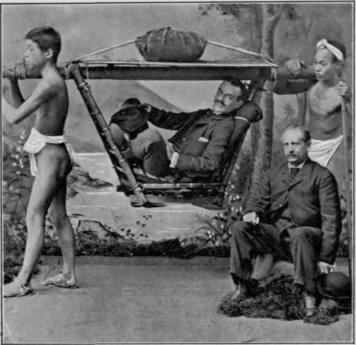
A Kago.

1. A Rain - Coat. 2. Among The Flowers. 3. A Kago.
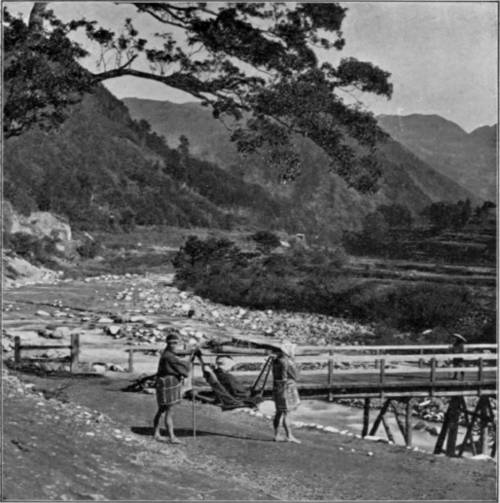
Swinging Like A Pendulum.
On a broad road, one experiences no sense of danger in these swinging cars; but, once in a while, when I was being carried thus along a path two feet in width, - a mountain grazing my right elbow, and a ravine one thousand feet in depth just under my left shoulder-blade, I used to wonder just what would happen if one of these men should stumble; or if, becoming weary of their load, they should suddenly shoot me outward into space like a stone from a catapult. I prudently kept on good terms with my kago-men, and never refused them when they asked the privilege of halting to take a smoke.

Human Ponies.
Almost everything in Japan is small; nor is a Japanese pipe an exception to the rule. It is about as large as a lead- pencil with a child's thimble at the end. Three whiffs are all that any man can take from them, and the wad of tobacco thus consumed is just about the size of a two-grain quinine pill. Hence, the long inhalations of our smokers, the drooping backward of the head, the languid lifting of the eyes to watch the rings of perfumed smoke float lazily away, - all these are unknown to the Japanese. With them, - three little puffs, and all is over. This seems, however, to satisfy them completely, and with the air of one who has dined well, they knock the ashes from the tiny thimbles, and resume their march. After about four hours of this kagoriding we reached the summit of a mountain pass, called Otemetoge. From this point a glorious vista met our gaze.
Behind us, in the distance, lay Miyanoshita and its neighboring villages, resembling a group of islands in an ocean of green foliage. Far off upon the heights a line of sunlit buildings gleamed like whitecaps on a bright-green sea. Nearer, and almost at our feet, some objects glittering in the noonday light attracted our attention; and these, examined through a field- glass, proved to be a foaming mountain stream and silvery cascade. At first we hardly dared to look on the other side of the pass, lest we should experience disappointment. But fortune favored us. The sky was clear; and gazing eagerly toward the west, we saw, directly opposite our point of observation, the grand old sacred mountain of Japan, - the World-renowned Fuji-yama.
Continue to:


My Books

