


Japan. Part 21
Description
This section is from the book "Japan - John L. Stoddard's Lectures", by John L. Stoddard. Also available from Amazon: John L. Stoddard's Lectures 13 Volume Set.
Japan. Part 21
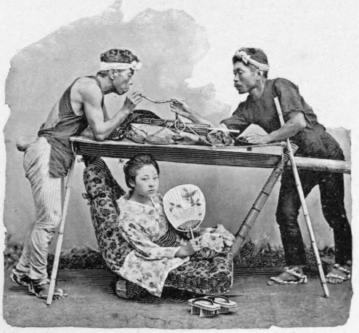
Stopping For A Smoke.
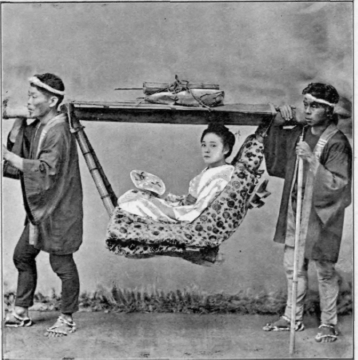
A Japanese Lady En Route.
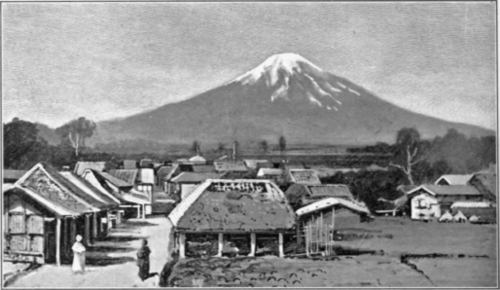
Fuji - Yama.
It made me fairly catch my breath to look for the first time upon this noble peak, whose form had been portrayed on almost every specimen of Japanese art that I had seen from childhood. I felt as if I had been ushered into the presence of some mighty sovereign, whose name and deeds and splendid court had from my earliest years called forth my admiration. A score of interesting traits render a study of this mountain valuable. It is, in the first place, a volcano, - the tallest of those fiery furnaces whose devastations cast a lurid light along the path of Japanese history. Its last eruption was in 1707, when all the plain around its base was buried deep with cinders, and ashes fell fifty miles away. Yet even now, although no wreath of smoke surrounds its brow, it sends forth steam through several apertures, much as a captive serpent hisses though its fangs are drawn. The little spur upon its southern slope is due to the last eruption. Before that, both of its curving sides were perfectly symmetrical.
The ascent of Fuji involves a long, hard climb for weary miles through lava-ashes, sometimes ankle-deep. The violence of the wind on certain portions of the mountain is proverbial, and by some travelers has been described as so appalling that they were fearful lest some furious blast might blow them into space and scatter their remains over a dozen provinces.
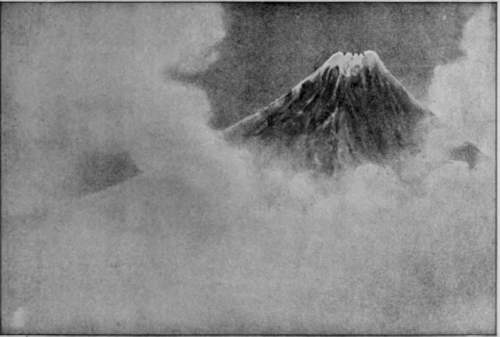
The Sacred Peak.
One cannot wonder that the Japanese have always deemed this mountain sacred. A perfect, silver-crested pyramid, over twelve thousand feet in height, rising in one majestic sweep from sea to sky; changing its color constantly from dawn to dusk, like some officiating priest, a mediator between God and man, assuming consecrated robes of purple, orange, violet, green, and gold, - how could man help regarding it as a glorious shrine inhabited by Deity itself? To its mighty base, as to some incense-burning altar, more than ten thousand reverent pilgrims annually come to make the arduous ascent; and to relieve their hardships, "rest-houses" have been built at intervals along the path, while, even on the summit, the three entrances to the volcano's crater, which is four hundred feet deep, are marked by sacred gateways. Most of these pilgrims wear upon their shoulders the garments almost universally worn in stormy weather by the Japanese peasants, - a kind of waterproof, made of straw or grass, to shed the rain and snow. These vary from a finely- plaited matting to the cheaper, rougher grades, which make the wearer's back look like the roof of a thatched cottage. Upon their heads are hats of split bamboo or straw, that bear a comical resemblance to enormous mushrooms, and serve as sunshades or umbrellas, according to the condition of the weather. We met such pilgrims everywhere throughout Japan. At least a hundred thousand people thus become, in summer-time, religious tramps, and make their way to sacred islands, holy mountain-tops, and shrines whose names would fill a lengthy catalogue.
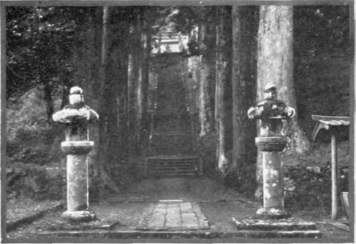
Approach To A Shrike.
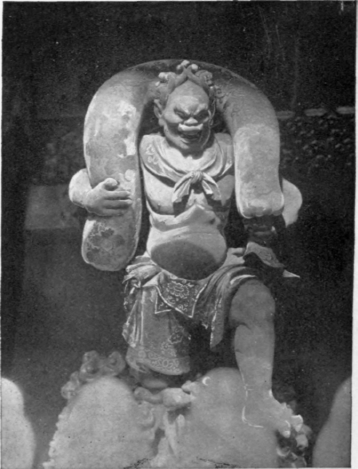
The God Of Wind.

Mendicant Pilgrims.
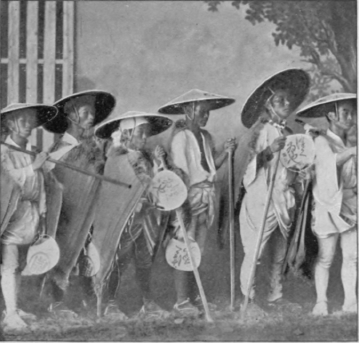
The Pilgrim Garb.
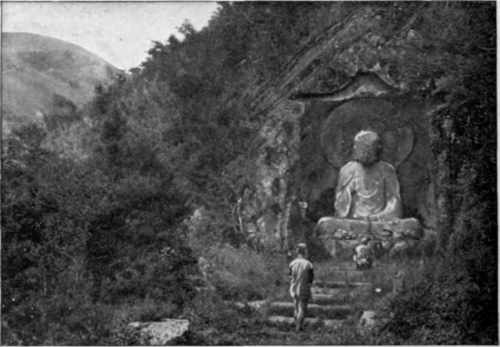
Statue Of Jizo.
Many of these itinerant worshipers solicit alms to help them on their way; but there are also associations of these pilgrims, whose members pay one cent a month into a common treasury. From such a tax as that, however, the treasury never becomes congested, and hence the number of those who travel is necessarily limited. When, therefore, the pilgrim season opens, a certain number of the wanderers, chosen by lot, visit the shrines and represent those whose circumstances compel them to remain at home. These pilgrimages, it is said, are on the wane, but they are still popular. Only five years ago, at the festival of one famous shrine, twenty-one thousand people alighted in two days at a country railway station where the daily average is three hundred and fifty; and to another sacred shrine about two hundred and fifty thousand pilgrims annually come.
Continue to:


My Books

