


Japan. Part 22
Description
This section is from the book "Japan - John L. Stoddard's Lectures", by John L. Stoddard. Also available from Amazon: John L. Stoddard's Lectures 13 Volume Set.
Japan. Part 22
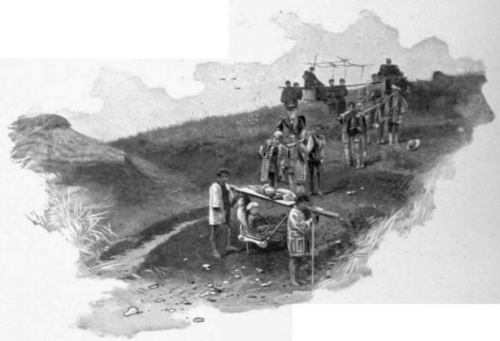
Crossing The Ten - Province Pass.
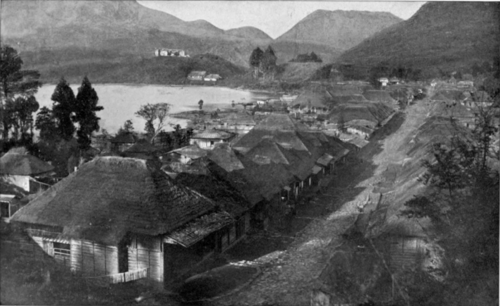
Village Street.
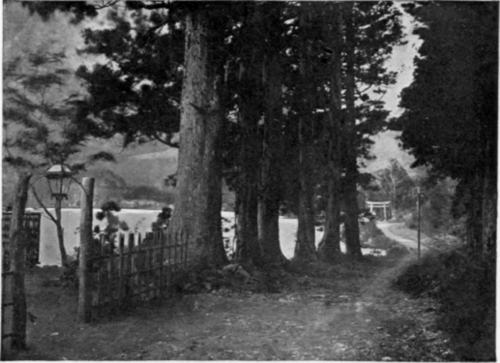
A Lovely Walk Near Hakone.
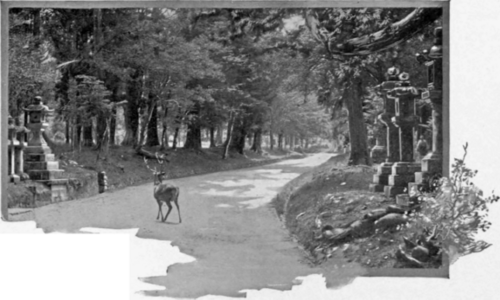
Approach To The Temple At Nara.
Another charming excursion in Japan led us across the "Ten-province pass" to Atami on the southern coast. Of course it had to be made in chairs or kagos; but such slight hardships sink to insignificance when one recalls delightful days spent in enjoying lovely scenery, inhaling pure, invigorating air, and riding over mountain-paths on which the sunlight, filtering through the trees, traced tremulous mosaics of alternate light and shade.
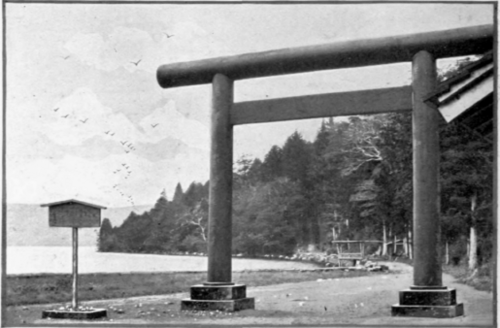
On The Shore Of Hakone Lake.
Occasionally on this journey we came upon the sculptured effigy of some protecting deity. We were especially impressed by one that was colossal in dimensions, and had been carved laboriously from the natural cliff eleven hundred years before. It represents the Buddhist god, Jizo, who is the especial guardian of travelers and little children. Around the base of this extraordinary figure were heaps of pebbles which had been placed there, one by one, by wayfarers for centuries. This custom originated in one of the most singular myths which religion has ever produced, and is a striking proof of the fondness of the Japanese for children. Upon the banks of the river, in the lower world, is said to live a demon who catches little children as they try to cross, and makes them work for him at his eternal task of piling stones upon the shore. Every pebble laid at the statue's feet is thought to lighten the burden of some little one below! Smilingly yielding to the influence of this pathetic superstition, we ourselves left some pebbles, and then moved onward down the mountain side, in the same path pursued by all the thousands who had here preceded us, like little boats upon the stream of Time.

The Mikado's Palace, Hakone.
Presently a sudden turn revealed to us Hakone Lake, - a lovely sheet of water surrounded by densely wooded hills.

Atami.
This is a summer resort that rivals even Mi- yan<5shita in popularity. The air is delightfully invigorating here, twenty-four hundred feet above the sea, and in the hot season, not only are all the Japanese tea - houses filled with guests, but families from Tokio and Yokohama rent all the available cottages around the lake.
To some extent, indeed, this region has imperial patronage, for, on a pretty hill which overlooks the water, is a palace built for the Mikado. It must be said, however, that he has never occupied it, since he rarely leaves his residence in Tokio, but we were told that the Crown Prince, a lad of fourteen, had been here several times. In almost every other country in the world the public is now permitted to enter the abodes of royalty when their distinguished occupants are absent; but not so here. These palace doors are closed inexorably to all travelers. We were not allowed even to step within the grounds.
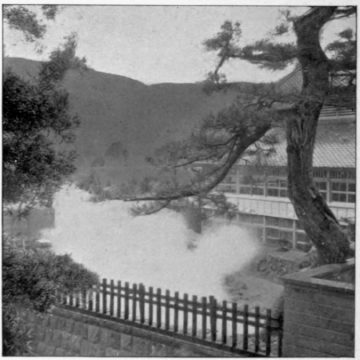
The Geyser At Atami.
At length, descending to the level of the sea, our faithful bearers brought us to Atami - a pretty town, famous for the manufacture of that Japanese paper which seemed to me one of the most astonishing products of the country. It is so fine and soft that it is used for handkerchiefs and napkins, and takes the place of lint in surgery; yet is so firm that it is manufactured into lantern-screens, brooms, air-cushions, and umbrellas. Torn into strips, it also takes the place of string, while all the inner walls of Japanese houses consist of screens of paper, divided into squares, like panes of glass.
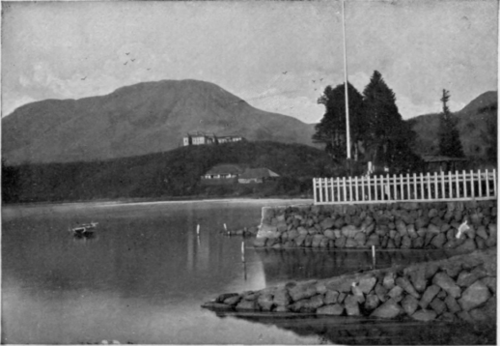
By Lake Hakone.
As we were one day walking through Atami, a sudden outburst of steam, on the other side of a fence, came very near stampeding our entire party. When we recovered sufficient breath to ask the cause of the explosion, we learned that it was occasioned by a small geyser, which has a species of convulsion every four hours, and each time pours out sulphurous vapor for a space of fifteen minutes. It would appear that the people of Atami are living on the lid of a volcanic tea-kettle, but evidently they have no fear. They have enclosed the geyser with a fence like a wild animal in a cage, and close beside it is a sanitarium, where patients with diseases of the throat and lungs inhale the steam. It may be an excellent place for sufferers from pulmonary troubles, but we concluded that nervous occupants of this retreat must feel like the traditional darky on the safety - valve of a Mississippi steamboat. The old - style doctors of Japan are still in vogue in certain rural districts, though they are being rapidly superseded by the young practitioners who have received a medical education in Europe or America. With the old Japanese physicians a favorite mode of cure was sticking a long needle into the part of the body supposed to be diseased. Another universal panacea was branding the body with a burning weed called moxa. This was prescribed for troubles as unlike as rheuma tism and toothache. Women, at certain critical moments in their lives, were thought to be relieved by having the little toe of their right foot burned three times. We often noticed scars upon the naked backs and limbs of our jinrikisha men, and learned that they had been produced by this strange medical treatment.
Continue to:


My Books

