


Malta. Part 2
Description
This section is from the book "Malta - John L. Stoddard's Lectures", by John L. Stoddard. Also available from Amazon: John L. Stoddard's Lectures 13 Volume Set.
Malta. Part 2
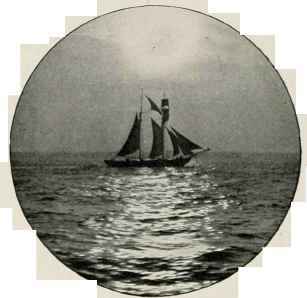
Classic Waters.

Ruins Of Tyre.
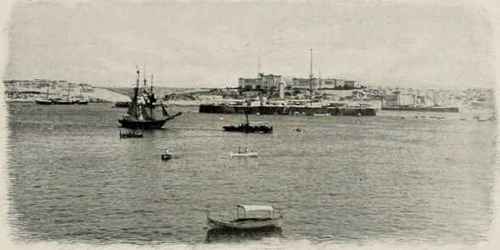
Approaching Malta.
They are the islands Malta, Gozo, and Comino. Not long ago they rose still higher from the waves, and were united. That such was their condition, even since the advent here of civilized man, is evident from the fact that on the opposite coasts of Malta and Gozo traces of cart-wheels in the hard stone are discernible, leading directly to the shore, and continuing toward each other for some distance under the sea. At one time, therefore, vehicles must have passed across the intervening space of four and a half miles, now covered by the waves. Malta itself is seventeen miles in length and nine in breadth; Gozo a little less than half as large. Both, left to nature, would be barren rocks; but both have been transformed by human industry into a tiny portion of our earth, supporting a larger proportion of inhabitants to the cultivated square mile than is maintained by almost any equal area of the globe. Upon its northern side Malta has some of the finest harbors in the Mediterranean; but on its southern shore huge, perpendicular cliffs, at one point seven hundred and fifty feet in height, scowl threateningly toward the coast of Africa.
When I first caught a glimpse of Malta from the steamer, it seemed to me a treeless, arid heap of orange-colored rocks; but subsequent investigation showed me that much of the island's vegetation is concealed behind high walls of yellow stone, built round the gardens to screen them from the winds that sometimes sweep this unprotected region with great violence. Thus sheltered, cotton is raised here in large quantities; all kinds of fruits are also plentiful; and Maltese potatoes are as much desired in Europe as are "Bermudas" in America. Malta has now some seventy thousand acres under cultivation, and through the entire year thousands of orange-trees display their fragrant bloom or fruit of gold, while in the month of March the brilliant red of its famous clover fields, turned by the breeze to shimmering lakes of color, together with its hedges of geraniums, diversified with myriads of scarlet poppies, enabled me to understand why the inhabitants of Malta fondly name their sea-girt home the Malta is militant. The most abiding impression which it left upon my mind is that of a magnificently furnished arsenal, securely locked and guarded in the centre of the inland sea. Its capital, Valetta is apparently impregnable. No city in the world has given me such an idea of defensive strength. Its port may be compared to a dragon's mouth, the jaws of which are granite rocks. From these jaws long, sharp teeth project into the mouth, each crowned with an elaborate fortress; and, as our steamer glided inward from the Mediterranean, these teeth appeared to close behind us like the bars of a portcullis. To carry out the simile, Valetta lies upon the dragon's tongue, the tip of which supports the fort and lighthouse of St. Elmo. On each side of the town - that is, between the "tongue" and "teeth" - extends a long, deep channel; one called the "Grand," the other the "Quarantine," Harbor. These could, together, furnish anchorage to six hundred steamers, and are connected in the rear of Valetta by a deep moat three thousand feet in length and thirty in breadth, which makes the city virtually an island. Valetta, therefore, bears a slight resemblance to New York in form, although on a much smaller scale, being less than two miles long. Nevertheless, for purposes of explanation, its lateral harbors may be said to correspond to the North and East rivers and St. Elmo to the Battery, while its main thoroughfare, the Strada Reale, extending through the centre of the town, is the Maltese Broadway. In other respects, however, Valetta is entirely unlike the American metropolis, since it is situated on a promontory, with sides so steep that one ascends to it from either of the harbors by long flights of steps. Perhaps the best idea of its ground plan may be gained by likening it to the skeleton of a whale, of which the spinal column is represented by the Strada Reale; while the side streets, which curve abruptly to the water on the east and west, may be compared roughly to the monster's ribs. It can be well imagined, therefore, that Valetta, seated on this terraced height, and girdled by the triple belt of animated harbors, massive fortresses, and glittering sea, is wonderfully picturesque.
Continue to:


My Books

