


Malta. Part 3
Description
This section is from the book "Malta - John L. Stoddard's Lectures", by John L. Stoddard. Also available from Amazon: John L. Stoddard's Lectures 13 Volume Set.
Malta. Part 3

A Maltese Garden.
"Fior del Mondo"
- the "Flower of the World".

A Tempting Dish.

Gliding Inward From The Sea.

Entrance To The Grand Harbor.
The impression of its power is also omnipresent. When I had disembarked upon the great stone staircase of the landing pier, and looked above me at the tiers of battlements which flank Valetta like immense retaining walls, and then beheld, across the harbor, the numerous forts, so skillfully constructed and strategically planned, I felt as if I were a fly crawling upon a target, at which so many batteries were aimed that, if by any chance their gunners should "let slip the dogs of war," I should be blown to atoms in an instant. Nor is Valetta defended merely on the water side. When the great drawbridge, spanning the moat in the rear of the city, is raised, the isolation of Valetta is complete; but even beyond this trench, in the adjoining suburb, Floriana, one finds an intricate network of fortified ditches, walls, and parapets, the greater part of which have been hewn out of solid rock; while to prevent a paucity of provisions, in case of siege, immense stone caverns have been excavated to be used as granaries. These subterranean storehouses can be hermetically sealed, and it is claimed that grain can be preserved in them without the slightest injury for years. Even in times of peace a certain quantity of food is always kept in them, for Malta is prepared for all emergencies. It is not strange, however, that these precautions are adopted, and that the island has defenses of prodigious strength. Napoleon, who once possessed it, rightly called it the Key of the Mediterranean; and a remark ascribed to him is often quoted, to the effect that if he conquered England, he would make his residence here, controlling Europe with one hand, and India with the other. Great Britain, which has held it now for more than a century, maintains a garrison here of rarely less than eight thousand men; for this not only forms the principal station of her Mediterranean war fleet, but is a halfway halting-place between Gibraltar and Port Said, an ever watchful guardian of the route to India, and one of the most essential links in England's chain of fortifications round the globe.

The Grand Harbor.

The Landing Stage.

Valetta, From The Grand Harbor.

On One Side Of Valetta.

The Granaries At Floriana.

The Gate To Floriana.
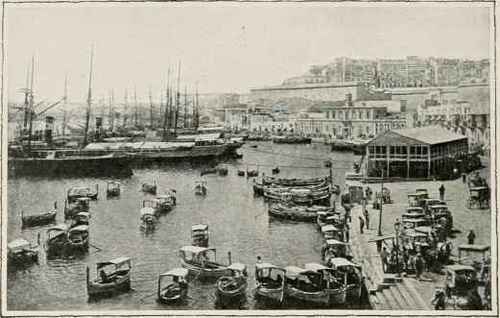
Custom House, Valetta.
Yet Malta has a more than military value. One is too apt to think of it as useful only to the British government and of comparatively little interest to the outside world. It has, however, a commerce not to be ignored. The imports of Valetta average more than one hundred million dollars annually, and even its exports seldom fall below the same amount. To mention but one item, more than half a million tons of coal are yearly brought to this great coaling station; and in addition to occasional war-ships, about a dozen steamers enter or leave the parallel harbors of Valetta daily.
Valetta is not old, as European cities go. In fact, it owes its origin, as well as name, to John de la Valette, the fortieth Grand Master of the Knights of St. John and hero of the siege of Malta in 1565. Accordingly it is, par excellence, the capital of the Knights of Malta, built o'er their bones and consecrated by their blood. As such, it would be quite incomprehensible without some previous knowledge of those famous Chevaliers of the Cross; and, if the tourist be wise, he will refresh his memory on the subject ere he disembarks, as one would read the argument of a libretto before the curtain rises on the opera. The Maltese Islands have had many masters. The waves of conquest, which have often swept between the shores of Syria and Spain, have never failed to break against these isolated rocks, and hold them temporarily as their own. Their earliest colonists were Phenicians (where, indeed, do we not find traces of navigators?) and it is thought that fifteen centuries before the Christian era they had established here a government which lasted seven hundred years. Then came the Greeks, who called the largest of the islands, Melita; and after them a long array of Carthaginians, Romans, Vandals, Arabs, Normans, Germans, Spaniards, French, and English, the records of whose sovereignties follow one another on these headlands like the writings of a palimpsest. But in the whole long list of Malta's monarchies, none ever raised it to so great a height of splendor and renown, or left such grand memorials of its magnificence, as the illustrious Order of mediaeval chivalry which for a little more than two and a half centuries ruled these islands under the title of the Knights of Malta, or the Knights of St. John.
Continue to:


My Books

