


Malta. Part 4
Description
This section is from the book "Malta - John L. Stoddard's Lectures", by John L. Stoddard. Also available from Amazon: John L. Stoddard's Lectures 13 Volume Set.
Malta. Part 4
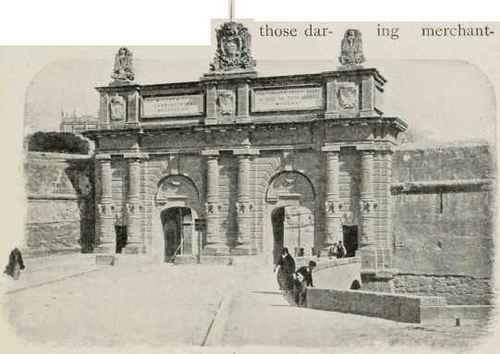
Gate Of The Bombs.
The origin of this brotherhood was humble, peaceful, and self-sacrificing ; for, early in the eleventh century, it started in Jerusalem as a society of guardians and nurses for sick and needy pilgrims to the Tomb of Christ, its members taking the most solemn vows of poverty, fraternity, and chastity. It was established as an Order in 1048, and after the conquest of the holy city by Godfrey de Bouillon in 1099, it was remodeled on a military basis, and soon developed into a brotherhood of warrior-monks, who, while still pledged to be "hospitalers" in the strict sense of the term, formed such a branch of the church militant as the world had never seen. There was good reason at the outset for this transformation. The brothers found it necessary to defend their hospital and chapel from their Moslem foes, and to protect the pilgrims who now came to Palestine in constantly increasing numbers, and needed an armed escort to such holy places as the Jordan, Bethlehem, and Hebron. Hence, in that age of chivalry and the crusades, a combination of the saint and soldier was soon made, the meekness of the one being quickly superseded by the militancy of the other.

Sword And Spurs Of Godfrey De Bouillon. In Church Of The Holy Sepulchre, Jerusalem.
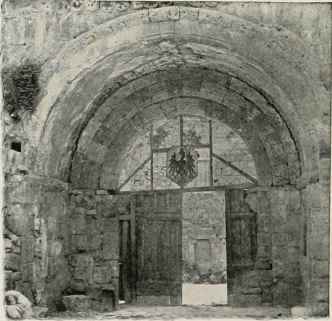
Ruins Of The Hospital Of St. John.
The subsequent history of these Knights forms one of the most romantic pages in the annals of the last millennium. Driven, in the twelfth century, from their original quarters in Jerusalem, the interesting ruins of which may still be seen, they were, in 1191, established by Richard the Lion-hearted in the redoubtable Syrian stronghold, St. Jean d'Acre, which, six hundred years later, was to prove an insurmountable barrier to the progress of Napoleon. Here they remained for nearly a century. Expelled at length entirely from Syria by the Mohammedans, they sailed to the neighboring island of Cyprus, which Richard Coeur de Lion had taken from the Saracens, and which they made their home for twenty years. In 1310, however, after a long and memorable struggle, they gained possession of the beautiful and fertile island of Rhodes, just off the coast of Asia Minor, and there intrenched themselves so strongly that they retained it for two centuries despite the repeated efforts of Sultans to dislodge them. At last, however, in 1522, Solyman the Magnificent, eager to do what even the famous conqueror of Constantinople, Mohammed II., had failed to accomplish, besieged this sea-girt fortress with such an overwhelming force of Turks, that after an heroic resistance of six months, the leader of the brotherhood, L'Isle d'Adam, and his garrison of seven hundred Knights and six thousand men-at-arms, were compelled to capitulate, and, two weeks later, to depart forever from the " Island of Roses," which for so long a time had been their home.
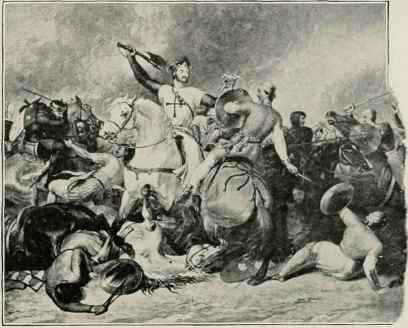
Richard The Lion-Hearted In Combat With Saladin.

The Island Of Rhodes.
Nevertheless, in spite of this misfortune, the prestige of the soldier-monks was scarcely dimmed, so nobly had their valor been displayed in fighting to the last against such overpowering odds. The emperor, Charles V., was especially impressed by their superb defense. "There has been nothing in the world so well lost as Rhodes," he exclaimed enthusiastically. Nor did his admiration limit itself to words; for, not long after, in a royal grant that any one may see to-day in the old armory at Malta, he gave to the Fraternity for its perpetual use and sovereignty the Maltese Islands, which formed part of his possessions. The phrase "perpetual use and sovereignty" means sometimes very little, as the world's records plainly show; but the Knights' ownership of Malta lasted from 1530 till the arrival of Bonaparte in 1798, a period of two hundred and sixty-eight years. This is considered the Golden Age of Maltese history. It was, however, largely one of warfare. The Knights had now become the most aggressive warriors in the Levant, their charitable and religious characteristics being much less prominent than their military prowess. The Turks were naturally the especial objects of their onslaughts; but they waged war, too, more or less openly, against the Greeks, who had incurred their wrath by secretly opposing the crusaders, and who, moreover, were themselves a race of pirates, plundering every vessel they encountered as legitimate prey. In fact, the Mediterranean and AEgean in those days fairly swarmed with corsairs of all creeds and privateers of all complexions. Of these sea robbers, two, the Turks and Al-gerines, were to a certain extent united by the same religious faith, and usually helped each other in harassing their common enemy, the Knights. The latter strove, on their side, to surpass them in every bold and desperate deed that pirates can perform; and thus, year after year, and generation after generation, these sanguinary champions of the Cross and Crescent contended for supremacy and spoils, claiming religious zeal as their chief motive, but actuated largely by a lust for booty and revenge. For such a life the situation of their new home gave the Knights a great advantage Malta is almost an ideal rendezvous for corsairs. Lying not only in the centre of the inland sea, but also in the narrow roadstead between Italy and Africa, its owners have an opportunity to intercept all ships that pass between the East and West. Its coast is also well adapted for such enterprises. Numerous inlets run like slender fingers into the interior, as if to hide away the articles secured upon the main. Many small coves lie open to the sea, like empty purses waiting to be filled with gold. Scores of deep caverns also, fashioned by the waves, seem specially designed to serve as hiding-places for belligerent galleys, or secret storehouses for plunder.
Continue to:


My Books

