


St. Petersburg. Part 10
Description
This section is from the book "St. Petersburg and Moscow - John L. Stoddard's Lectures", by John L. Stoddard. Also available from Amazon: John L. Stoddard's Lectures 13 Volume Set.
St. Petersburg. Part 10

A Russian Cab.
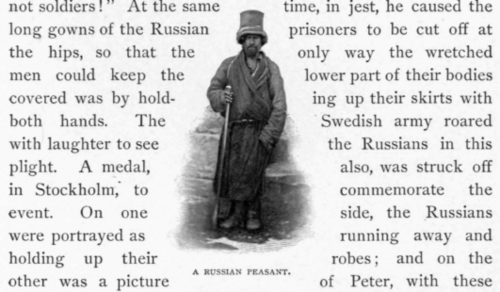
This experience prompted the Tsar to institute a practical reform. In those days the Russian peasants wore much longer gowns than they do now. On his return from western Europe, therefore, these trailing garments struck Peter as absurd; for, though they served as a protection against cold, they were extremely inconvenient for laborers and soldiers. Accordingly, he ordered them to be shortened. Still worse, however, in Peter's eyes were the long, unkempt Russian beards. These he resolved should disappear entirely. He would not have a person near him who did not shave, and levied on every beard worn by the upper classes an annual tax of from sixty to two hundred dollars. To him of petticoat and beard at one fell swoop.

A Street Shrine.
A still more radical and important change effected by Peter had reference to the female sex. Up to his time Russian women had been secluded in a kind of harem; or if they ventured into the streets, they were forced to put on veils, or ride in carriages with curtains drawn. Wife-beating was a universal custom. The priests merely advised men not to use too thick a club. A Russian proverb makes a husband say to his wife, " I love thee like my soul, but I dust thee like my jacket." A historian mentions a Muscovite woman who, having married a foreigner, did not believe herself loved because he did not beat her. What a picture the Russia of one hundred years ago presents, compared to the witty, social intercourse of France or of England! In those times, also, a Russian husband saw his bride unveiled for the first time at the wedding banquet. But Peter roughly changed all this, and decreed that six weeks before every marriage a betrothal should take place, and that thenceforth the bridal pair might see each other freely; and, if they were not satisfied, might break the engagement.

A Palace Guard In St. Petersburg.
Shocking as this appeared to his people, worse still was to come ; for Peter further horrified his nobles by ordering them to bring their wives and daughters into society. He made a law that social gatherings should be held three times a week, in the houses of the nobility in turn, besides an occasional ball in his own palace. At these assemblies men and women were ordered to appear dressed in the European style, and even to dance together; while, most curious of all, French and Swedish prisoners of war were admitted to these gatherings, to serve as models in society manners. One marvels that his subjects did not rise a hundred times to depose or murder Peter; but he maintained his absolute authority, and even in his rules of social etiquette, governed his subjects with a rod of iron. Once, when his Prime Minister, Prince Menchikoff, forgot himself, and danced with his sword on, Peter gave him a blow that made the blood flow freely. At another time, when an unlucky officer forgot to salute his partner after dancing, he knocked him down.

An Imperial Boudoir.

Peter The Great.
Yet, after all, it is sad to realize that this great toiler for his country's civilization never really understood what civilization meant. He left no code of laws founded on noble principles of justice. Material progress alone kindled his enthusiasm. He did not try to elevate the morals of his people, and the result was well expressed in the rough words of Diderot, who said, " The Russians, as fashioned by Peter, were rotten before they were ripe! "
It is an illustration of Peter's peculiar character, that his life alternated between great physical exertion and wild dissipation. Shortly before his death, he gave a banquet at which three thousand bottles of wine were emptied, and Peter took so prominent a part in their depletion, that he kept to his bed for a week. Nevertheless, as soon as he was able to go out, he went to his new foundry, and, with his own hands, hammered out a sheet of iron weighing a hundred pounds. In the ballroom of the palace, which he built at Peterhof, hangs a painting that represents an actual event in Peter's life : when, in a fearful storm on Lake Ladoga, he pushed aside the trembling sailors and brought the boat in safety to the shore. Physically, Peter was a giant; so tall, that we stand like pygmies by the rod which indicates his height; so strong, that his walking-stick, still kept in the museum, was a bar of iron; so skillful, that he made with his own hands his house, his furniture, and boats. The character of the man was, in some ways, wonderfully great; in others, pitifully small. He was a strange creation, half colossus and half dwarf. Of this he was himself aware. " I wish to reform my empire," he once said, sadly, "but I cannot reform myself."
Continue to:


My Books

