


St. Petersburg. Part 9
Description
This section is from the book "St. Petersburg and Moscow - John L. Stoddard's Lectures", by John L. Stoddard. Also available from Amazon: John L. Stoddard's Lectures 13 Volume Set.
St. Petersburg. Part 9

Peter Saved By His Mother.

Native Washerwomen.

The Volga.
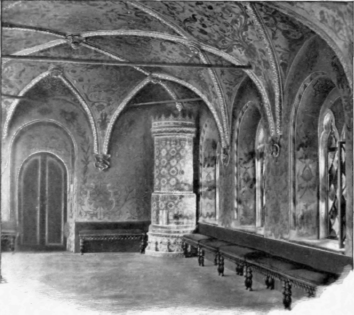
The Guard-Room.
Peter naturally chose Holland as the school which he would attend; for that country was then the centre of the maritime world. During his stay there, while making his investigations, he fairly exhausted all his guides by his insatiable curiosity. Of course, his first attention was given to the art of shipbuilding ; but he also visited manufactories and rope-walks; watched surgical operations in the hospitals, and acquired the art of blood-letting and tapping for the dropsy. Moreover, the young Tsar was so charmed by the manipulations of a dentist that he called him to his lodgings, learned how to use his implements of torture, and thenceforth amused himself, in his leisure moments, by practicing on his wretched followers.

Where Peter Went To School.
Although Peter worked so indefatigably, he showed himself at times to be little more than an uncouth savage, to whom the laws and customs of society were unbearable. Artificial articles of toilet, for example, were quite new to him. On one occasion, he snatched a new and stylish wig from the head of the master of ceremonies at the Dutch Court, and, after looking at it for a moment with supreme disgust, threw it upon the floor. When he danced with the Holland ladies, he could not understand the stiffness of their corsets, and exclaimed, "The bones of these Dutch women seem to me devilish hard." "Who are those men?" he asked, when in London, pointing to some English barristers wearing their wigs and gowns. " Lawyers," was the reply " Lawyers!" repeated Peter, " what is the use of so many ? I have only two in my whole empire, and I mean to hang one of them as soon as I return." Yet, notwithstanding his ferocity and coarseness, Peter must be regarded as one of the world's great men. The difficulties which he met were almost insurmountable; for the entire nation was against him, - still he executed his reforms with a tenacity of will almost sublime.
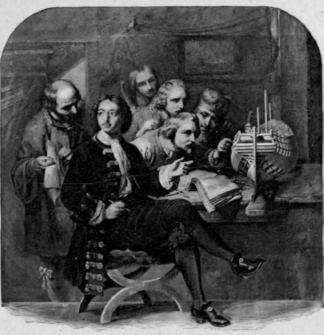
Peter In Holland.
A Russian writer represents him standing alone and pulling upward, while millions of opponents pulled the other way. The Russians, more than any other people in Europe, have been opposed to change. For generations they had looked upon foreigners with contempt. " Novelty brings calamity," is one of their proverbs. Whenever I think of Peter I am reminded of the painting that represents a Russian driver struggling heroically in a storm that threatens to destroy him. It was just such a spirit which animated Peter. Nothing discouraged him. Thus, in his early conflicts with the Swedes for the possession of the Baltic, he was repeatedly defeated; but he was not disheartened. After several years of such misfortunes he wrote to his wife: " I expected to be defeated at the start; but finally the Swedes will teach me how to beat them." That sentence indicates his character. What can eventually overcome a man who never knows when he is beaten, and after every fall rises, Antaeus-like, to grimly try again, at any sacrifice of men and money ? " Glory to God!" he wrote, some twelve months later, " I have gotten my Russian soldiers now so that they will beat the Swedes when we are four to their one; by and by they will do it on equal terms." In truth they did so, enabling Peter to secure the coveted situation by the ocean, where he located and built St. Petersburg.
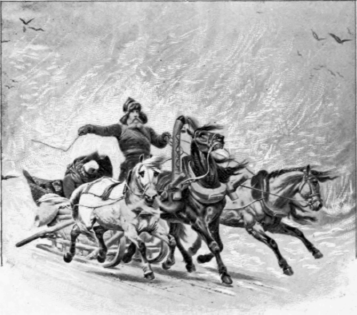
Overcoming Obstacles.
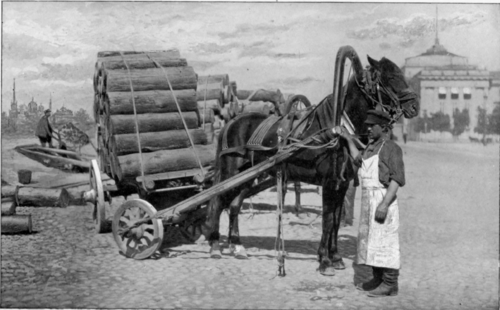
A Heavy Load.
We may, however, be very sure that, when shut out from the observation of the world, Peter often suffered bitterly from rage and shame. Once, for example, the Swedes defeated him and took so many Russians prisoners, that Charles XII. could not keep them. Charles, therefore, took away their weapons and set them free, saying: " Go home and raise cabbages; that is all you are good for. You are words, " And Peter went out and wept bitterly."
Continue to:


My Books

