


St. Petersburg. Part 8
Description
This section is from the book "St. Petersburg and Moscow - John L. Stoddard's Lectures", by John L. Stoddard. Also available from Amazon: John L. Stoddard's Lectures 13 Volume Set.
St. Petersburg. Part 8
Filled with such thoughts, I stood with admiration and respect before the statue of the man who could conceive and execute such stupendous plans. He is portrayed reining in his steed at full gallop, on the very verge of a precipice. His face looks toward the Neva, and his outstretched hand seems beckoning to the world to gaze upon the vast metropolis which, compelled by a will that knew no obstacle, appears to have risen to, and to be resting upon, the surface of the river, like a fair lily with resplendent colors. Even the pedestal of this monument is remarkable. It is a mighty mass of granite, weighing fifteen hundred tons, and was brought hither with immense labor from Finland. No other stone, however, would the Russians have; for it was on this rock that Peter stood and watched the victory of his infant navy over his enemies, the Swedes.
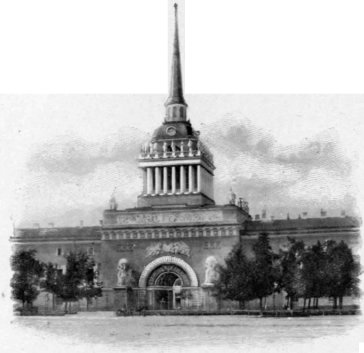
The Tower Of The Admiralty.
It is only right and just that St. Petersburg should bear the name of its founder, since it is impossible to take a step here without being reminded of him. Do we walk on pavements ? It is due to his engineering that we are not sinking in a swamp. Do we observe the city's animated life ? It is the life breathed into it by its creator. Do we admire its imposing palaces, granite monoliths, its churches built of marble, bronze, and gold, its endless avenues where hundreds can march abreast ? It was at his command that they were reared, and on a soil, too, into which whole forests had at first to disappear; so that the .foundations of this city sink almost as far below the surface of the ground as its resplendent spires rise toward Heaven. Truly, in view of the stupendous difficulties of creating this great city of the North, its faults (due largely to its youth and rapid growth) disappear beside the marvelous fact that it exists at all.
Nothing was to me more interesting, in the Russian capital, than the little house which Peter was content to occupy, while urging on in person the mighty work of building. This home of Peter, erected largely by his own hands, is kept within an outer structure, like a jewel in a box. It is composed of logs and consists of only three apartments, - a bedroom, dining-room, and kitchen. But what a contrast between the rooms of Peter then and now! His bedroom, for example, has been changed into a gorgeous chapel, with marble floor and alabaster ceiling, and walls gleaming with paintings and magnificent gems; for Peter (much to his astonishment, no doubt, if he is aware of it) has become a saint, and the vast empire, which he so greatly influenced and modernized, now glorifies him in forty different languages ; since from the Polar Sea to the Caspian, and from the Gulf of Finland to the Chinese Wall, the name of Peter is spoken almost as of some deity.

Peter The Great.

Kazan Cathedral.

The House And Church Of Peter The Great.
From the day when his political enemies tried to murder Peter in childhood, and he was rescued by his mother, who fled with him to a sacred shrine, and, pointing to the picture of the Virgin and her Child, forbade the assassins to advance, his whole life reads like a romance. To realize fully what he accomplished when he came to manhood, we must remember that his entire empire was then inland. It is true the billows of the Polar Sea broke on the icebergs of his northern coast, but that shore was practically worthless. Of other oceans he had none. Between his western boundary and the Baltic stood the Swedes; between his southern limit and the Black Sea were the Turks; and even the sunny lands, bordering on the Caspian, were held by the effeminate Persians. All the great natural gateways of his realm, therefore, were not only locked, but the keys were in the possession of his enemies.
Yet, when one looks on some of the mighty rivers in the Russian Empire, such as the Volga, the Neva, and the Dnieper, he realizes how those noble streams, sweeping to their different oceans, must have lured the young Tsar's fancy down their channels, and kindled in his breast the great ambition of his life, -to open Russia to the sea. " It is not land that I need," he cried repeatedly, "but water." To burst the barriers that encompassed him, and secure an exit to the outer world, he perceived was the sole means of lifting his empire from the slough of barbarism, and changing it from a dull, Asiatic monarchy into an active European state. Now, to detect this at the start, and then to form a plan to which he adhered all his life, in spite of unexampled obstacles, proves Peter to have been a man of genius. The world has seldom seen such a display of courage and determination as that which Peter gave when, setting at defiance the opposition of his nobles and the prejudices of his people, he deliberately left his throne for a time and went to Europe; not to enjoy a royal holiday, but rather to exchange his sceptre for an ax, and to acquire a thorough knowledge of those maritime affairs on which his heart was set. Since he had resolved to have a fleet, he must learn how to build it, and then must secure a sea on which his ships could sail. He had already sent fifty Russian nobles to study civilized life in Italy and Germany. But this was not enough. To set them an example, he must himself do what he had ordered them to accomplish.
Continue to:


My Books

