


St. Petersburg. Part 3
Description
This section is from the book "St. Petersburg and Moscow - John L. Stoddard's Lectures", by John L. Stoddard. Also available from Amazon: John L. Stoddard's Lectures 13 Volume Set.
St. Petersburg. Part 3
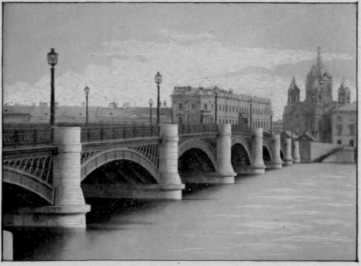
The St. Nicholas Bridge.
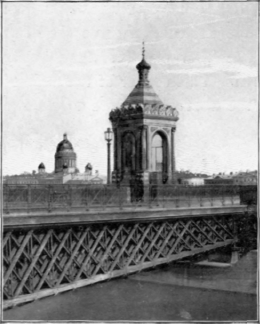
A Shrine For Prayer.
Of course, with such a foundation as St. Petersburg possesses, it is emphatically a city of bridges, of which the finest bears the name of St. Nicholas. Beneath its iron arches and between its granite piers the river rushes on with rapid current, as if rejoicing to be free from icy fetters; for, during the greater part of the year, its waters are bridged by a crystal pavement - on which the heaviest burdens pass in safety - where large ships floated and blue waves tossed, perhaps, a fortnight before. The numerous branches of the Neva form, then, a series of glittering boulevards, into whose shining pavements lamp-posts are inserted, and which, for months, assume the characteristics of spacious, crowded thoroughfares, like white arms tightly locked about the city of the Tsar.
Near the extremity of this bridge stands a little structure which I at first supposed to be a toll-house. It is a shrine for prayer, containing a picture of St. Nicholas. I should be afraid to hazard a statement as to the number of such shrines in St. Petersburg. Their name is "legion." Before them, morning, noon, and night, there is the same show of devotion. No Russian, however busy he may be, will pass a church or the picture of a saint, without pausing long enough to cross himself. This is, indeed, a very common gesture in Russia; for every peasant, when he yawns, makes the sign of the cross before his mouth to prevent the devil from entering. Some even prostrate themselves before this painting of St. Nicholas, and kiss the pavement. Be on your guard, however, in such places; for pick-pockets combine both business and religion here, and while they cross themselves with one hand, they rob you with the other.
St. Isaac's Cathedral is an illustration of the fact that, when she makes the effort, Russia can surpass the world in the magnificence of her architecture; for the treasures of her quarries are exhaustless, and the skill of her lapidaries is unexcelled. It is, however, unfortunate that there is no eminence in St. Petersburg on which St. Isaac's could have been placed; since, at even a little distance, it is impossible to see to advantage the stairways leading to its various portals. Yet each of these steps is one gigantic block of rose granite, worthy of the Egyptian temple of Karnak; and every portico is supported by stupendous shafts of the same material, sixty feet in height and seven feet in diameter, and polished like the surface of a mirror.
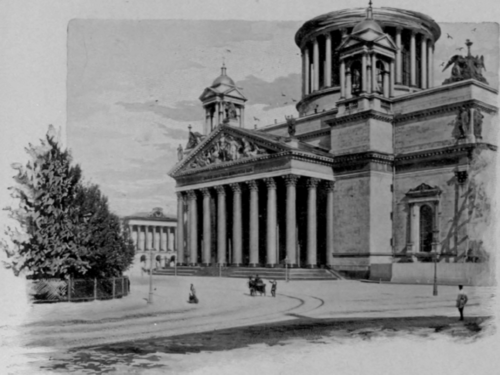
Entrance To St. Isaac's Cathedral.
At first, however, the tourist may inquire: " What is there so remarkable in these porticos to distinguish them from others ?" But, let him look along the columns for their lines of jointure. He will discover none, for each is a solid mass of beautifully polished stone. In fact, with the exception of Pompey's Pillar in Egypt, and the Alexander Column in St. Petersburg, they are the largest monoliths which the hand of man has ever quarried, turned, and polished. Ordinarily, one such entrance would suffice for any temple, but this magnificence is repeated on each of the four sides of St. Isaac's. We can, then, readily believe the statement that the whole cost of this cathedral exceeded fourteen million dollars, - one million having been expended in merely making a sufficiently strong foundation for the enormous mass. Moreover, like everything else in St. Petersburg, this is a proof of autocratic will, expressed in speed. Other cathedrals have been matured through centuries, but St. Isaac's was completed within forty years.
But if this be the exterior, how shall I describe the interior of this temple of the North ? Before its gilded altar-screen are ten columns of malachite, thirty feet high, and pillars of lapis-lazuli, each of which cost thirty thousand dollars. This exceeds every other display of these marvelous stones that the world knows. We are accustomed to regard a small fragment of either as a valuable ornament. Imagine, then, whole columns of them five times as high as ourselves!
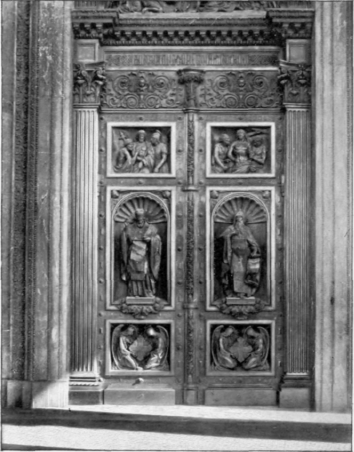
Bronze Doors Of St. Isaac S.
Continue to:


My Books

