


St. Petersburg. Part 4
Description
This section is from the book "St. Petersburg and Moscow - John L. Stoddard's Lectures", by John L. Stoddard. Also available from Amazon: John L. Stoddard's Lectures 13 Volume Set.
St. Petersburg. Part 4

St. Isaac's Cathedral.
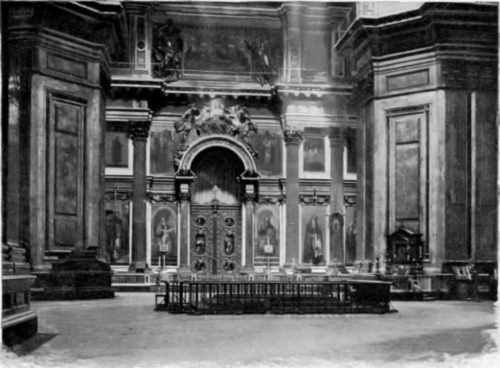
Interior Of st. Isaac's cathedral.
Yet this is only in keeping with the entire building; for in St. Isaac's we tread a pavement of variegated marble; we ascend steps of polished jasper; we clasp railings of pure alabaster; and are surrounded by walls inlaid with verd-antique and porphyry, interspersed with vast mosaic portraits of the saints, and shrines of gold incrusted with jewels. One portrait of Christ is studded with diamonds, the largest of which is valued at thirty-five thousand dollars. The whole, in fact, is so magnificent as to appear incredible till actually seen.
One of the first things to impress me in St. Petersburg was the comparative lack of people in the streets. Compared with London, Paris, and New York, it seems deserted. The truth is, St. Petersburg is still too large for its population. Its buildings are too vast for the inhabitants.

The Nevski Prospekt And The Admiralty.
Its mammoth streets and squares seem to have been designed for the evolutions of large bodies of troops. On such a colossal scale is the city built, that possibly the frame allotted to it by its founder will never be adequately filled. Moreover, people die off rapidly in St. Petersburg. Its death-rate always exceeds its birth-rate. The increase of its population is largely dependent on arrivals from the country. In Peter's time there was danger from wild animals; and as late as 1714, two soldiers were devoured by them, while, in the same year a woman was torn to pieces by wolves in front of Prince Menchikof f's house.
The characteristic Russian cab is unique. It has four wheels, each about as large as that of a wheelbarrow. Above them is raised a slender framework, usually containing two seats: one for the driver, the other for the passenger. Under the circumstances, these seats are too near each other, since the proximity of the driver's coat causes at times unpleasant zoological experiences. Of course there are some very elegant private droshkies, but I am sure that the Deacon's "one-horse shay," in its last moments, never had such a desperately seedy air as an ordinary Russian cab. An English nobleman once offered, it is said, a thousand pounds to any one who would find, in a civilized country, a more uncomfortable vehicle; but he has his money still. By way of recompense, however, the horses that draw even the poorest of these vehicles, are not such skinny beasts as those which we commiserate in Paris and Naples. Almost without exception, Russian horses, although small, are swift, elegantly formed, and sleek. Their harnesses are so light that they seem to be mere ribbons of leather ; while a curious arch extends from one shaft to the other, making the head of the pretty animal appear as if set in a picture-frame. These horses usually go like the wind. No matter whether you are riding " by the course" or "by the hour," you will be whirled over Peter's paving-stones with a rapidity that startles you. Perhaps this is owing to the fact that during the greater part of the year these ponies draw light sleighs and sledges over an icy crust, and thus become accustomed to a rapid gait.

Mammoth Streets And Squares.

A Russian Droshky.
The famous Alexander Column, in St. Petersburg, is a monument of which all Russia may be justly proud. Even Egypt would have been satisfied with it. It is the greatest monolith of modern times, being a single column of red granite, eighty-four feet in height and fourteen in diameter, exclusive of pedestal and capital. When one beholds it standing so securely, it is hard to realize the immense amount of labor necessary to bring it from the mountain quarry and erect it here. But since the whole of St. Petersburg is built the capital, is of bronze, is the brief inscription, " Grateful Russia to Alexander I." It is said that the French King, Louis Philippe, once asked the Emperor Nicholas for a similar column from his Finland quarries. The Tsar, however, begged to be excused. " I do not wish," he said, "to send you a smaller one, a similar one I cannot afford, and a larger one it is impossible to obtain." As we turned away from this noble monolith, on the night of our arrival in St. Petersburg, the slowly descending globe of the northern sun was flooding the city with a marvelous radiance, and gilding brightly the summit of the column. In fact, so far into the night did this illumination linger, clothing the angel and his cross with glory, that we could almost fancy it unwilling to leave them, until they should again be greeted by the kiss of dawn.
Continue to:


My Books

